
ONEOK’s Fee-Based Model Surpasses Expectations, But Liquidity and Market Dynamics Shape the Next Act
ONEOK delivered stronger-than-expected Q3 2026 earnings and raised its full-year outlook, demonstrating the strength of its fee-based midstream platform. However, sub-1.0 liquidity ratios, ongoing commodity exposure, and intensifying competition mean that execution and capital discipline will be tested as the company pursues growth amid evolving energy markets.
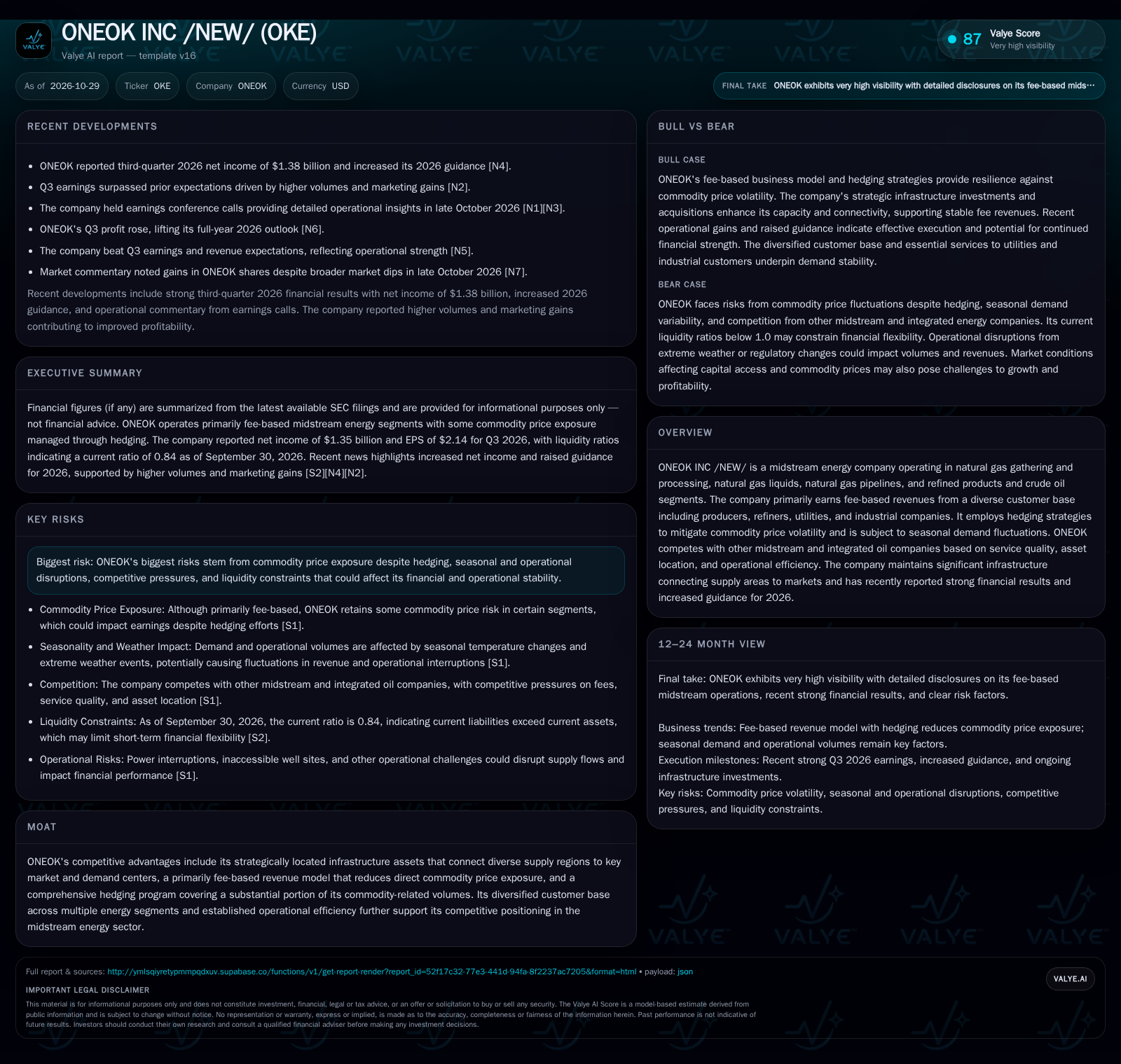
ONEOK’s Q3 2026 results highlight the earnings power of its fee-based midstream strategy, with net income beating expectations and guidance raised. The company’s hedging reduces—but does not eliminate—commodity risk, and seasonality remains a material driver. [S2] [N2] [N4]
ONEOK’s latest quarter delivered a clear signal: its fee-based midstream model remains robust, with Q3 2026 net income and updated guidance exceeding market expectations. As energy markets shift and capital discipline becomes paramount, ONEOK’s ability to defend margins, manage liquidity, and execute on its growth strategy will determine whether recent momentum translates into durable outperformance.
ONEOK’s Q3 Beat and Liquidity Constraints Set the Stage
ONEOK reported Q3 2026 net income of $1.38 billion, outpacing previous expectations and prompting a raised full-year outlook on higher operational volumes and marketing gains [N4] [N2]. This performance underscores the strength of its fee-based business model, which provides a buffer against commodity price swings. However, as of September 30, 2026, ONEOK’s current assets of $6.25 billion are outweighed by current liabilities of $7.42 billion, resulting in a current ratio of 0.84 and a cash ratio of 0.03, indicating constrained short-term liquidity [S2].
How ONEOK’s Fee-Based Revenues and Hedging Shape Its Earnings Engine
ONEOK’s revenues are primarily generated through fee-based contracts across its natural gas gathering, processing, natural gas liquids, pipelines, and refined products segments [S1]. This structure reduces direct exposure to commodity price volatility, making cash flows more predictable than those of pure-play E&Ps. However, the company is not immune to commodity cycles: its Natural Gas Gathering and Processing and Natural Gas Liquids segments retain some commodity-linked exposure, with hedging strategies covering about 75% of monthly equity volumes [S1]. This leaves a residual earnings volatility tied to unhedged volumes and basis differentials.
Seasonality is another core economic driver: cold winters boost heating demand, while hot summers spur gas-fired electricity generation [S1]. This cyclical demand profile can amplify both upside and downside swings. Fixed costs are significant due to the capital-intensive nature of midstream infrastructure, so operating leverage is high—rising volumes can quickly expand margins, but volume declines or operational disruptions can pressure earnings. Capital needs remain material, especially for maintenance and expansion projects, and are set against the backdrop of current liabilities exceeding current assets, heightening the need for disciplined investment and cash flow management [S2].
The partial commodity exposure retained in certain segments introduces a layered complexity to risk management and earnings stability. While hedging covers a substantial portion of volumes, residual exposure to basis risk and unhedged volumes means that earnings can still fluctuate with regional supply-demand imbalances, transportation bottlenecks, or shifts in commodity differentials. The cited source reports dividend-related activity; that disclosure alone does not establish dividend-policy continuity, management confidence, or a material constraint on capital flexibility. Furthermore, the capital-intensive nature of midstream assets means that any sustained downturn in commodity prices could indirectly pressure capital allocation decisions by dampening throughput growth or delaying expansion projects.
Asset Location, Service Quality, and Capital Access Define Competitive Edge
ONEOK’s competitive positioning is anchored in its strategically located assets connecting supply-rich basins to major demand centers, enabling it to offer reliable, high-volume transportation and processing services [S1]. Its fee-based model and hedging reduce volatility relative to many peers, but barriers to entry are not absolute. Competing midstream firms, integrated majors, and independent E&Ps vie for volumes and customer contracts, often pressuring fees and demanding higher service quality.
Switching frictions exist—many utility and industrial customers require stable long-term service regardless of spot commodity prices, and physical infrastructure is difficult to replicate quickly. However, as pipeline and processing capacity in North America has grown, incremental returns on new investment have compressed, making operational efficiency and capital discipline crucial. Access to capital is a differentiator, and with liquidity ratios below 1.0, ONEOK may be at a relative disadvantage if funding conditions tighten or if large-scale growth projects are contemplated.
Volume Growth and Efficient Asset Utilization Drive Sustained Outperformance
If ONEOK can continue to capture higher volumes—whether through organic demand growth, new customer contracts, or further infrastructure optimization—its high operating leverage could translate incremental throughput into outsized earnings gains. The recent Q3 beat and increased guidance suggest this dynamic is already in play [N4] [N2]. Further upside could come from disciplined expansion projects that leverage existing corridors, deepening relationships with utility and industrial customers least sensitive to commodity cycles.
Confirmation of this scenario would include continued volume increases, widening segment margins, a sustained trend of beating guidance, and evidence of successful expansion without straining the balance sheet. Falsification would come from stagnating or declining volumes, margin compression, or the need to raise dilutive capital to fund operations or growth.
Stable Fee Revenues with Managed Volatility and Selective Expansion
The most plausible trajectory is for ONEOK to maintain its strong fee-based revenue stream, with modest volume growth offsetting episodic volatility from commodity exposure and seasonality. The company will likely prioritize operational reliability, incremental efficiency gains, and selective, funded expansion—balancing growth ambitions against liquidity constraints.
A shift toward higher leverage, rising operating costs, or increased frequency of operational disruptions would challenge this scenario.
Liquidity Constraints Amplify Commodity and Operational Risks
In this scenario, the company may be forced to curtail capital spending, defer maintenance, or raise external capital under less favorable terms, eroding earnings power and potentially pressuring the dividend.
Downside confirmation would include declining volumes, missed earnings or guidance, rising short-term debt, reduced dividend payments, or asset sales. Conversely, stabilization of cash flows and successful refinancing or working capital management would help falsify the most negative outcomes.
Milestones and Data Points That Will Test ONEOK’s Midstream Thesis
Quarterly volume trends by segment—especially in Natural Gas Gathering and Processing and NGLs—will indicate demand health and asset utilization.
Changes in current ratio, cash ratio, and short-term debt levels will provide early signals of liquidity stress or improvement.
Segment-level margin trends and reported basis differential impacts would clarify the effectiveness of hedging and operational efficiency.
Evidence of customer contract renewals or new long-term agreements would support the case for durable fee-based revenues.
Disclosure of major new expansion projects, their funding structure, and capex commitments would test capital discipline and balance-sheet flexibility.
Any operational disruptions, weather events, or regulatory changes affecting throughput or asset reliability would directly test the company’s risk management.
Disclaimer: This is research-only, informational analysis and not investment advice. It may include AI-generated interpretation and general industry context. Always verify important details using primary sources.

Comments