
Prologis: Lease Repricing Power, Development Leverage, and the Next Phase of Global Logistics Real Estate
With a dominant global logistics portfolio and significant lease mark-to-market upside, Prologis faces a pivotal period where rental economics, development execution, and capital management will determine the durability and scale of its cash generation.
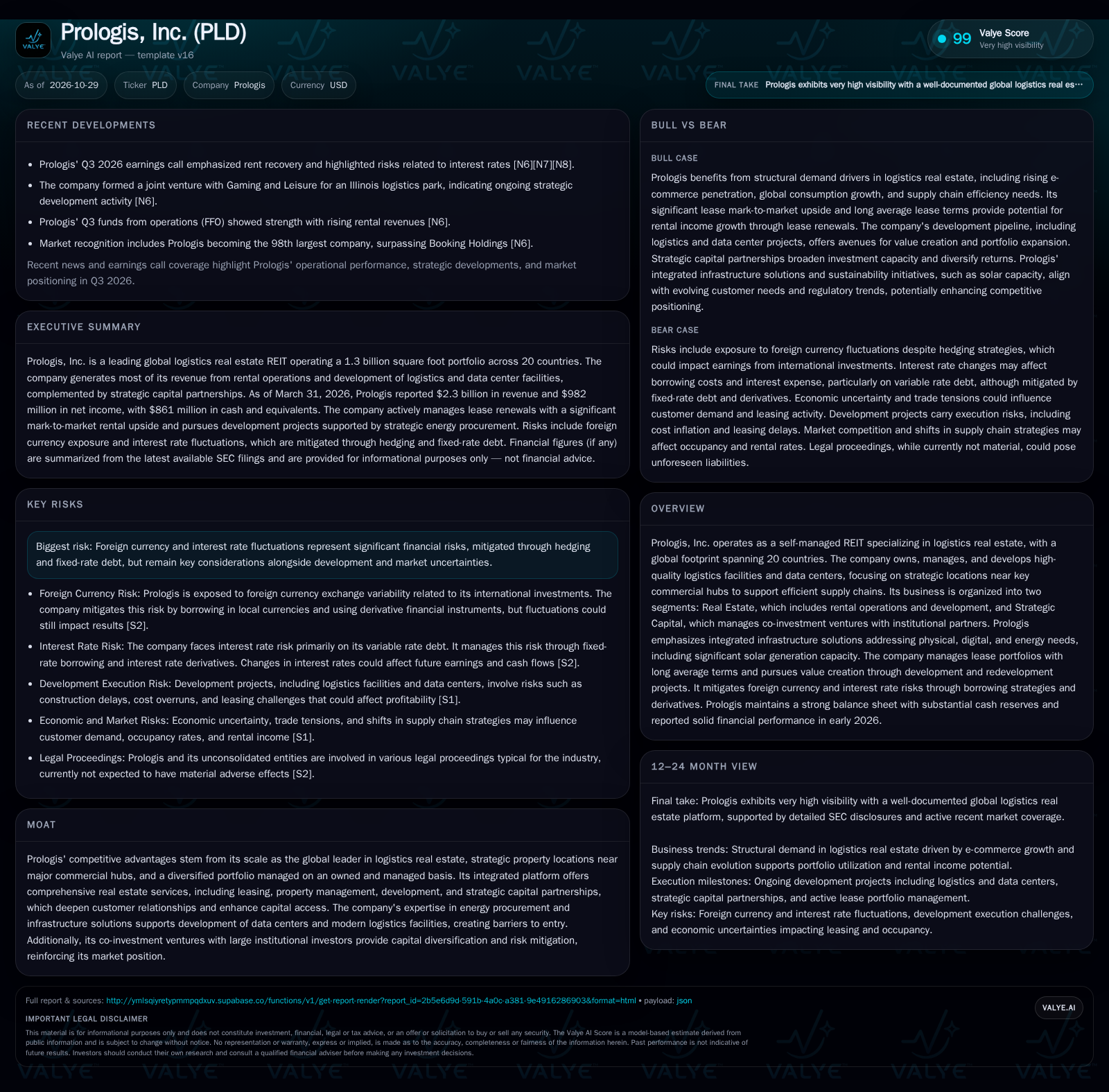
Prologis operates the world’s largest logistics real estate platform, with over 1.3 billion square feet across 20 countries. As of March 2026, the company reported robust financials, including $2.3 billion in quarterly revenue and $982 million in net income. Its core business—long-term logistics leasing—offers a notable 18% mark-to-market rent increase opportunity. Prologis is also expanding into data centers and integrating energy infrastructure, but faces ongoing risks from interest rates, development execution, and global economic shifts. The company’s ability to convert its embedded lease upside and manage development risk will be central to its value creation over the next cycle. [S1] [S2] [N6]
Prologis stands at the intersection of global logistics, real estate, and infrastructure transformation. As e-commerce and supply chain resilience drive demand for modern logistics facilities, Prologis’ scale—spanning 1.3 billion square feet—positions it to benefit from secular trends. Its current lease portfolio offers significant embedded rent growth, but the company must also navigate development complexity, interest rate volatility, and global macro shifts. The next chapter for Prologis will be defined by its ability to unlock lease repricing, execute on development, and manage capital across cycles.
Lease Repricing, Development Ambitions, and Financial Performance in Focus
As of March 31, 2026, Prologis reported revenue of $2.298 billion and net income of $982 million, supported by a portfolio spanning 1.3 billion square feet of logistics and data center facilities across 20 countries. The Real Estate segment—encompassing rental operations and development—remains the dominant earnings driver, contributing roughly 90-95% of consolidated revenues and FFO. The average lease term for new leases commenced in 2025 stands at 70 months, underpinning cash flow visibility. Importantly, the company’s lease mark-to-market opportunity is significant: as of December 31, 2025, Prologis estimates an 18% average gap between in-place and market rents, offering a substantial tailwind as leases roll over. Recent Q3 2026 results highlighted ongoing rent recovery and underscored both the opportunity and risk associated with interest rate exposure and disciplined development execution. [S1] [S2] [N6] [N7] [N8]
How Prologis Monetizes Scale: Rental Income, Development, and Strategic Capital
Prologis’ core economic engine is the rental of logistics and data center properties under long-term contractual leases, typically with fixed or inflation-linked escalations. This structure provides high operating leverage: once properties are stabilized, incremental revenue from rent increases or new developments flows through at high margins due to the fixed-cost nature of property management and administration. The company’s size enables favorable procurement, operational efficiencies, and a broad customer base, reducing vacancy risk and supporting pricing power in strategic locations.
The development arm—building new logistics facilities or redeveloping assets for industrial and selective data center use—offers additional value creation but requires substantial upfront capital and introduces timing and leasing risks. Returns on development can exceed stabilized asset yields if leasing and cost targets are met, but missteps (e.g., cost overruns, demand shortfalls) can erode value.
Strategic Capital, while a smaller contributor (5-10% of revenues), enables Prologis to co-invest with institutional partners, earning management and incentive fees. This segment diversifies earnings and provides fee-based income less sensitive to direct property market cycles. The company’s integrated platform—combining real estate, energy infrastructure, and digital solutions—may support premium rents and customer stickiness if value-added services are effectively monetized.
Scale, Location, and Platform Integration: Durable Advantages and Competitive Threats
Prologis’ differentiated scale in logistics real estate, with a global footprint and deep presence near major commercial hubs, confers sourcing and pricing advantages not easily replicated by smaller peers or new entrants. Its ability to offer integrated solutions—including energy infrastructure and digital connectivity—may increase switching costs for customers seeking full-spectrum logistics support.
However, the sector is not immune to competition. Institutional capital continues to flow into global industrial real estate, with alternative asset managers, sovereign wealth funds, and regional REITs competing for the same prized locations and tenants. The rise of e-commerce platforms and large retailers developing their own logistics infrastructure could also pose a long-term substitution threat. Furthermore, the economics of data center development are distinct from logistics facilities and attract specialized competitors; success will depend on Prologis’ ability to build differentiated offerings and operational expertise.
Unlocking Embedded Rent Growth and Development Alpha
The most favorable trajectory for Prologis is one where the company successfully captures its 18% lease mark-to-market upside as leases roll over, translating directly into higher net operating income and FFO. If market rents remain resilient or rise further—driven by sustained e-commerce demand, supply chain optimization, and limited new supply—Prologis could see outsized organic earnings growth without significant incremental capital.
Development projects, if executed on-budget and pre-leased to high-quality tenants, could further boost returns and portfolio value. Selective expansion into data centers, supported by energy procurement and infrastructure capabilities, may open additional high-margin revenue streams. Confirmation of this scenario would come from accelerating same-store NOI growth, above-peer FFO per share expansion, and high pre-leasing rates on new developments. Conversely, evidence of lease rollover shortfalls, cost overruns, or development delays would challenge the upside thesis.
Sustained Rental Growth with Disciplined Development and Risk Management
The most plausible outcome is that Prologis gradually realizes a portion of the mark-to-market rent upside as leases renew, but faces periodic headwinds from economic cycles, tenant churn, or local market oversupply. Rental income grows steadily, supported by long lease terms and contractual escalations, while development activity contributes modest incremental returns.
Interest rate and foreign currency risks remain contained due to proactive hedging and a predominantly fixed-rate debt structure. Strategic capital partnerships continue to provide low-volatility fee income. This scenario would be confirmed by stable occupancy, moderate same-store NOI growth, and measured expansion of the development pipeline. Material deviations in occupancy, cost discipline, or capital returns would signal a departure from this base case.
Interest Rate Shocks, Development Missteps, and Macro Volatility
A negative turn could occur if interest rates rise sharply or remain elevated, increasing borrowing costs and pressuring cap rates and asset values. Should economic weakness or supply chain shifts reduce tenant demand, Prologis could face higher vacancy or lease renewal at lower-than-anticipated rents, eroding NOI and FFO.
Development risks—such as construction cost inflation, delays, or weak tenant demand for new data center projects—could further impair returns and tie up capital. If competitors accelerate supply in key markets, rental growth could stall or reverse. This scenario would be confirmed by declining occupancy, stalled or negative same-store NOI, FFO contraction, or evidence of asset impairments and development write-downs.
Testing the Prologis Thesis: Where to Look Next
Lease rollover and mark-to-market capture rates: Actual rent increases achieved on lease renewals versus the estimated 18% opportunity would validate the core earnings thesis.
Same-store net operating income (NOI) growth: A useful metric to track rental growth and operational efficiency across the stabilized portfolio.
Pre-leasing and yield on development pipeline: If disclosed, the percentage of new developments pre-leased and the realized yields versus underwriting targets would indicate development discipline.
Occupancy rates and tenant retention: Sustained high occupancy and strong retention would signal continued demand and customer stickiness.
Interest expense trends and debt structure: Monitoring shifts in fixed versus variable rate debt, refinancing activity, and overall interest expense is critical given the rate environment.
Data center segment performance: Breakout data on occupancy, rental rates, and returns from data center projects would help test the value-add and risk profile of this expansion.
Strategic capital fee and promote income: Tracking the contribution and variability of fee-based income from co-investment ventures as a diversifier and capital amplifier.
Development cost inflation and project delivery: Evidence of cost discipline and on-time delivery for major projects would confirm execution capability.
Disclaimer: This is research-only, informational analysis and not investment advice. It may include AI-generated interpretation and general industry context. Always verify important details using primary sources.

Comments