
Baker Hughes: Diversification, LNG Growth, and the Challenge of Geopolitical Volatility
Baker Hughes’ Q3 2026 results highlight robust top-line growth, driven by LNG infrastructure and new energy initiatives, against a backdrop of geopolitical risk and margin compression. The company’s diversified portfolio and substantial order book provide forward visibility, but execution and market dynamics will test its ability to translate orders into sustained profitability.
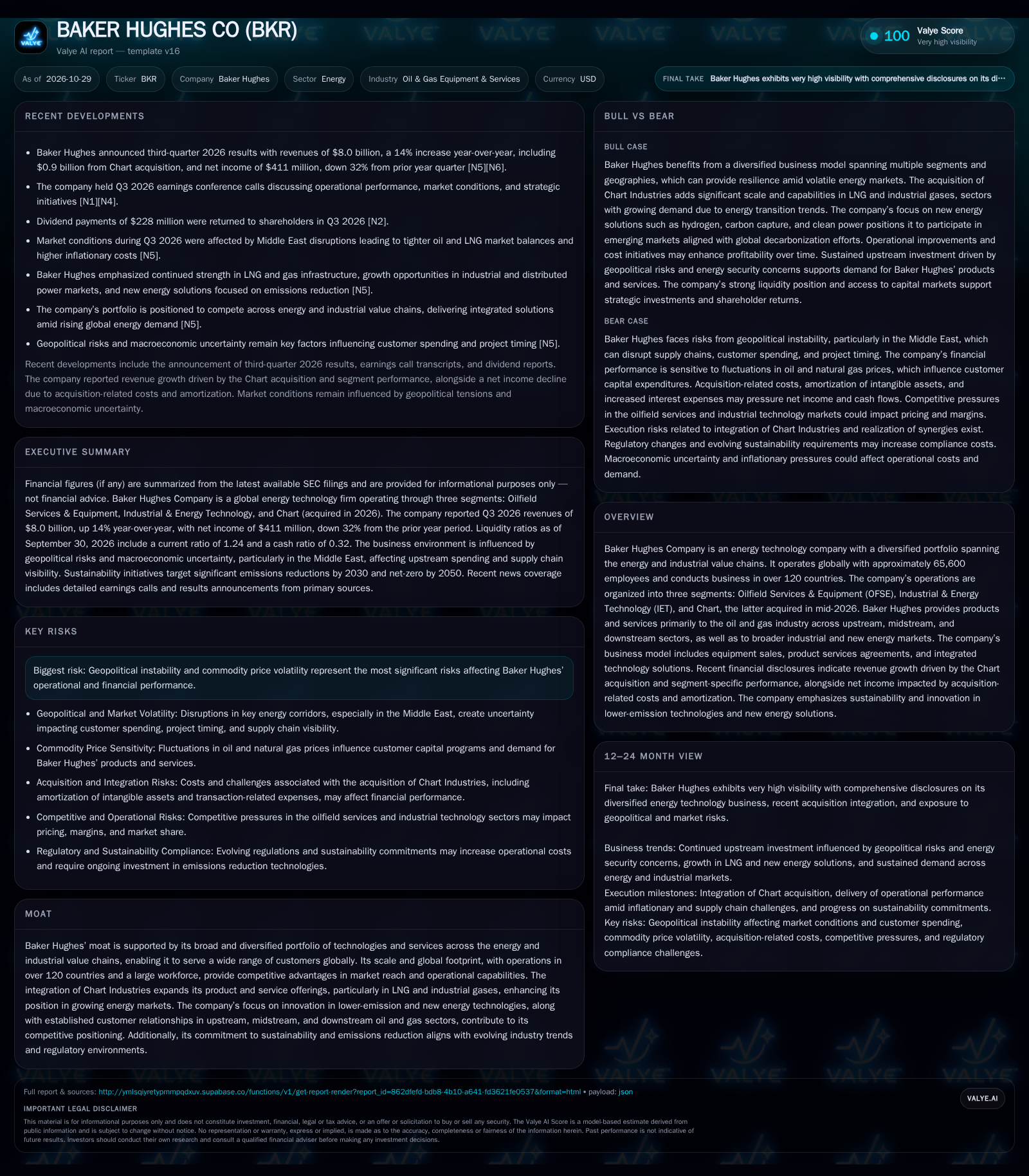
Baker Hughes delivered 14% year-over-year revenue growth in Q3 2026, supported by the integration of Chart Industries and strength in LNG and gas technology markets. While a $46.4 billion order book offers forward visibility, net income fell 32% as cost and margin pressures persisted. The company’s exposure to Middle East disruptions and commodity price swings remains material, and future performance will hinge on project execution, integration benefits, and the pace of energy transition investments. [S2] [N5]
Baker Hughes’ latest quarterly results encapsulate both the opportunity and complexity of operating at the intersection of traditional oilfield services, industrial technology, and new energy solutions. The company’s robust revenue growth and substantial order book underscore its strategic positioning in LNG and the broader energy transition. Yet, declining net income and ongoing exposure to macroeconomic and geopolitical risks reveal the challenge of converting scale and diversification into durable margin expansion. The question for investors is whether Baker Hughes can capitalize on its orders and new energy initiatives faster than external headwinds erode profitability.
Recent Performance: Growth in Revenues, Margin Compression, and Order Visibility
In Q3 2026, Baker Hughes generated $8.0 billion in revenue, marking a 14% increase year-over-year, with $0.9 billion attributable to the recently integrated Chart Industries. Despite this strong top-line growth, net income fell 32% compared to the prior year, reflecting ongoing cost and margin pressures. The company’s orders and remaining performance obligations totaled $46.4 billion as of September 30, 2026, led by the Industrial & Energy Technology (IET) segment, which continues to benefit from demand in LNG and climate technology solutions. Baker Hughes’ exposure to macroeconomic and geopolitical risks, especially disruptions in the Middle East, remains a central factor influencing both its operational outlook and investor risk calculus. [S2] [N5]
How Baker Hughes Makes Money: Volume, Mix, and the Leverage of Scale
Baker Hughes operates a hybrid business model combining capital equipment sales, long-term service agreements, and integrated technology solutions across upstream, midstream, and downstream energy sectors, as well as industrial and new energy markets. Revenue is generated via a mix of one-time project deliveries (e.g., LNG and gas processing equipment), recurring service and maintenance contracts, and—potentially—growing streams from new energy offerings such as hydrogen and carbon capture.
Economically, the business is characterized by substantial fixed costs (engineering, R&D, global footprint), with variable costs dominated by materials, logistics, and labor tied to project delivery. This structure allows for operating leverage when volumes rise, but also means that cost overruns or underutilization can quickly erode margins. The flat performance of the Oilfield Services & Equipment (OFSE) segment in Q3 2026 suggests that not all business lines are benefiting equally from the current demand environment, pointing to ongoing pricing and competition pressures in the more commoditized upstream services market. The company’s ability to convert its substantial order book into profitable revenue, while managing inflationary and supply-chain costs, will be a central determinant of medium-term margin trajectory.
Competing in an Evolving Energy Landscape: Scale, Breadth, and the Limits of Diversification
Baker Hughes’ global scale—with operations in over 120 countries and a workforce exceeding 65,000—confers logistical and customer-access advantages, particularly for complex, multinational projects. Its diversified portfolio spans oilfield services, LNG/gas technology, industrial solutions, and a developing suite of new energy offerings, enabling cross-segment synergies and some insulation from commodity-specific downturns. The integration of Chart Industries enhances its competitive position in LNG and industrial gases, markets with higher barriers to entry due to technological complexity, project scale, and customer qualification requirements.
However, the company faces persistent counterforces: traditional oilfield services remain highly competitive, with pricing pressure from both diversified peers and regional specialists. In the industrial and new energy segments, Baker Hughes competes against both established conglomerates and pure-play technology challengers. The company’s ability to maintain pricing power and defend margins in legacy businesses, while scaling new energy offerings fast enough to offset any secular decline in upstream capex, is not guaranteed. Technology substitution risk is present as customers seek lower-carbon or electrified solutions, though Baker Hughes’ early moves in hydrogen and carbon capture may provide a first-mover advantage if adoption accelerates. Still, these markets remain nascent and, for now, are unlikely to offset the scale of the legacy portfolio.
Translating Orders into Margin Expansion: What Would Signal a Positive Inflection
The favorable scenario for Baker Hughes hinges on its ability to convert the $46.4 billion in orders and remaining performance obligations—especially in LNG and climate technology—into high-margin, on-time project execution. If global LNG demand remains robust, and the company successfully integrates Chart Industries’ offerings, Baker Hughes could capture outsized share of new project awards, benefiting from both volume growth and improved pricing. Further, if its new energy solutions (hydrogen, carbon capture, clean power) gain traction with early-adopter customers, these could begin contributing meaningfully to topline and, eventually, margin accretion.
Evidence confirming this scenario would include a sustained acceleration in IET and new energy segment revenues, expansion in operating margin (especially as inflationary pressures ebb), and positive updates on project completions and synergy realization from the Chart integration. Additional signals would be major multi-year contract wins in hydrogen or carbon capture, and increased disclosure of recurring revenue from service and technology platforms. Conversely, if margin improvement stalls or growth in new energy segments remains immaterial, the bull thesis would be weakened.
Order Execution and Macro Uncertainty: The Most Likely Near-Term Outcome
The most plausible scenario is that Baker Hughes delivers steady, if uneven, revenue growth as it works through its substantial orders and performance obligations, with margins remaining under pressure from cost inflation, project mix, and competitive dynamics in legacy businesses. LNG and gas technology will likely remain the primary growth engines, offsetting flat or volatile performance in upstream oilfield services. Integration of Chart Industries will produce incremental revenue and some cost synergies, but realization may be gradual and subject to execution risk.
Ongoing geopolitical tensions, particularly in the Middle East, will continue to create uncertainty around project timing and customer capex. Inflationary pressures and supply-chain disruptions could persist, limiting near-term margin expansion. Signs confirming this scenario would be continued top-line growth with modest or flat operating margins, regular order wins in core segments, and incremental progress in new energy without a step-change in financial contribution. If macro conditions deteriorate or integration issues surface, downside risk could increase.
Cost Overruns, Project Delays, and Energy Market Volatility: What Could Derail the Thesis
The adverse scenario involves a convergence of external and internal headwinds: a sharp or prolonged decline in oil and gas prices prompts customers to curtail spending, leading to project delays, order cancellations, or renegotiations. Geopolitical disruptions—particularly in the Middle East—could exacerbate supply chain issues and impair execution of large infrastructure projects. If inflationary cost pressures persist or escalate, Baker Hughes may struggle to protect margins, especially if project contracts do not allow for cost pass-through.
Internally, failure to realize expected synergies from the Chart acquisition, or missteps in integrating new product lines and teams, could further pressure profitability and erode management credibility. The downside would be evidenced by declining or flat revenues, further margin compression, negative project updates, or unexpected charges related to project delays or integration. If new energy initiatives fail to gain commercial traction, the company could be left exposed to secular decline in its traditional markets without a viable offset.
What Will Determine Whether Baker Hughes Converts Orders into Profitable Growth
Progression of operating margins in the IET and OFSE segments, especially in the context of rising input costs and inflationary pressures.
Quarterly updates on order intake, conversion rates for orders and remaining performance obligations, and any disclosed project delays or cancellations, especially in LNG and new energy verticals.
Synergy realization milestones and integration updates following the Chart Industries acquisition, including any disclosed cost savings or revenue cross-sell.
Revenue and order growth in new energy segments (hydrogen, carbon capture, clean power), if disclosed, as an indicator of market adoption and Baker Hughes’ competitive position.
Material changes in customer spending patterns or project timing linked to geopolitical events, particularly in the Middle East and LNG-exporting regions.
Disclosure of recurring revenue streams from long-term service agreements or digital/technology platforms, which would signal improved revenue visibility and business resiliency.
Any regulatory developments or shifts in sustainability requirements that could meaningfully impact compliance costs or open new addressable markets.
Disclaimer: This is research-only, informational analysis and not investment advice. It may include AI-generated interpretation and general industry context. Always verify important details using primary sources.

Comments