
Citizens Financial Group: Deposit Growth, Digital Investment, and the Battle for Regional Banking Relevance
Recent net interest income gains and a dividend increase spotlight Citizens Financial Group’s strategic focus, but the durability of its regional banking model will depend on its ability to deepen customer relationships, defend deposit share, and adapt to intensifying competition from both traditional and digital-native rivals.
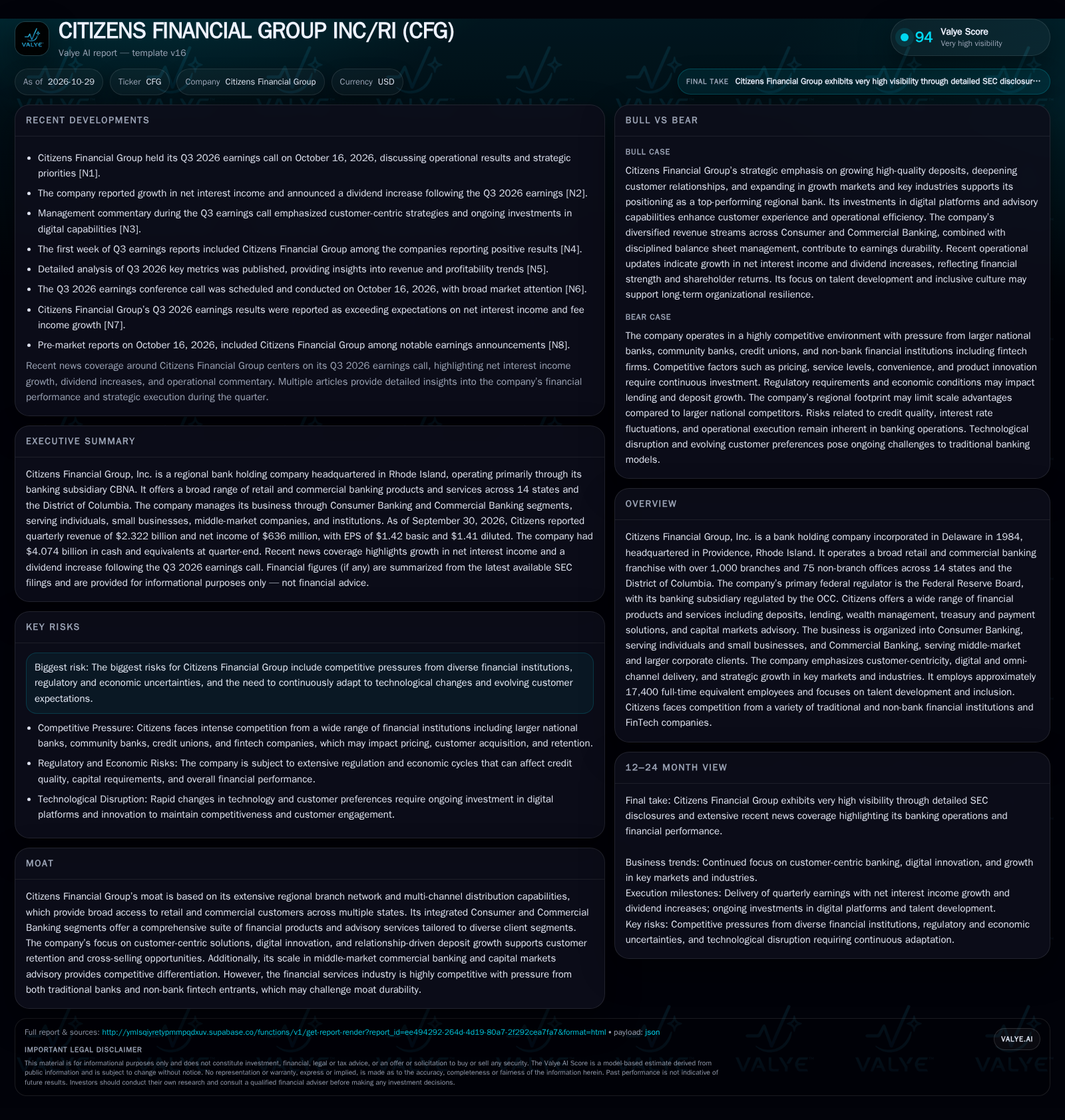
Citizens Financial Group’s Q3 2026 results show net interest income growth and a dividend hike, underscoring operational momentum. However, the company must continually invest in digital capabilities and customer-centric strategies to compete with larger banks and fintechs, while managing regulatory and economic risks in a shifting banking landscape. The critical question is whether Citizens can leverage its regional scale and omni-channel reach to sustain deposit growth and maintain profitability as industry dynamics evolve. [S2] [N1] [N2] [N3] [N7]
Citizens Financial Group’s latest quarterly results highlight a regional bank navigating both opportunity and threat. The company’s Q3 2026 performance, marked by net interest income gains and a dividend hike, demonstrates near-term operational strength. Yet, as banking competition intensifies and digital innovation accelerates, Citizens’ long-term relevance will hinge on its ability to defend deposit share, deepen customer relationships, and orchestrate a seamless omni-channel experience. The next phase will test whether its scale, strategic focus, and digital investments can offset the headwinds of industry consolidation, fintech disruption, and regulatory complexity. [S2] [N1] [N2] [N3] [N7]
Q3 2026 Results Highlight Deposit and Income Momentum
Citizens Financial Group reported Q3 2026 revenue of $2.322 billion and net income of $636 million, with basic EPS at $1.42 and diluted EPS at $1.41. The company’s cash and equivalents stood at $4.074 billion at quarter-end. Notably, Citizens announced a dividend increase following its earnings release, while management commentary emphasized net interest income growth and positive operational performance. These developments signal both earnings momentum and a willingness to return capital to shareholders, suggesting management’s confidence in near-term performance. However, the sustainability of these trends will depend on the company’s ability to defend its deposit base and navigate margin pressures in a competitive and shifting rate environment. [S2] [N1] [N2] [N3] [N7]
Deposit Pricing, Loan Mix, and the Levers of Regional Bank Profitability
Citizens Financial Group’s economics rest on the classic banking spread: earning interest income from loans funded by customer deposits, while controlling funding costs and credit risk. The bank’s dual-segment structure—Consumer Banking and Commercial Banking—enables cross-selling and diversification across individuals, small businesses, and larger enterprises. In the current environment, the ability to attract and retain high-quality, low-cost deposits is critical, as rising deposit betas (the sensitivity of deposit rates to market rates) can compress net interest margins when competition for funds is fierce.
Fee income from wealth management, treasury services, and capital markets activities provides a supplemental earnings stream, but the core engine remains net interest income. Fixed costs—including branch network, compliance, and technology—create operating leverage, such that incremental deposit and lending growth can drive margin expansion if credit quality holds. However, capital needs are dictated by regulatory requirements and risk-weighted asset growth, which can constrain balance sheet expansion or dividend flexibility if asset quality deteriorates. The ongoing investment in digital platforms is necessary to retain customers and lower servicing costs, but such expenditures can weigh on near-term efficiency ratios if not matched by revenue growth.
Regional Scale Versus National and Digital Challengers
Citizens’ competitive position is anchored by its extensive branch and ATM network across 14 states and the District of Columbia, supporting broad access for retail and commercial clients. This footprint enables strong local brand recognition and relationship-driven banking, particularly in middle-market commercial lending and advisory. However, the bank faces pressure on multiple fronts: national banks leverage broader scale and technology budgets, while fintechs and digital-native banks target high-value customers with superior digital experiences and lower-cost models.
The bank’s ability to offer a full suite of products, from deposits and loans to wealth management and capital markets advisory, creates cross-selling and retention opportunities. Yet, customer switching costs in banking are moderate—digital account opening, instant payments, and third-party aggregators have reduced frictions, especially for younger, tech-savvy customers. In this context, Citizens’ success will depend on the perceived value of its advisory services, the convenience of its omni-channel offerings, and the competitiveness of its pricing. The question is whether its regional scale remains an advantage or becomes a constraint as industry consolidation and digital adoption accelerate.
Deepening Relationships and Digital Innovation Drive Outperformance
A favorable outcome would see Citizens leveraging its investments in digital platforms to improve customer experience and drive both deposit growth and cross-selling in targeted segments. If the bank can successfully deepen relationships with existing customers—evidenced by rising average balances per account, increased product penetration, and higher digital engagement—operating leverage could expand, supporting higher returns on equity.
Continued growth in fee-based income from wealth management and capital markets, along with stable or improving credit metrics, would reinforce the case for durable earnings power. Evidence of market share gains in key geographies or customer segments would further validate the strategy.
Incremental Gains Amid Margin Pressures and Elevated Competition
The most plausible trajectory is that Citizens continues to deliver modest revenue and earnings growth, driven by a stable deposit base and disciplined lending. Net interest income may grow incrementally if loan demand remains solid and deposit costs can be managed, but competitive intensity and rising funding costs are likely to constrain margin expansion. Fee income streams offer diversification, though not enough to offset core spread compression if industry-wide pressures persist.
This scenario would be confirmed by steady, but not dramatic, growth in key operating metrics: loan and deposit balances, digital adoption rates, and efficiency ratios. Dividend growth may continue in line with profit trends, but capital return will remain subject to regulatory capital requirements and asset quality performance. Any significant deviation—such as a marked increase in non-performing assets or deposit outflows—would challenge this steady-state outcome.
Deposit Attrition or Credit Deterioration Undermines Performance
Adverse outcomes could be triggered if Citizens experiences significant deposit outflows—whether due to more aggressive pricing by competitors, loss of customer trust, or a broader shift toward digital-only banking alternatives. Such attrition would force the bank to rely on higher-cost wholesale funding, eroding net interest margins and potentially compressing profitability.
A second risk is credit quality deterioration, especially if economic conditions worsen or commercial real estate exposures come under stress. Rising non-performing loans would raise provisioning costs and constrain capital return, while also increasing regulatory scrutiny. Evidence of either accelerating deposit outflows, sharp increases in non-performing assets, or regulatory intervention would confirm this downside scenario.
Milestones That Will Reveal Citizens’ Staying Power in Regional Banking
Quarterly trends in net interest margin and deposit betas: If disclosed, these metrics would clarify whether Citizens can defend its funding cost advantage amid rising competition.
Customer retention and cross-sell rates: A useful metric would be changes in the average number of products per retail and commercial customer, revealing the depth of client relationships.
Digital channel adoption and usage: Increases in mobile/online banking engagement, if disclosed, would indicate success in shifting customers to lower-cost, stickier channels.
Loan growth and credit quality indicators: Trends in loan balances, non-performing assets, and provisioning expenses will signal the health of the lending portfolio.
Efficiency ratio trajectory: Sustained improvement despite higher technology investment would demonstrate operating leverage and cost discipline.
Deposit growth and composition: Monitoring both total deposits and the mix between core and higher-cost sources will reveal competitive positioning.
Regulatory developments or significant changes in capital requirements: Any new rules or supervisory comments could alter the bank’s operating latitude and capital allocation.
Disclaimer: This is research-only, informational analysis and not investment advice. It may include AI-generated interpretation and general industry context. Always verify important details using primary sources.

Comments