
Diebold Nixdorf at a Crossroads: Margin Pressure, Liquidity Tension, and the Next Phase of Retail Banking Technology
Diebold Nixdorf’s Q3 2026 results highlight the tension between scale and profitability in a rapidly evolving retail and financial technology landscape.
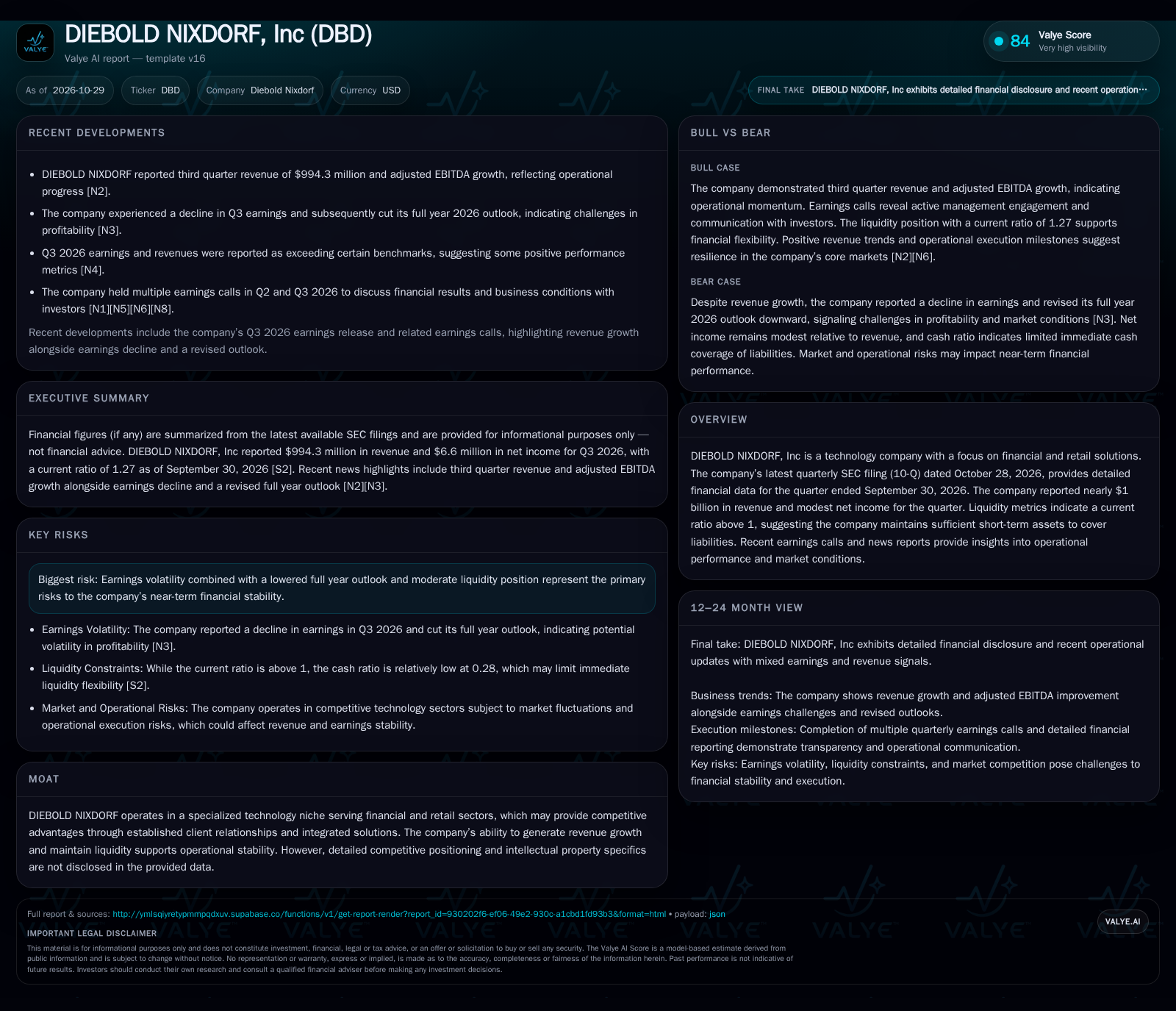
Diebold Nixdorf reported Q3 2026 revenue of $994.3 million and net income of $6.6 million, with a current ratio of 1.27 but a lower cash ratio of 0.28 [S2]. Management cut the full-year outlook following a decline in Q3 earnings [N3], even as results beat some benchmarks [N4]. The company faces ongoing margin pressure and must balance liquidity management with the need to invest in innovation and customer retention.
While nearly $1 billion in quarterly revenue underscores a sizable installed base and entrenched customer relationships, modest net income and a lowered full-year outlook signal pressure on margins and execution. The company’s ability to balance short-term financial discipline with the ongoing need to invest in innovation and service delivery will set the tone for its next chapter.
Recent Results Reveal Both Scale and Financial Tension
For the quarter ended September 30, 2026, Diebold Nixdorf reported revenue of $994.3 million and net income of $6.6 million, translating to diluted EPS of $0.19 [S2]. The company’s liquidity snapshot shows current assets of $1.655 billion against current liabilities of $1.303 billion, with a current ratio of 1.27, but the cash ratio stands at a lower 0.28 [S2]. Critically, management cut its full-year 2026 outlook after a decline in Q3 earnings, even as earnings and revenues beat certain benchmarks [N3] [N4]. These facts highlight a business with substantial revenue scale but persistent pressure on margins, cash flow, and near-term visibility. The revised outlook suggests ongoing uncertainty around demand, cost control, or both.
How Diebold Nixdorf’s Model Converts Installed Base into Cash Flow
Diebold Nixdorf’s core economics revolve around large-scale deployments of hardware, software, and services to retail and financial institutions. Revenue is typically a blend of upfront equipment sales (such as ATMs and point-of-sale terminals), recurring maintenance/service contracts, and increasingly, software and integration solutions. Gross margins are structurally pressured by the capital-intensive nature of hardware and the need to support legacy installed bases, while service and software can offer higher incremental margins if scaled effectively.
Fixed costs are significant due to R&D, manufacturing overhead, and a global support footprint. This creates potential for operating leverage if revenue grows or the mix shifts toward higher-margin services and software. However, product commoditization and customer pricing pressure limit the company’s ability to expand gross margins without continuous cost discipline or meaningful mix improvement. Working capital swings are material, as customers may negotiate extended payment terms and inventory cycles are long. The company reported cash and liquidity metrics for the period; these figures do not by themselves establish operating runway, investment capacity, financial flexibility, or financing capacity.
Capital needs are ongoing: maintaining and upgrading product lines, investing in software integration, and supporting global service operations require steady reinvestment. The challenge is to finance growth and innovation without overextending the balance sheet, particularly given the modest net income base and cash coverage constraints.
Defending Share in a Market Undergoing Digital Disruption
Diebold Nixdorf operates within the specialized but rapidly evolving markets of retail banking and point-of-sale technology. Its primary competitors include global ATM manufacturers, payment terminal vendors, and service/software providers targeting financial institutions and large retailers. Competitive advantages may stem from legacy client relationships, scale in field service, and integrated offerings—but these are increasingly at risk as customers accelerate digital transformation and seek flexible, software-driven solutions.
Switching costs for large banks and retailers can be significant due to the complexity of replacing hardware and retraining staff, but the rise of cloud-based platforms, open banking APIs, and mobile-first solutions is eroding barriers to entry. Traditional ATM and POS hardware is under threat from digital-only banking, cashless payment adoption, and the entry of fintech disruptors. To maintain relevance, Diebold Nixdorf must continuously evolve its portfolio, demonstrate ROI for customers, and offer seamless integration with emerging digital ecosystems.
Price competition remains intense, especially in commoditized hardware. The company’s ability to upsell value-added services or transition customers to recurring software models will be critical in defending both share and margins.
Operating Leverage from Mix Shift and Digital Upsell Could Reignite Profitability
If Diebold Nixdorf successfully accelerates the transition from hardware-dependent revenues to higher-margin software and recurring service contracts, the business could unlock operating leverage and stabilize cash flow. Evidence of this would include a rising share of software/service revenue, improved gross margins, and higher recurring revenue visibility. Additional upside could come from new product launches that address digital transformation needs—such as cloud-based ATM management, retail analytics, or payment orchestration platforms.
A credible path to margin expansion would likely require both cost rationalization (e.g., supply chain efficiency, footprint optimization) and successful cross-selling of integrated solutions. Confirmation would come from sustained improvement in gross and operating margins, increased R&D efficiency, and customer wins for next-generation solutions. Conversely, failure to demonstrate mix improvement or to win strategic digital contracts would undermine this scenario.
Steady-State Maturity: Margin Pressure with Incremental Innovation
The most plausible trajectory is that Diebold Nixdorf remains a mature provider in a consolidating market—generating large, stable (but low-growth) revenues from legacy hardware and service contracts, with gradual adoption of new digital offerings. Margins remain thin due to price competition and the need to support both legacy and emerging platforms.
This scenario would be confirmed by continued modest net income, a stable but unimproved cash ratio, and incremental rather than transformative product rollouts. If the company can maintain share in its core customer base and prevent material erosion from fintech entrants—while slowly building up its software/service mix—it may achieve moderate stability, but not breakout growth or margin expansion. A miss on major digital transformation opportunities, or persistent cost overruns, would tilt this scenario toward the downside.
Margin Compression, Liquidity Stress, and Share Loss to Digital Natives
Adverse outcomes could materialize if competitive intensity accelerates and Diebold Nixdorf is unable to offset hardware commoditization with new digital offerings. In this scenario, margin compression intensifies as customers negotiate harder on price and shift spending to fintech or software-first competitors. The company’s fixed cost base and working capital needs could exacerbate cash flow stress, especially if revenue declines or payment cycles lengthen.
Confirmation of this scenario would include further earnings declines, negative or near-zero net income, a deteriorating cash ratio, and potentially the need for asset sales, debt refinancing, or defensive restructuring. Loss of major customer relationships, failure to win digital transformation mandates, or inability to invest in product refreshes would further accelerate downside risks.
What Will Determine Diebold Nixdorf’s Next Chapter in Retail Banking Tech?
Quarterly gross margin trends—sustained improvement would suggest successful mix shift or cost control; deterioration would signal rising price pressure or operational inefficiency.
The proportion of revenue derived from software and recurring service contracts, if disclosed, as evidence of transition away from hardware dependency.
Operating cash flow directionality—whether the company can consistently generate cash from operations, not just manage liquidity via working capital swings.
Customer retention and new contract wins in digital transformation projects; loss of major legacy accounts or failure to secure new digital mandates would be a warning sign.
R&D and capital expenditure levels relative to revenue, as indicators of both innovation capacity and capital discipline.
Net debt trajectory and any refinancing or asset sale activity, which would indicate liquidity pressure or balance sheet stress.
Management commentary on competitive threats, digital adoption rates, and customer feedback from earnings calls or investor updates.
Any changes to the full-year outlook, especially if accompanied by revised guidance on margins, revenue mix, or capital allocation priorities.
Disclaimer: This is research-only, informational analysis and not investment advice. It may include AI-generated interpretation and general industry context. Always verify important details using primary sources.

Comments