
Wingstop’s Digital-First Franchise Model: Scale, Margin Leverage, and the Limits of Asset-Light Expansion
Wingstop’s recent outperformance and digital penetration highlight the strengths of its highly franchised, capital-light model. Yet, as the brand pushes further into international markets and leans on technology-driven customer engagement, the durability of its unit economics and ability to sustain growth amid input cost volatility and competitive saturation face real-world stress tests.
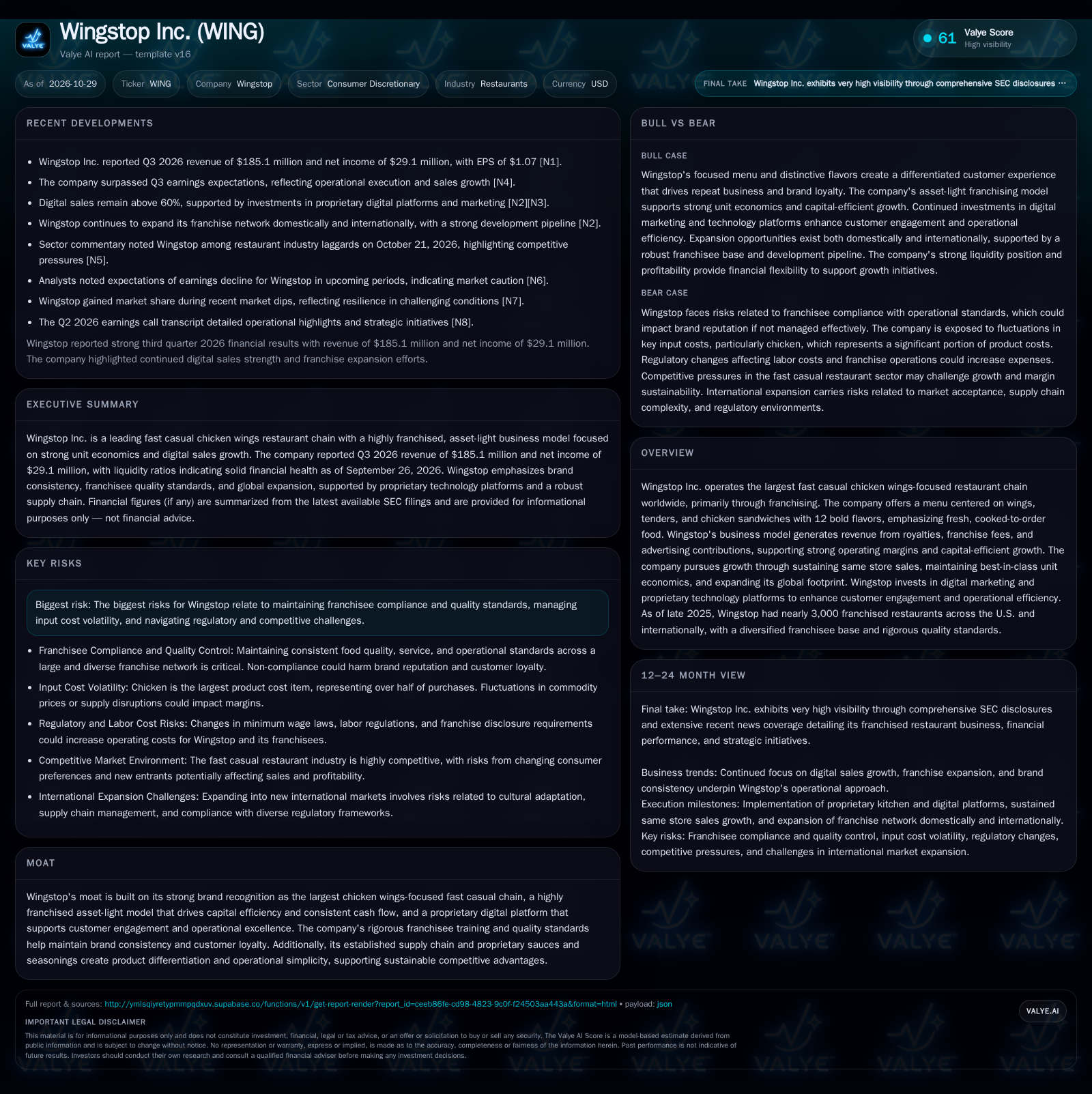
Wingstop exceeded Q3 2026 earnings expectations, with digital sales accounting for more than 60% of revenue, underlining the effectiveness of its proprietary digital platform and asset-light franchise strategy. The company’s development pipeline remains robust, supporting ongoing domestic and international expansion. However, analysts have flagged potential earnings declines ahead, reflecting caution around cost pressures and sector competition. Wingstop’s resilience during recent market volatility suggests brand strength, but the sustainability of its margins and growth trajectory faces risks tied to franchisee compliance, input costs, and new market execution. [N2] [N3] [N4] [N6] [N7]
Wingstop Inc. stands at a pivotal moment, having demonstrated the scaling power of its digital-driven, asset-light franchise model with nearly 3,000 global units and a recent earnings beat. The company's high digital sales penetration and brand focus have supported robust same-store sales and expansion, even as analysts warn of possible near-term earnings softness. As Wingstop accelerates its international push and deepens its digital engagement, the core question is whether its differentiated economics and operational discipline can withstand rising input costs, intensifying competition, and the complexities of a global footprint. The next phase will test whether Wingstop’s capital efficiency and franchise rigor can continue to deliver margin resilience and sustainable growth. [N2] [N3] [N4] [N6] [N7]
Earnings Beat, Digital Mix, and Expansion Momentum Define the Current Landscape
Wingstop surpassed Q3 2026 earnings expectations, a result attributed to strong operational execution and continued sales growth. Digital sales accounted for more than 60% of total revenue, a figure sustained by ongoing investments in proprietary technology and marketing platforms. The franchise network continues to expand both domestically and internationally, with a robust development pipeline signaling confidence in the model. Despite these positives, some analysts anticipate a potential earnings decline in upcoming periods, highlighting market caution around margin durability and competitive pressures. Notably, Wingstop gained market share even as broader restaurant industry trends softened, underlining brand resilience. [N2] [N3] [N4] [N6] [N7]
How Wingstop’s Asset-Light Franchise Model Drives Margin Leverage—And Where It Could Strain
Wingstop’s revenue is principally derived from royalties, initial franchise fees, and advertising contributions, with company-owned stores representing a minority of the footprint. This capital-light approach minimizes direct operating risk, enabling rapid unit growth without the burden of heavy capital expenditures. The core economics hinge on strong franchisee unit performance: high average unit volumes, disciplined cost controls, and efficient labor models. Digital sales, now exceeding 60%, further enhance order throughput, upsell opportunities, and operational efficiency, potentially lowering labor intensity per transaction. [S1] [S2]
However, the model’s dependence on franchisee health means Wingstop’s economics are indirectly exposed to input cost swings—especially chicken, which comprises over half of product costs. Franchisees bear much of the direct commodity cost risk, but sustained input inflation could pressure store-level margins, slow new unit development, or increase franchisee turnover. Operating leverage is high at the corporate level, as incremental royalty and marketing dollars flow with minimal added overhead, but this leverage can work in reverse if same-store sales or franchise unit growth stalls. International expansion, while promising for growth, may require higher up-front investment in supply chain, training, and support infrastructure to ensure quality and brand consistency across diverse markets. [S1] [S2]
Brand Strength, Digital Engagement, and the Moat Against Fast Casual Rivals
Wingstop’s competitive edge is rooted in its singular focus on chicken wings, bold flavor variety, and a streamlined menu, which simplifies operations and supports consistent customer experiences. The company’s proprietary sauces and seasonings, along with rigorous franchisee training and quality standards, contribute to product differentiation and customer loyalty. High digital penetration creates a data-rich environment for targeted marketing and customer retention, while also enabling more efficient order processing and delivery integration. [S1]
Yet, the fast casual restaurant sector is intensely competitive, with both national chains and regional independents vying for consumer attention and share of stomach. Barriers to entry are moderate: while Wingstop’s brand is strong, new concepts can emerge quickly, and switching costs for consumers are low. Competing platforms are also upgrading digital ordering and delivery capabilities, eroding some of Wingstop’s early-mover digital advantage. Internationally, local tastes and established competitors may limit the transferability of the Wingstop model without adaptation. Ultimately, the moat relies on maintaining operational consistency, franchisee alignment, and consumer relevance even as the landscape evolves. [S1]
If Digital-Driven Expansion and Franchisee Health Hold, Margin Power Could Compound
In a favorable scenario, Wingstop sustains robust same-store sales growth, driven by continued digital engagement, menu innovation, and effective marketing. Franchisee economics remain attractive despite input cost volatility, supporting accelerated unit development in both core U.S. and new international markets. Proprietary technology investments yield further gains in operational efficiency and customer lifetime value, while supply chain scale helps mitigate commodity price swings. The result: high-margin, capital-efficient growth, with expanding royalty streams and limited corporate overhead drag.
Evidence that would confirm this trajectory includes: persistent digital sales above 60% (or rising), accelerating net new restaurant openings, stable or improving franchisee profitability metrics (if disclosed), and consistent same-store sales outperformance versus fast casual peers. Margin expansion at the corporate level, despite input volatility, would also support the thesis.
Digital Scale Offsets Cost Pressures, But Growth Normalizes Amid Industry Competition
The most plausible outcome is that Wingstop maintains modestly positive same-store sales and continues disciplined unit growth, but faces periodic margin headwinds from input cost fluctuations and competitive pricing. Digital sales remain robust and support operational efficiency, but incremental gains become harder as competitors close the technology gap and consumer digital adoption plateaus. Franchisee profitability holds up, but may compress at the margin in high-cost periods, slowing the pace of new unit openings and requiring more targeted corporate support.
Confirmation of this scenario would come from steady digital sales penetration, a stable but not accelerating franchise development pipeline, and reported margin figures that fluctuate in line with commodity cycles. Evidence of franchisee churn, slower international ramp, or increased support costs would suggest the model is meeting growing pains but not breaking down.
If Input Costs Spike and Franchisee Economics Deteriorate, Expansion Could Stall
A negative chain of events would involve sharp, sustained increases in chicken and other input costs, eroding store-level profitability for franchisees. This could lead to reduced franchisee investment, unit closures, or renegotiation of royalty rates. At the same time, intensifying competition and shifting consumer preferences could dampen same-store sales and undermine brand momentum. International markets might prove more challenging than anticipated, with higher-than-expected support costs and slower customer adoption. In such a scenario, the asset-light model’s operating leverage works in reverse: lower royalties and reduced development fees flow through quickly to corporate margins, while fixed support costs remain.
Evidence supporting this scenario would include a meaningful drop in net new unit openings, rising franchisee attrition (if disclosed), declining same-store sales, and shrinking corporate margins—especially if these trends persist even as the broader restaurant sector recovers.
What Will Determine Whether Wingstop’s Franchise Model Remains Resilient?
Same-store sales growth trends by quarter and year, especially relative to fast casual peers.
Digital sales penetration rate—continued stability above 60% or further increases would support the upside case.
Net new unit openings and franchise development pipeline progress, both in the U.S. and international markets.
Franchisee profitability and store-level margin data (if disclosed), as a proxy for sustainability of unit economics.
Input cost trends, especially for chicken, and the company’s ability to manage or pass through commodity volatility.
Corporate margin trends and royalty rate stability—watch for any pressure on royalty streams or increased support costs.
Franchisee attrition or closure rates, particularly during periods of input cost spikes or competitive pressure.
International market performance: unit economics, ramp speed, and brand acceptance outside the U.S.
Disclaimer: This is research-only, informational analysis and not investment advice. It may include AI-generated interpretation and general industry context. Always verify important details using primary sources.

Comments