
McGrath RentCorp: Asset Utilization, Diversification, and the Next Phase of Modular Rental Economics
Recent quarterly results confirm McGrath RentCorp’s ability to generate robust rental income across economic cycles, but the company faces renewed scrutiny over supply chain risks, regulatory headwinds, and the evolving economics of modular asset deployment. The key challenge is whether its operational infrastructure and customer relationships can continue to translate long-lived assets into high-return rental streams amid shifting external pressures.
McGrath RentCorp’s Q3 2026 results reinforce the core thesis of durable rental economics, underpinned by long asset lives and diversified segment exposure. The company’s fleet management and in-house refurbishment support asset utilization and margin stability, but future performance hinges on navigating regulatory, supply chain, and demand-side risks. Monitoring asset turns, segment demand, and regulatory shifts will be crucial to evaluating the sustainability of its rental model.
McGrath RentCorp’s latest quarterly results demonstrate the resilience and scalability of its diversified asset rental platform, which spans modular buildings, portable storage containers, and electronic test equipment. The company’s ability to recover its capital outlay quickly and redeploy assets efficiently remains central to its economics. However, the operating environment is becoming more complex, with geopolitical and regulatory risks threatening both cost structures and demand visibility. The core question is whether McGrath’s operational infrastructure and customer focus can continue to deliver stable returns as external pressures mount.
Recent Results and Operational Backdrop: What Q3 2026 Tells Us
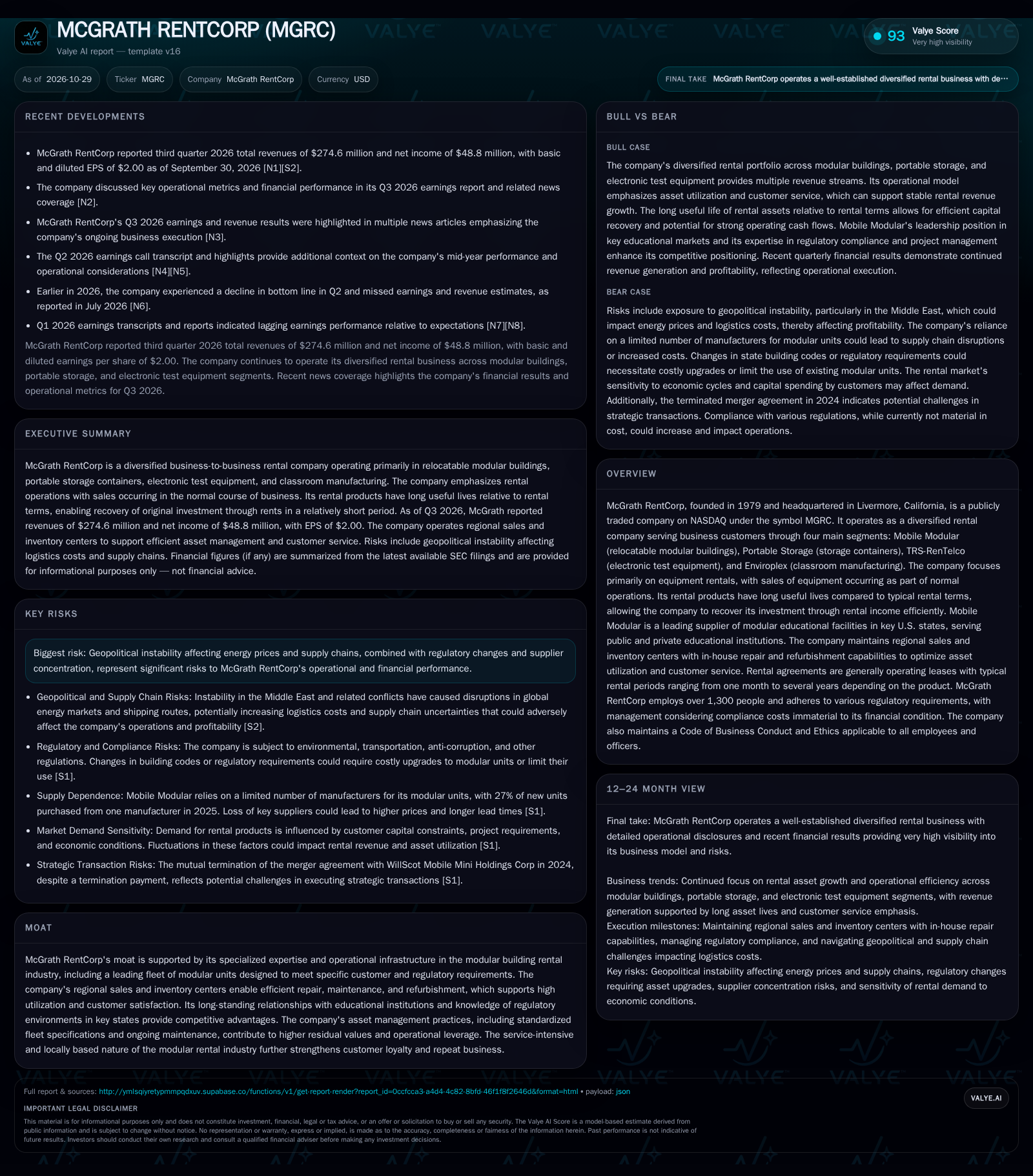
McGrath RentCorp reported Q3 2026 total revenues of $274.6 million and net income of $48.8 million, translating to basic and diluted EPS of $2.00 [S2] [N1]. This performance underscores the company’s ongoing ability to generate cash flow and maintain profitability across its modular, storage, and test equipment segments.
The company’s rental model revolves around long-lived assets—such as modular buildings (18-year average life), portable storage containers (25 years), and electronic test equipment (1-8 years)—with typical rental terms far shorter than asset lives. Management reports that capital invested in these assets is generally recovered in three to four years through rental income [S1].
Recent disclosures highlight increased risks from geopolitical instability, particularly in the Middle East, which could drive up energy and logistics costs and disrupt supply chains [S2]. These factors, along with recent earnings volatility in Q2 and Q1 2026 [N6] [N8], frame the current operational backdrop and the central issues for forward-looking analysis.
How McGrath Converts Long-Lived Assets into High-Margin Rental Streams
The company’s economics hinge on the mismatch between the useful life of rental assets and the much shorter rental terms. For example, modular buildings and storage containers are typically rented for 12-24 months and 3-12 months, respectively, but last 18-25 years. This enables McGrath to recover its investment relatively quickly—modulars in about four years, containers and test equipment in about three—while continuing to generate rental income over the remaining asset life [S1].
The operational leverage inherent in this model is supported by scale: regional sales and inventory centers, combined with in-house repair and refurbishment, allow for rapid asset redeployment and higher utilization. This infrastructure helps manage downtime between rentals and supports margin stability, as fixed costs are spread over a large asset base and recurring customer engagements.
Variable costs are tied to asset servicing, logistics, and occasional asset sales, but the core rental margin is protected by high fleet utilization and the relatively low incremental cost of re-renting a depreciated asset. The company reported cash and liquidity metrics for the period; these figures do not by themselves establish operating runway, investment capacity, financial flexibility, or financing capacity.
Competitive Levers in Modular Rental: Scale, Customization, and Customer Stickiness
McGrath’s primary competitive advantages stem from its scale in key markets (especially educational modulars in California, Florida, and Texas), its regional asset management infrastructure, and its ability to customize and rapidly deliver units. In-house refurbishment provides a cost and availability edge relative to smaller rivals or those reliant solely on third-party servicing.
Customer relationships—especially with public and private educational institutions—are reinforced by the company’s expertise in regulatory compliance, project management, and preventive maintenance. These factors create switching frictions, as customers value reliability, regulatory familiarity, and responsiveness, which are difficult for new entrants or undifferentiated providers to replicate quickly.
However, the company faces counterforces: concentration of modular unit supply (with 27% of new units from a single manufacturer in 2025) exposes McGrath to procurement risk and potential cost inflation [S1]. The modular and storage rental market also attracts competition from both regional independents and large national platforms, with technology and digital platforms lowering some customer acquisition barriers. Substitution risk is low for regulated, large-scale deployments (e.g., schools), but could rise if alternative workspace or storage solutions gain traction.
What Would Drive Outperformance? Asset Turns, Regulatory Tailwinds, and Demand Recovery
A favorable scenario unfolds if McGrath sustains or increases asset utilization rates, keeps capital recovery periods short, and benefits from robust demand in its core education and commercial end markets. Regulatory or funding tailwinds—such as increased school infrastructure spending or disaster recovery needs—could drive higher modular deployments and longer rental durations.
Confirmation of this scenario would come from rising segment revenues, higher fleet utilization disclosed by management (if provided), and a stable or declining time-to-capital-recovery metric. Evidence of new or renewed multi-year contracts with major educational or corporate clients, as well as expansion into new geographies or sectors, would also support the upside case.
Falsification would be signaled by a decline in utilization, extended idle periods for assets, or a material rise in capital expenditures without corresponding revenue growth. Supply chain bottlenecks preventing timely asset deployment would also undermine the thesis.
Sustaining Returns Amid Moderate Demand and Manageable Disruption
The most plausible path is one where McGrath continues to generate steady rental income from its diversified portfolio, with periodic fluctuations in segment demand but no structural impairment to its model. Asset turns remain consistent, and capital recovery periods do not materially lengthen.
This scenario is confirmed by stable top-line growth across modular, storage, and test equipment, modest variability in operating margins, and management commentary indicating normal asset redeployment and customer retention. The company would absorb logistics and supply chain shocks through pricing adjustments or operational efficiencies, avoiding significant margin compression.
Falsification would require evidence of persistent revenue declines in key segments, margin erosion that exceeds historical norms, or an inability to redeploy assets efficiently—potentially due to regulatory barriers, supply chain failures, or sustained customer demand weakness.
How External Shocks Could Disrupt the Rental Flywheel
A negative outcome could result from a convergence of supply chain disruptions, regulatory changes, and demand-side shocks. For example, a sharp rise in logistics costs due to geopolitical instability could raise asset deployment expenses and reduce margins, especially if not fully passed through to customers [S2].
If new regulations or building codes require costly upgrades to the existing modular fleet, McGrath may face higher capex and potential write-downs on non-compliant assets, lengthening payback periods and lowering returns. Supply dependence—particularly if a key modular supplier fails or raises prices—could lead to asset shortages or cost spikes.
This scenario would be confirmed by a marked increase in idle assets, rising capital expenditures without commensurate rental income, or disclosures of lost contracts and customer churn. Prolonged earnings misses, as seen in Q2 and Q1 2026 [N6] [N8], could indicate structural rather than cyclical weakness.
What Will Test the Resilience of McGrath’s Rental Model Next?
Fleet utilization rates by segment—if disclosed—would directly test the core thesis of efficient asset deployment and high return on invested capital.
The average time to capital recovery for new asset purchases, as management reports, will indicate whether the economics of new deployments remain attractive.
Segment-level revenue and margin trends, especially for Mobile Modular and Portable Storage, will show whether demand is stable, improving, or weakening.
Customer retention and renewal rates, particularly among educational and institutional clients, would help assess switching frictions and recurring revenue durability.
Capital expenditure trends relative to revenue growth, as seen in future filings, will reveal whether incremental investment is translating into profitable growth.
Updates on supply chain disruptions, input cost inflation, or regulatory compliance expenses would clarify external risk exposure.
Disclosures of new contract wins, geographic expansion, or major customer relationships would support the upside case for growth and diversification.
Any management commentary on the impact of geopolitical events or regulatory changes on logistics, deployment, and cost structure would provide early warning of downside pressures.
Disclaimer: This is research-only, informational analysis and not investment advice. It may include AI-generated interpretation and general industry context. Always verify important details using primary sources.

Comments