
IDEX Corporation’s Record Q3: Profitability Strength, Guidance Momentum, and Strategic Visibility
IDEX Corporation delivered record Q3 2026 revenue and profitability, surpassing prior periods and prompting a raise in full-year guidance.
IDEX Corporation delivered record Q3 2026 revenue and profitability, surpassing prior periods and prompting a raise in full-year guidance. The forward scenario hinges on sustaining execution and adapting to potential macro or sector-specific headwinds.
IDEX Corporation’s third quarter of 2026 marks a high point in recent operational history, combining record revenue and profit with a notable increase in full-year guidance. However, while financial disclosures reflect stability and transparency, they reveal little about the company’s deeper industry positioning or the sustainability of its current trajectory. The key for investors and analysts is to parse whether IDEX’s momentum is underpinned by structural advantages or is more exposed to cyclical and competitive forces than its financials alone suggest.
Record Q3 Results and Upward Guidance Define Near-Term Landscape
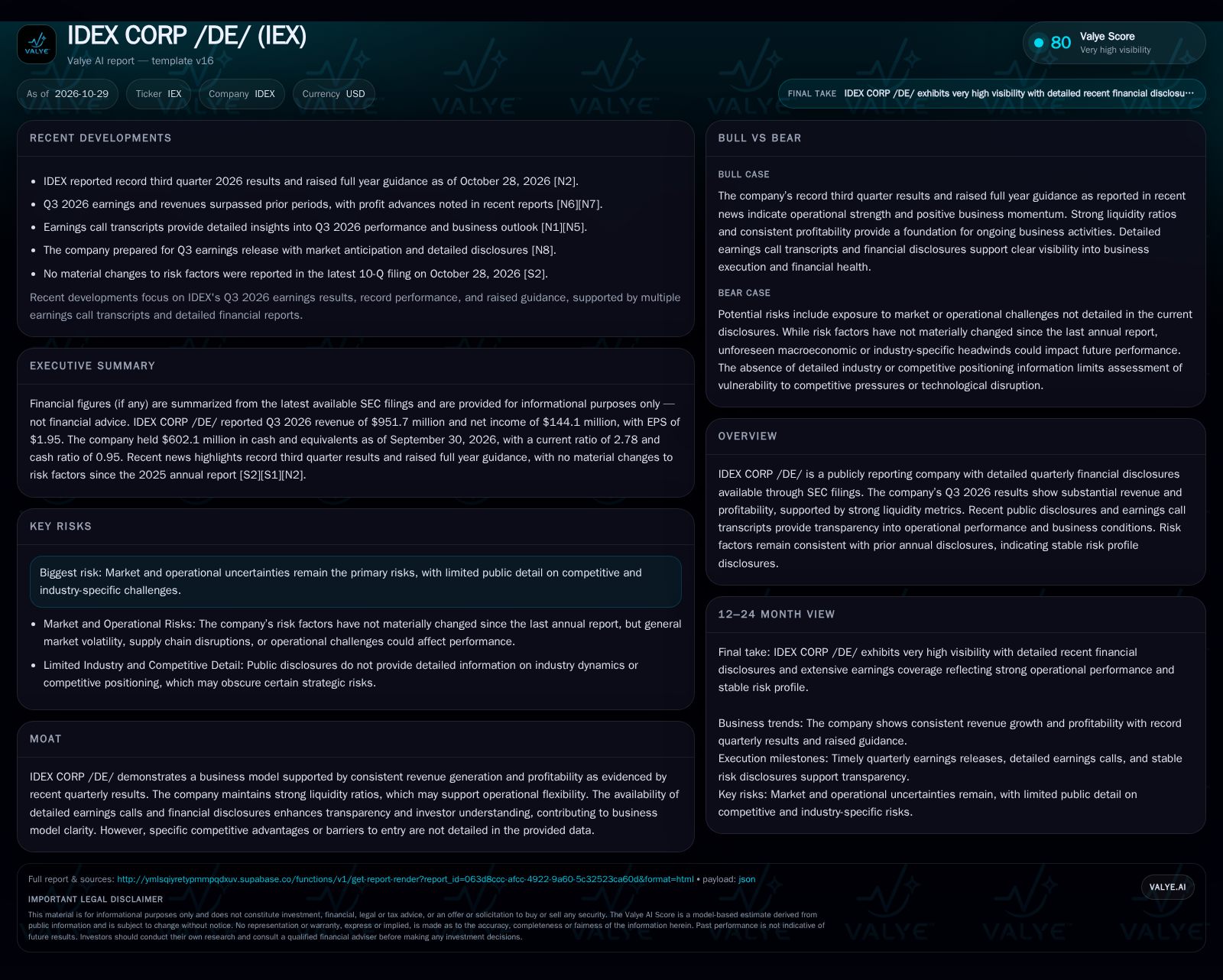
IDEX reported Q3 2026 revenue of $951.7 million and net income of $144.1 million, with both basic and diluted EPS at $1.95 [S2] [N2]. This marks a record quarter for the company, with both earnings and revenues exceeding those of prior periods [N6] [N7]. On the back of these results, IDEX raised its full-year guidance, signaling management’s confidence in the business outlook [N2]. As of September 30, 2026, the company’s cash and cash equivalents totaled $602.1 million, and its current ratio was 2.78, reflecting reported liquidity position [S2]. Importantly, no material changes to risk factors were disclosed in the latest 10-Q, suggesting a stable risk profile [S2]. These developments combine to create a picture of operational momentum and financial stability, but they do not clarify the underlying drivers of growth or the durability of the current performance trajectory.
Evaluating Revenue Quality, Margin Structure, and Financial Leverage
IDEX’s business economics are characterized by its ability to generate substantial quarterly revenue and consistent profitability, as evidenced by its Q3 2026 results [S2]. The company’s model—based on publicly available data—likely involves a mix of engineered products, diversified end markets, and a blend of recurring and project-based sales, which can help smooth revenue volatility. The reported net income margin (approx. 15%) in the latest quarter suggests disciplined cost control and operational leverage, but without segment or product-line disclosures, it is unclear how much margin expansion is driven by mix, pricing, or scale.
The company reported a current ratio of 2.78 for the period. Durable industrial companies often face moderate capital intensity, and future growth could require incremental investment in R&D, capacity expansion, or bolt-on acquisitions. The lack of disclosed segment profitability or granularity on recurring versus transactional revenue makes it difficult to assess the sustainability of current margins. If a significant portion of revenue is tied to aftermarket parts, service, or highly engineered products, this could support higher margins and stickier customer relationships; otherwise, exposure to cyclical capital spending could introduce volatility.
Further insight into IDEX's margin dynamics could be gained by analyzing the company's cost structure sensitivity to raw material price fluctuations and labor costs, which are significant factors in industrial manufacturing. If IDEX has implemented effective hedging strategies or long-term supplier contracts, it could mitigate input cost volatility, supporting stable or expanding margins. Conversely, exposure to commodity price swings without adequate protection could compress profitability during periods of inflationary pressure. Additionally, understanding the fixed versus variable cost composition would clarify operating leverage potential; a higher proportion of fixed costs could amplify earnings growth in expanding markets but also increase risk during downturns.
Assessing Competitive Moats in a Fragmented Industrial Landscape
IDEX’s public disclosures do not specify the company’s competitive positioning or detail its strategic moats. In the diversified industrials sector, defensibility often hinges on proprietary technology, high switching costs, deep customer integration, or brand reputation. The reported financial stability and recurring profitability could indicate some combination of these factors, but without explicit evidence, it remains speculative.
The industrial sector is subject to competition from both multinational conglomerates and specialized niche players. If IDEX’s portfolio includes highly engineered, mission-critical components, it may benefit from customer lock-in and pricing power; conversely, commoditized products or exposure to price-sensitive markets would erode those advantages. Substitution risk is typically moderate for differentiated solutions but can rise if technological innovation or new entrants disrupt established supply chains. The absence of segment or product-line disclosure in recent filings limits the ability to rigorously test the company’s competitive resilience or vulnerability to secular shifts.
The durability of IDEX's competitive position may also depend on its innovation pipeline and ability to adapt to evolving customer requirements. In industrial sectors, continuous product improvement and customization capabilities often underpin long-term customer relationships and pricing power. If IDEX maintains a robust R&D function and a culture of innovation, it could sustain differentiation even amid intensifying competition. However, failure to innovate or respond to technological shifts—such as digitalization or sustainability-driven product demands—might erode its market standing. Moreover, the company's geographic footprint and diversification across end markets could influence its resilience, with broader exposure potentially offsetting localized economic or sectoral downturns.
Sustained Execution and Margin Expansion Could Drive Outperformance
The most favorable scenario for IDEX involves continued operational discipline, margin expansion, and successful capture of growth opportunities in its core markets. If the company’s recent record results are underpinned by durable structural advantages—such as proprietary technology, high-value recurring revenue, or expanding addressable markets—then the raised full-year guidance could prove conservative. Additional upside could come from accretive acquisitions, successful new product launches, or deeper penetration in resilient end markets.
Evidence that would confirm this scenario includes sustained revenue and profit growth above industry averages, rising operating margins, and disclosures indicating a growing mix of recurring or high-margin business. Announcements of strategic partnerships, new technology introductions, or expansion into higher-growth verticals would further support the upside case. Falsification would occur if future quarters show margin compression, revenue stagnation, or increased sensitivity to cyclical downturns.
In addition to operational execution, strategic capital allocation could catalyze outperformance. If IDEX selectively pursues acquisitions that complement its existing capabilities or expand its addressable markets, it could accelerate growth and margin enhancement. Such transactions would need to be accretive without overextending financial leverage, preserving balance sheet strength. Furthermore, leveraging digital transformation initiatives—such as advanced analytics for supply chain optimization or customer engagement platforms—could improve efficiency and unlock new revenue streams. These strategic moves, combined with core execution, would reinforce the company’s competitive moat and support sustained shareholder value creation.
Operational Consistency and Macro Sensitivity Define the Middle Ground
The most plausible trajectory for IDEX is continued operational consistency, with performance tracking close to raised guidance and financial results reflecting a blend of organic execution and end-market demand trends.
Base case falsification would involve either a sudden deterioration in financial metrics—such as a significant drop in revenue or margins—or the emergence of new competitive or operational risks in future disclosures.
Macro Headwinds or Competitive Disruption Could Pressure Growth and Margins
A negative scenario could materialize if IDEX faces unexpected macroeconomic shocks, supply chain disruptions, or intensified competition—especially if its business mix is more cyclical or commoditized than currently visible. Exposure to sectors highly sensitive to capital spending, or loss of key customers, could drive revenue volatility and margin compression.
Confirmation of downside risk would be visible in future quarters through declining revenues, shrinking net income margins, or downward revisions to guidance. Additional warning signs would include new risk disclosures in SEC filings, management commentary highlighting end-market weakness, or evidence of price competition eroding profitability. Conversely, resilience through a downturn or quick recovery from shocks would falsify the worst-case scenario.
Testing IDEX’s Thesis: What Will Reveal Durability and Advantage?
Quarterly revenue and net income trends: Sustained growth or sudden inflection points would indicate the trajectory of demand and execution [S2] [N2].
Evolution of gross and operating margins: Rising margins could signal favorable mix or pricing power, while compression would raise concerns about cost pressures or competition.
Mix of recurring versus transactional revenue (if disclosed): A higher proportion of recurring revenue would support durability; disclosures here would help clarify business model resilience.
Segment or product-line performance (if disclosed): Visibility into which business units are driving growth or lagging would illuminate sources of strength or vulnerability.
Management commentary on end-market demand: Earnings call insights into customer trends, backlog, or order activity would help test the sustainability of current results [N1] [N5].
Capital allocation moves: Announcements of acquisitions, divestitures, or major investments could signal strategic direction and risk appetite.
Updates to risk factors or emergence of new disclosures: Any material change in stated risks could indicate evolving challenges or opportunities [S2].
Disclaimer: This is research-only, informational analysis and not investment advice. It may include AI-generated interpretation and general industry context. Always verify important details using primary sources.

Comments