
W. P. Carey’s Net-Lease Model: Diversification, Lease Durability, and the Changing Landscape of Commercial Real Estate
With a vast, geographically diverse portfolio leased primarily on long-term triple-net terms, W. P. Carey Inc. is positioned at the intersection of stable cash flow and evolving tenant risk. Recent asset sales, robust acquisition activity, and a substantial debt load frame the next phase of its capital allocation and portfolio management strategy.
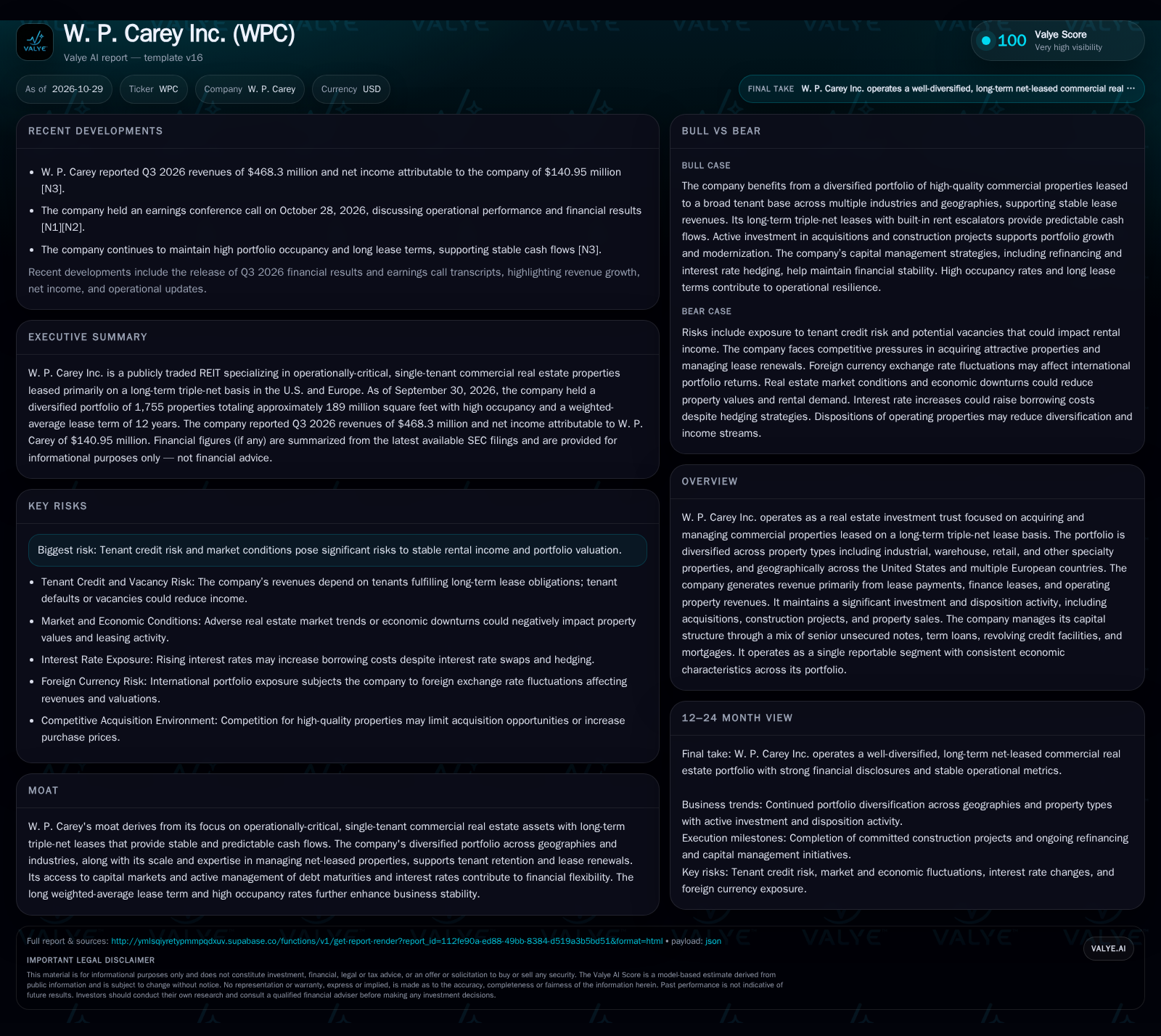
W. P. Carey’s 1,755-property portfolio remains highly occupied and diversified, with long lease terms supporting stable rental income. Recent financial results show solid revenue and net income growth, while ongoing property acquisitions and dispositions reflect a strategy of active portfolio management. The company’s significant debt obligations and exposure to tenant credit and market cycles will test the resilience of its net-lease model as macro and competitive pressures evolve. [S2] [N3]
W. P. Carey Inc. stands out among net-lease REITs for its scale, geographic reach, and active portfolio management. As of September 2026, the company’s 1,755-property portfolio boasts high occupancy, lengthy average lease terms, and broad tenant and sector diversification. Recent quarters have seen strong financial results and continued transactional activity, including both acquisitions and strategic property sales. However, the company’s sizable debt load and exposure to tenant risk and global economic cycles highlight the importance of disciplined capital management and ongoing tenant underwriting as the real estate landscape evolves.
Recent Portfolio Moves and Financial Performance Shape the Strategic Backdrop
As of September 30, 2026, W. P. Carey’s portfolio comprised 1,755 properties totaling about 189 million square feet, with a weighted-average lease term of 12 years and an occupancy rate of 98.6% [S2]. This high occupancy and long lease duration underpin the company’s recurring cash flow profile.
In 2025, the company executed $2.0 billion in acquisitions and disposed of 128 properties for $1.5 billion, actively recycling capital and refining portfolio composition [S1].
Q3 2026 results show total revenues of $468.3 million and net income of $140.95 million, reflecting continued growth and margin stability [S2] [N3].
On the liability side, debt obligations stood at $8.78 billion, with refinancing and interest rate swaps deployed to manage interest expense and maturity risk [S2].
Triple-Net Lease Economics: Predictable Revenue, but Capital-Intensive Growth
W. P. Carey’s core business model relies on owning operationally-critical commercial assets and leasing them on long-term triple-net terms. Under this structure, tenants are responsible for taxes, insurance, and maintenance, shifting property-level operating risk away from W. P. Carey and stabilizing its cash flows. This enables leaner overhead and less variable expense exposure compared to multi-tenant or gross lease models.
Revenue is derived primarily from base rents, supplemented by finance lease income and lease-related fees. The company’s long lease durations and contractual rent escalators provide visibility into future cash flows, but they also tie cash flow growth to lease structuring and the creditworthiness of tenants rather than direct market rent appreciation.
The capital intensity of growth is significant: property acquisitions require substantial upfront capital, often funded through a mix of debt and equity. Dispositions recycle capital, but successful reinvestment is required to avoid dilution or cash flow erosion. Leverage amplifies returns but increases sensitivity to interest rates and refinancing windows.
Operating leverage is limited by the net-lease structure, as most costs are fixed and incremental revenue from new acquisitions is offset by higher capital needs. Thus, sustainable FFO (funds from operations) growth depends on disciplined capital allocation, effective tenant underwriting, and the ability to source accretive deals in a competitive market.
Diversification, Scale, and the Competitive Net-Lease Landscape
W. P. Carey’s geographic and sector diversification—61% of annualized base rent from the U.S. and 39% from international markets—provides insulation from localized economic shocks, but also introduces foreign currency exposure and varying regulatory environments [S1]. The company’s tenant base spans industries from industrial and warehouse to retail, pharmaceuticals, and education, reducing reliance on any single sector or tenant.
In the competitive landscape, peers include both U.S.-focused and global net-lease REITs as well as private real estate funds targeting similar assets. Competition for high-quality, operationally critical single-tenant assets remains intense, often driving up acquisition prices and compressing cap rates. The ability to underwrite non-standard or cross-border leases and execute large-scale transactions is a potential advantage, but also requires deep market knowledge and risk discipline.
Substitution risk is most acute in sectors facing secular challenges (e.g., brick-and-mortar retail), or where tenants may shift toward owned rather than leased real estate. However, the mission-critical nature of many leased assets and long lease terms typically create switching frictions for tenants, supporting retention and renewal rates if tenant health is maintained.
Accretive Reinvestment and Tenant Stability Drive Compounding Cash Flows
The most favorable scenario for W. P. Carey involves stable or improving tenant credit, allowing for high renewal rates and minimal rent concessions. Successful reinvestment of disposition proceeds into higher-yielding or strategically important assets could drive incremental cash flow growth. A benign or declining interest rate environment would reduce debt service costs and potentially boost acquisition capacity.
Further upside could come from capturing market rent growth on lease rollovers, especially in industrial and logistics assets where demand remains robust. If W. P. Carey is able to consistently source accretive deals despite competition, operating scale and cost discipline could translate into higher FFO and dividend growth.
Evidence for this scenario would include sustained high occupancy, rising same-property net operating income, accretive acquisitions with above-average cap rates, and tenant lists remaining weighted toward investment-grade or strongly performing credits.
Active Portfolio Management Anchors Steady Returns Amid Macro Volatility
The most plausible trajectory for W. P. Carey is continued execution of its core strategy: maintaining high occupancy and long lease terms, recycling capital through acquisitions and dispositions, and incrementally growing FFO through disciplined underwriting. Rent escalators and contractual protections should support modest cash flow growth, while active refinancing and hedging manage interest expense.
Periodic tenant issues or localized market softness may cause episodic vacancies or rent concessions, but broad diversification and careful tenant selection are likely to limit severe disruptions. Foreign currency fluctuations may introduce some earnings volatility, but the overall impact is buffered by the company’s international experience and hedging tools.
This scenario would be confirmed by stable or gradually rising revenue and FFO per share, continued high occupancy and lease duration metrics, and a tenant roster with limited concentration risk or downgrades.
Tenant Defaults and Capital Market Tightening Stress the Net-Lease Model
A more adverse scenario could materialize if tenant credit deteriorates, leading to a spike in vacancies or rent collections issues. Exposure to sectors under structural pressure or to tenants whose business models are disrupted (e.g., non-essential retail or financially stressed industrials) would expose W. P. Carey to cash flow interruptions and potential write-downs.
On the capital side, a sustained rise in interest rates or a tightening in credit markets would increase debt service costs and potentially limit the company’s ability to refinance or fund new acquisitions on attractive terms. If asset values fall, disposition proceeds could shrink and leverage ratios might rise, pressuring both balance sheet flexibility and dividend coverage.
Confirmation of this scenario would include a rising vacancy rate, declining occupancy, tenant bankruptcies or major rent concessions, negative same-property NOI growth, and difficulty in accessing affordable debt or equity capital.
Testing the Resilience of W. P. Carey’s Net-Lease Strategy: What Needs to Hold, Shift, or Improve
Sustained occupancy rates at or above 97% would support the thesis of cash flow stability; any sustained decline would challenge it.
Weighted-average lease term: maintenance of 10+ years would indicate ongoing lease durability and tenant retention.
Tenant concentration: monitoring the share of ABR from top tenants and any credit rating downgrades or financial distress would help test tenant risk assumptions.
Portfolio allocation by property type and geography: shifts in mix (e.g., increased exposure to challenged retail or weaker international regions) would be meaningful.
Same-property net operating income (NOI) growth, if disclosed, would clarify the organic cash flow trajectory.
Acquisition and disposition cap rates: trends in these rates would signal the company’s ability to source accretive deals in a competitive market.
Average interest rate on debt and refinancing activity: rising costs or constrained access would indicate capital market risk.
Foreign currency impact: tracking the effect of FX translation on reported earnings and ABR would help gauge the volatility of international exposure.
Disclaimer: This is research-only, informational analysis and not investment advice. It may include AI-generated interpretation and general industry context. Always verify important details using primary sources.

Comments