
NewHydrogen’s ThermoLoop™ Ambition: Cost Disruption, Technical Hurdles, and the Green Hydrogen Commercialization Race
NewHydrogen, Inc. is betting on a proprietary thermochemical process—ThermoLoop™—to slash the cost of green hydrogen by using heat instead of electricity. While the company’s intellectual property position and university partnership offer a path to differentiation, the absence of commercial traction, ongoing losses, and a crowded field of competitors underscore the challenge of moving from lab to market.
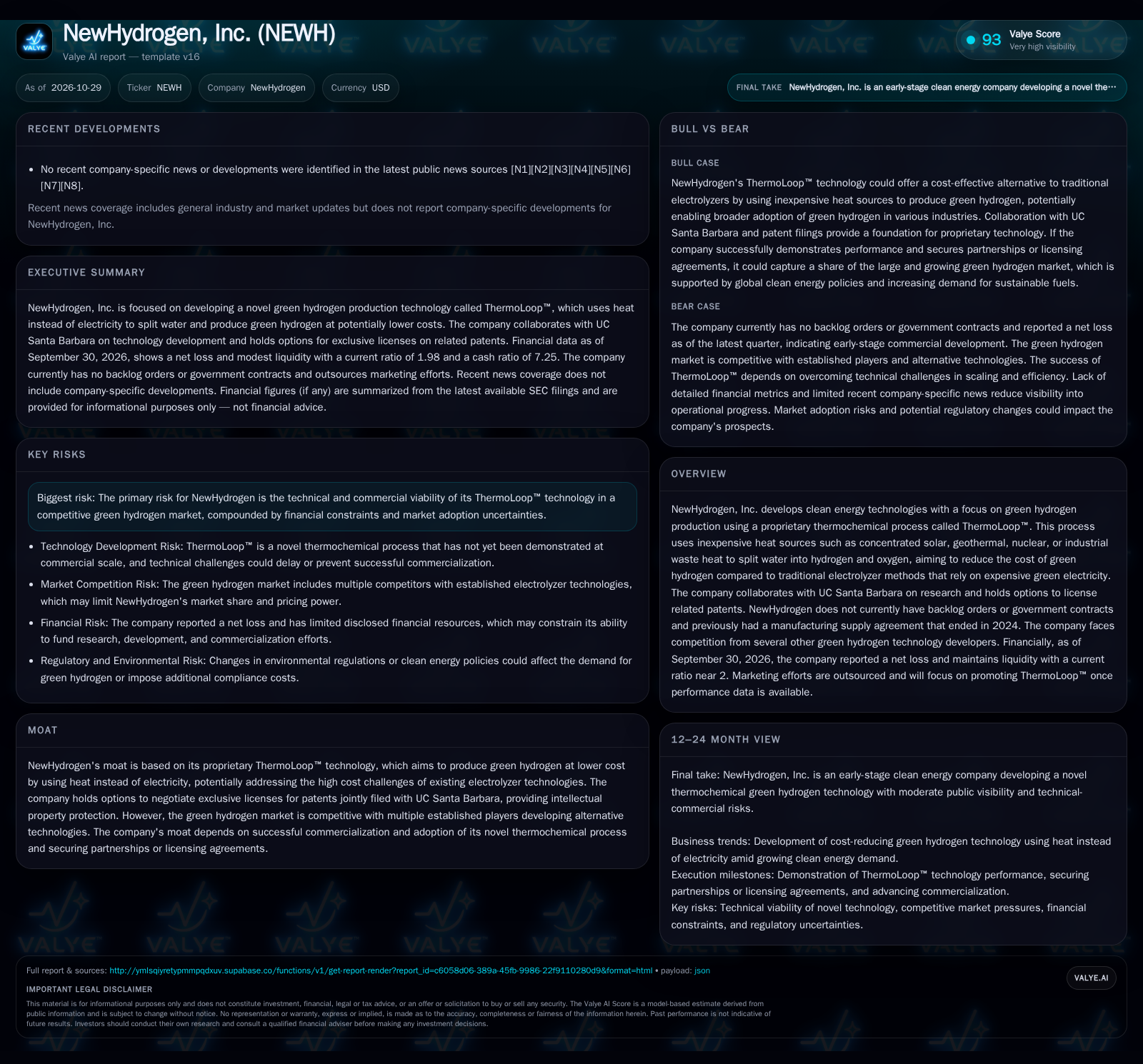
NewHydrogen is developing ThermoLoop™, a novel process targeting lower-cost green hydrogen production by substituting inexpensive heat for costly electricity. The company’s progress hinges on demonstrating technical viability, securing partnerships, and overcoming competitive and financial constraints, with no current orders or contracts in place. Near-term milestones include performance validation and commercial agreements, but risks remain substantial due to unproven scale, market adoption uncertainty, and ongoing losses. [S1] [S2]
NewHydrogen, Inc. aims to challenge the economics of green hydrogen with ThermoLoop™, a proprietary thermochemical process that uses cheap heat rather than expensive electricity to split water and generate hydrogen. This approach targets the single largest cost barrier in green hydrogen production, potentially unlocking new applications across transportation, industry, and power. However, the company remains pre-commercial, with no current orders or contracts, ongoing losses, and a need to demonstrate both technical viability and scalable economics. Its ability to transition from research partner to commercial disruptor will hinge on overcoming technical, financial, and competitive headwinds in a rapidly evolving energy landscape. [S1] [S2]
What NewHydrogen’s Latest Financials and Partnerships Reveal About Its Position
As of September 30, 2026, NewHydrogen reported a cash balance of $1.31 million, current assets of $357,083, and current liabilities of $180,055, producing a current ratio of 1.98 and a cash ratio of 7.25. The company posted a net loss of $872,564 for the period and had no backlog orders or government contracts in place. [S2] Its ThermoLoop™ technology is being developed in collaboration with UC Santa Barbara, with options to negotiate exclusive licenses for related patents. [S1] The company’s previous manufacturing supply agreement ended in 2024, and no new commercial agreements have been announced. [S1] These facts position NewHydrogen as a pre-revenue, early-stage technology developer with reported liquidity position, an academic R&D anchor, and no visible commercial validation to date.
ThermoLoop™ and the Economics of Green Hydrogen: Where Cost Disruption Could Emerge
Green hydrogen’s largest cost driver is electricity, which can account for over 70% of production costs using conventional electrolysis. ThermoLoop™ targets this pain point by using heat—sourced from solar, geothermal, nuclear, or industrial waste—to drive a chemical looping process at sub-1000°C industrial temperatures. If successful, this could dramatically lower variable costs and enable production at sites with abundant heat but limited cheap electricity.
The business model for a novel hydrogen production technology typically hinges on one of three paths: direct equipment sales/licensing, joint ventures with industrial offtakers, or technology royalties. Without disclosed commercial mechanics, it is plausible that NewHydrogen could pursue licensing or partnership models, leveraging its IP portfolio and university collaboration to attract established hydrogen producers or industrial users. If ThermoLoop™ proves scalable and cost-competitive, it could support attractive margins due to lower input costs and potential IP-driven pricing power. However, significant capital will likely be needed for pilot demonstrations, scale-up, and commercial deployment, and current cash resources are insufficient for large-scale execution.
Operating leverage may be high if ThermoLoop™ transitions to licensing or royalty-based economics after initial R&D and demonstration expenses, but fixed costs related to ongoing R&D and the need for proof-of-concept pilots could weigh on near-term profitability. Funding needs will remain acute until either validation or commercial traction is achieved.
How NewHydrogen Stacks Up in a Crowded and Rapidly Advancing Hydrogen Market
NewHydrogen competes with a range of established and emerging players targeting green hydrogen, including ITM Power, Clean Power Hydrogen Group, Sunfire, Greenway Energy, Amalyst, and AFC Energy. Most competitors focus on electrolyzer technologies, some with proprietary catalysts or systems integration. ThermoLoop™ is differentiated by its thermochemical approach, which—if proven—could sidestep the scalability and electricity cost bottlenecks facing electrolysis.
However, the competitive moat is not yet established. NewHydrogen’s current edge rests on unproven process IP and its university partnership. The lack of commercial pilots, customer relationships, or government contracts leaves it vulnerable to better-funded or faster-moving peers. Moreover, established players may have an advantage in regulatory navigation, project financing, and integration into existing industrial infrastructure.
Technology substitution risk is real: improvements in electrolyzer efficiency, cheaper renewable electricity, or alternative hydrogen vectors (e.g., methane pyrolysis) could erode ThermoLoop™’s potential cost advantage. Its ultimate defensibility will depend on successful IP protection, demonstrable efficiency/cost gains, and the ability to secure anchor customers or partners before competitors lock up the market.
A Path to Disruption: What It Would Take for ThermoLoop™ to Redefine Green Hydrogen Economics
The most favorable scenario for NewHydrogen involves successful demonstration of ThermoLoop™ at pilot scale, validating both technical efficiency and cost advantages over electrolysis. This could trigger industry and government interest, leading to partnerships, licensing deals, or joint ventures with industrial hydrogen users or infrastructure developers. If ThermoLoop™ delivers on promised cost savings, early adopters in price-sensitive sectors (e.g., ammonia, steel, refining) could provide reference projects and recurring royalty/licensing income.
Confirmation would come from announced pilot projects, performance data showing significant cost reductions versus electrolyzers, and the signing of commercial development or licensing agreements. Additional validating evidence would include government grants, anchor offtake agreements, or third-party technical endorsements. Falsification would occur if pilot demonstrations fail to show material cost or efficiency gains, or if competitors launch superior solutions with faster market uptake.
From Lab to Market: Most Likely Next Steps for NewHydrogen
The most plausible near-term trajectory is continued R&D and pilot development, with NewHydrogen seeking additional funding to bridge the gap to commercial demonstration. The company may pursue further non-dilutive grants, research partnerships, or small-scale pilot collaborations, while refining ThermoLoop™’s process and beginning limited promotional efforts once performance data is available. Commercial agreements or significant revenue are unlikely until technical validation is achieved.
This scenario would be confirmed by incremental technical updates, patent filings, or university-led feasibility studies, alongside modest increases in R&D spend and possibly small equity raises. Falsification would be indicated by extended delays in performance disclosure, failure to secure new funding, or the loss of research partnerships.
Where the Risks Concentrate: If ThermoLoop™ Fails to Scale or the Market Moves On
An adverse scenario results if ThermoLoop™ encounters insurmountable technical barriers—such as stability issues at scale, prohibitive capital costs, or inferior efficiency compared to next-generation electrolyzers. Without commercial proof points or new partners, NewHydrogen could exhaust its limited cash, forcing cutbacks or a pivot away from core technology development.
Downside confirmation would include the absence of pilot data or third-party validation, continued net losses without new funding, the departure of key research partners, or the emergence of alternative technologies that undercut ThermoLoop™’s value proposition. Regulatory changes that reduce incentives for green hydrogen or shift support toward other clean fuels could also accelerate downside outcomes.
Milestones That Will Determine Whether NewHydrogen Can Move Beyond R&D
Public disclosure of ThermoLoop™ pilot or demonstration project results, particularly cost and efficiency metrics versus conventional electrolyzers.
Announcements of commercial or government partnerships, licensing agreements, or anchor customers for ThermoLoop™ technology.
Updates on patent issuance, exclusivity terms, or expansion of IP coverage related to the core thermochemical process.
R&D progress metrics, such as published peer-reviewed studies, technical milestones, or university collaboration renewals.
Evidence of additional funding—either non-dilutive grants, equity raises, or strategic investments—to support ongoing development.
Changes in the competitive landscape, including the launch of rival low-cost hydrogen technologies or major breakthroughs by established players.
If disclosed, manufacturing or supply chain agreements that would enable scale-up and commercial readiness.
Regulatory or policy developments that incentivize thermochemical hydrogen production or alter the economics of competing green hydrogen pathways.
Disclaimer: This is research-only, informational analysis and not investment advice. It may include AI-generated interpretation and general industry context. Always verify important details using primary sources.

Comments