
KKR Real Estate Finance Trust: Navigating Strategic Uncertainty and CRE Credit Cycles
KKR Real Estate Finance Trust (KREF) faces a pivotal period marked by ongoing strategic review, persistent earnings volatility, and the challenges of a shifting commercial real estate (CRE) environment. Its floating-rate, senior loan portfolio and deep KKR affiliation offer structural advantages, but recent book value declines and credit headwinds underscore the need for adaptive risk management and decisive strategic action.
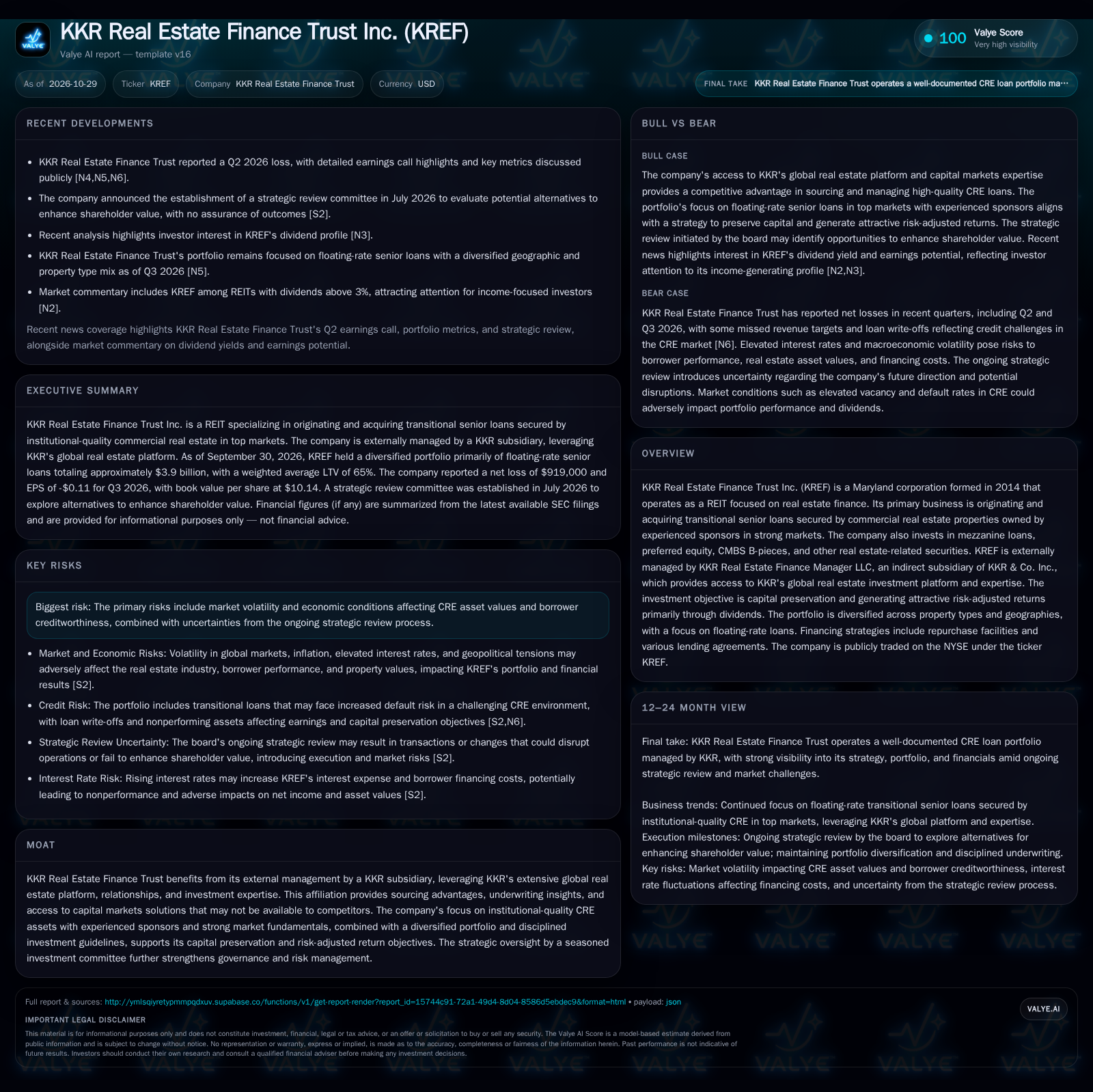
KREF’s $3.9B CRE loan portfolio—anchored by floating-rate senior loans and managed with KKR’s institutional resources—is experiencing earnings volatility, portfolio markdowns, and strategic uncertainty. The company’s board-initiated strategic review may drive significant change, but persistent credit and market risks complicate the outlook. The next phase hinges on portfolio performance, CRE market stabilization, and the outcome of strategic alternatives exploration. [S2]
KKR Real Estate Finance Trust stands at a crossroads. Its $3.9 billion loan portfolio—a mix of transitional senior loans, mezzanine debt, and other real estate securities—anchors the REIT’s strategy of capital preservation and dividend generation. Yet, as credit losses, book value attrition, and sectoral stress mount, KREF’s board has launched a strategic review to consider possible structural changes. With much of its income tied to floating-rate loans and the broader CRE market facing persistent turbulence, the company’s next moves will likely shape both its risk profile and its ability to deliver for shareholders.
Strategic Review and Book Value Decline Drive an Inflection Point
As of September 30, 2026, KKR Real Estate Finance Trust reported a $919,000 net loss and a basic and diluted EPS of -$0.11 for the quarter. Book value per share fell to $10.14, down from $13.04 at year-end 2025, reflecting portfolio markdowns and the impact of credit losses and repayments in a volatile CRE market. The board’s establishment of a strategic review committee in July 2026 signals openness to significant change, including potential asset sales, mergers, or other corporate actions, though no specific transaction is assured. KREF’s $3.9 billion loan portfolio remains diversified by property type and geography, with a focus on floating-rate senior loans (weighted average coupon 6.7%) and a weighted average LTV of 65%. These developments mark a period of heightened uncertainty and potential transition for the company. [S2]
Earnings Volatility and the Mechanics of CRE Lending
KREF’s core business is the origination and acquisition of transitional senior loans secured by institutional-quality CRE. The company earns interest income—predominantly on floating-rate terms—providing some protection in a rising rate environment, but also exposing borrowers to higher debt service costs and potential credit deterioration. Most loans are senior in the capital stack, with multifamily and industrial assets comprising the majority exposure, and a weighted average LTV of 65% helping to mitigate loss severity in default scenarios. The all-in yield of 7.0% as of Q3 2026 reflects both base rates and credit spreads.
Operating leverage is driven by the spread between loan yields and funding costs, with KREF utilizing repurchase facilities, collateralized loan obligations, and other forms of leverage. The business is capital-intensive, requiring careful liquidity management—evidenced by $165.9 million in cash as of September 30, 2026—and ongoing access to wholesale funding. Recent net losses and book value declines highlight the risk that credit losses, loan write-offs, and asset markdowns can quickly erode equity. Dividend capacity is directly tied to distributable earnings, which have been pressured by loan performance and higher funding costs. [S2]
Externally managed by a KKR affiliate, KREF leverages institutional underwriting, sourcing, and portfolio management expertise, but its fee structure may limit operating margin expansion if portfolio performance falters.
KKR Affiliation: Sourcing Edge Amid CRE Market Stress
KREF’s external management by a KKR subsidiary offers tangible advantages: access to a deep pipeline of CRE opportunities, the ability to underwrite complex transitional loans, and capital markets execution that smaller or standalone REITs may lack. This sourcing edge and underwriting discipline are particularly valuable in a market where liquidity is selective and credit risk is elevated.
However, structural advantages do not eliminate exposure to macroeconomic headwinds. The CRE finance landscape is crowded, with competition from other mortgage REITs, private credit funds, and banks—many of which are also tightening standards or seeking to offload risk. Substitution risk arises from direct lending platforms and non-bank lenders, especially as technology and data-driven underwriting improve. KREF’s focus on institutional-quality sponsors and top-tier properties provides some defense, but sectorwide stress—rising vacancy rates, declining valuations, and refinancing challenges—remains a persistent threat to both asset quality and loan demand.
Strategic Actions or CRE Recovery Unlock Shareholder Value
A favorable outcome for KREF could be catalyzed by one of two mechanisms: a successful strategic transaction (such as a sale, merger, or material asset disposition) that realizes value above current book, or a stabilization and recovery in the CRE market that drives improved loan performance and earnings. The strategic review, if it leads to a premium transaction or operational reset, could narrow the gap between book value and market price, or position the company for more efficient scale and capital deployment.
Confirmation would come from sequential improvements in portfolio risk ratings, reduced loan write-offs, and visible dividend coverage. Evidence of renewed loan origination activity at attractive spreads, or successful refinancing of maturing debt, would further support the upside case. [S2]
Portfolio Resilience Tested by Prolonged CRE Headwinds
The most plausible trajectory is one of continued earnings and book value volatility as KREF manages through a slow normalization of CRE markets. The company is likely to prioritize credit preservation, incremental portfolio repositioning, and careful liquidity management while the board’s strategic review plays out. Modest loan origination may resume if market spreads compensate for elevated credit risk, but repayments and asset sales could suppress portfolio growth in the near term.
Dividend payments may remain under pressure, reflecting both distributable earnings constraints and the need to preserve capital. Confirmation of this scenario would be stable or slightly improving risk ratings, a gradual reduction in nonperforming loans, and muted net loan growth. Lack of a decisive outcome from the strategic review, or only incremental operational changes, would further support this base case. [S2]
Credit Deterioration and Strategic Uncertainty Compound Losses
The adverse scenario is driven by worsening CRE fundamentals—rising borrower defaults, declining property values, and higher funding costs—leading to additional loan write-offs, further book value erosion, and potential dividend suspension. If refinancing markets remain tight and property cash flows deteriorate, KREF could face asset liquidations at discounts to book, compounding losses.
Strategic review outcomes could also turn negative if no attractive alternatives emerge, or if a distressed sale or restructuring is required. Signs of this scenario would include a spike in nonperforming assets, sequential increases in loan loss provisions, a material drop in book value per share, or a reduction or suspension of the dividend. Prolonged market illiquidity or adverse regulatory/tax changes could further exacerbate downside risks. [S2]
What Will Define KREF’s Next Chapter: Shareholder Value, Credit Quality, and Strategic Outcomes
Sequential trends in book value per share and the magnitude of quarterly loan loss provisions or asset markdowns.
Portfolio risk ratings and movement in nonperforming or watchlist loans, if disclosed, to assess credit quality trajectory.
Net loan origination and repayment activity, indicating whether portfolio growth or contraction is underway.
Leverage levels and refinancing of short-term debt or repurchase facilities, reflecting funding stability.
CRE market fundamentals—especially in multifamily and industrial sectors, which comprise 57% of the portfolio—and external indicators of property value recovery or further stress.
Disclaimer: This is research-only, informational analysis and not investment advice. It may include AI-generated interpretation and general industry context. Always verify important details using primary sources.

Comments