
Jushi Holdings at a Regulatory and Financial Crossroad in the U.S. Cannabis Market
Jushi Holdings faces a pivotal moment as partial federal rescheduling of medical cannabis products alters its tax landscape, but persistent net losses, tight liquidity, and the complex transition to adult-use markets like Virginia test its ability to capitalize on regulatory changes.
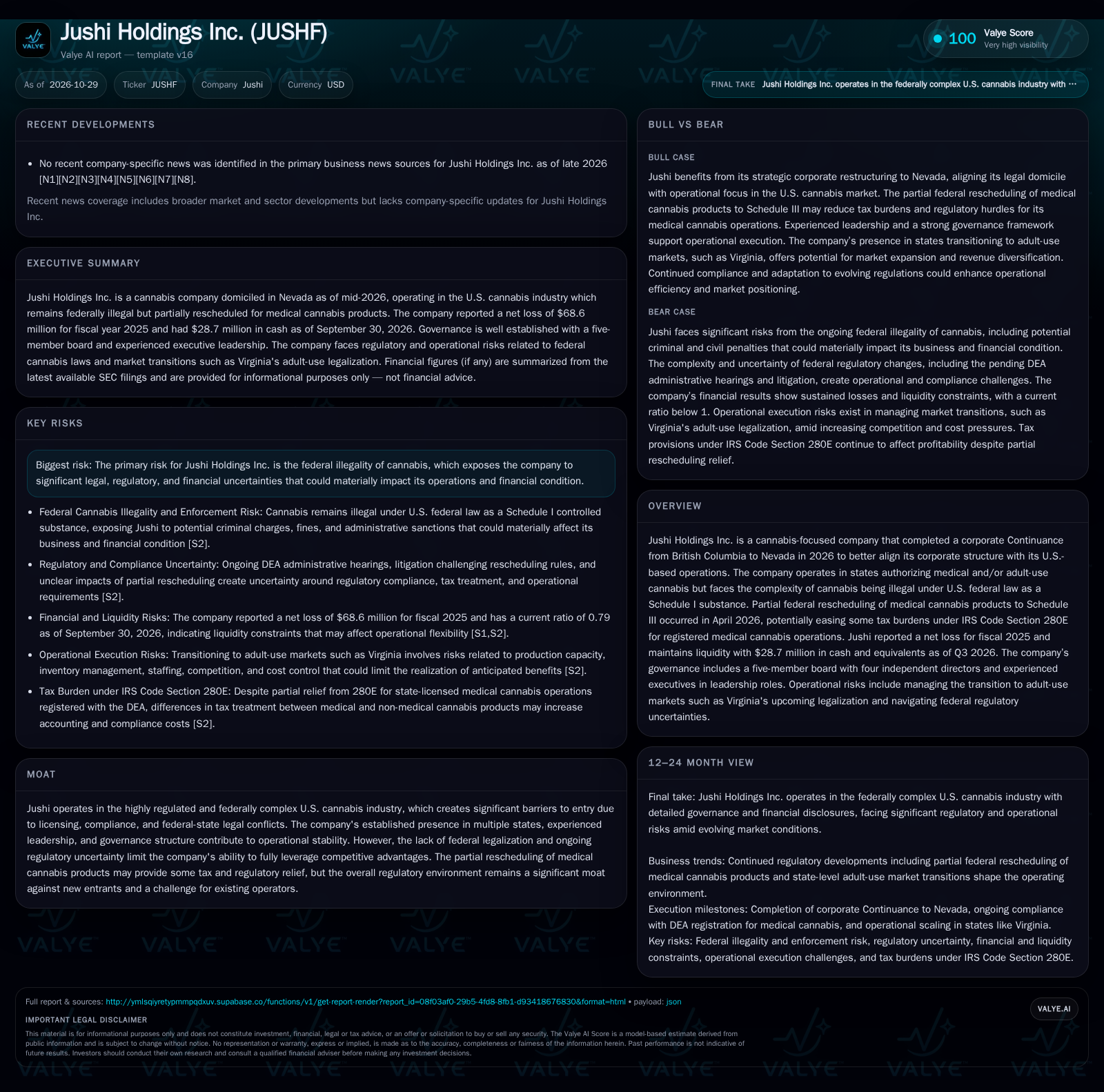
Jushi Holdings operates exclusively in the U.S. cannabis sector, contending with ongoing federal illegality but recently benefitting from partial rescheduling of medical products to Schedule III, which may ease some tax burdens. Despite experienced governance and leadership, the company reported a net loss of $68.6 million in 2025 and remains in a liquidity-constrained position as of Q3 2026, with a current ratio of 0.79. Operational risks loom large as Jushi prepares for Virginia’s adult-use market opening in 2027, making execution and regulatory adaptation the critical tests ahead. [S1] [S2]
Jushi Holdings Inc. stands at the intersection of regulatory flux and operational challenge in the U.S. cannabis sector. The company’s recent transition of corporate domicile to Nevada reflects its strategic focus on U.S. markets, just as federal authorities partially reschedule medical cannabis products, offering potential tax relief for parts of its business.
2026 Outlook Shaped by Regulatory Changes and Financial Performance
Jushi Holdings’ 2026 operating context is shaped by two material developments: the partial rescheduling of FDA-approved and state-licensed medical cannabis products to Schedule III by the DEA in April, and the company’s financial position as of Q3 2026. The regulatory change potentially relieves registered medical cannabis operations from the full burden of IRS Code Section 280E, offering a path to improved after-tax margins for DEA-registered products. However, this relief is limited—adult-use (recreational) cannabis and non-registered medical products remain subject to the old tax regime, preserving much of the legacy cost structure. [S1] [S2]
Operationally, Jushi faces a pivotal transition as Virginia prepares for adult-use cannabis legalization in July 2027, presenting both a growth catalyst and a test of the company’s ability to scale production, manage inventory, and compete effectively. The company’s governance structure remains robust, with a five-member board and leadership experienced in finance and consumer sectors, but the regulatory and financial pressures are likely to dominate strategic priorities in the coming quarters. [S1] [S2]
Tax Structures, Operational Efficiency, and Capital Needs in Cannabis
Jushi’s business model is fundamentally shaped by the unique economics of U.S. cannabis: high regulatory costs, fragmented state-by-state markets, and a federal tax regime that often suppresses after-tax profitability. The partial shift of medical cannabis to Schedule III status could allow DEA-registered medical operations to deduct ordinary business expenses, potentially boosting operating margins for those lines. However, most adult-use sales—which are typically higher-margin and higher-volume in mature markets—remain subject to Section 280E, keeping effective tax rates elevated.
Fixed costs in the industry are substantial: licensing, compliance, security, and real estate requirements are non-negotiable, while variable costs (cultivation, processing, retail labor) scale with volume. This structure means that incremental revenue from market expansion (e.g., Virginia’s adult-use opening) could drive significant operating leverage, but only if Jushi manages inventory, staffing, and competitive pricing effectively. Absent rapid cash flow improvement or new financing, capital constraints could force prioritization of core markets or limit responsiveness to unexpected regulatory or demand shocks. [S2]
State-Level Market Dynamics: Entry Barriers and Competitive Pressures
Jushi operates in a sector with high regulatory barriers to entry—licenses are scarce, compliance is costly, and federal-state legal contradictions deter many potential entrants. These structural hurdles confer some protection for established operators, but also limit market fluidity and raise the stakes for operational missteps. Within each state, competition comes from other vertically integrated multi-state operators (MSOs), local incumbents, and in some markets, illicit suppliers who can undercut prices due to lower regulatory burdens.
The partial rescheduling of medical cannabis products could strengthen Jushi’s position in medical-only markets by improving cost competitiveness, but the advantage is muted where adult-use dominates. In states transitioning to adult-use, the competitive landscape often shifts rapidly as new licenses are issued and existing operators scale aggressively. Substitution threats remain: traditional pharmaceutical products, illicit market channels, and in some cases, alternative wellness or recreational products. Jushi’s competitive edge will depend on its ability to secure prime retail locations, manage supply chains, and adapt to evolving consumer preferences while maintaining compliance.
Margin Improvement through Regulatory Advances and Adult-Use Growth
The most favorable scenario for Jushi involves a successful pivot to capitalize on regulatory developments and state-level market transitions. If Jushi rapidly registers its medical operations with the DEA and captures the full tax benefit of Schedule III rescheduling, it could see material improvement in after-tax cash flow from its medical segment. Simultaneously, if the company executes a smooth operational ramp in Virginia—scaling production, optimizing inventory, and capturing early share as adult-use sales begin—it could drive significant revenue growth and operating leverage.
Confirmation of this scenario would come from sequential improvement in operating margins, lower effective tax rates on medical sales, and evidence of strong initial market share in Virginia post-legalization. Additional signs would include expansion of cash reserves, a current ratio moving toward or above 1, and positive operating cash flow. Falsification would be indicated by continued losses, operational setbacks in new markets, or inability to realize tax benefits due to compliance or registration delays.
Navigating Limited Regulatory Progress with Ongoing Execution Challenges
The most plausible path for Jushi is one of incremental adaptation: partial tax relief is realized in medical lines, providing modest improvement to cash generation, but adult-use operations—remaining under the 280E regime—continue to weigh on overall profitability. The company manages to participate in Virginia’s adult-use rollout but faces margin pressure due to elevated costs, competitive pricing, and the need to ramp up production and retail infrastructure within capital constraints.
This scenario is confirmed by gradual narrowing of net losses, stabilization of cash balances, and modest improvements in current ratio, but not a return to robust profitability. Evidence of operational discipline in inventory and cost management, as well as retention of market share in core states, would further support this outcome. Falsification would occur if regulatory setbacks, cost overruns, or competitive displacement in key markets drive renewed financial stress or force retrenchment.
Heightened Downside Risks from Regulatory Delays and Financial Pressures
In a negative scenario, Jushi is unable to meaningfully benefit from Schedule III rescheduling—due to regulatory delays, limited DEA registration, or IRS challenges—leaving its tax burden largely unchanged. Simultaneously, execution missteps or intensified competition in Virginia and other states erode market share and compress margins, while persistent net losses and a sub-1 current ratio force asset sales, retrenchment, or dilutive capital raises.
Falsification would require sustained stabilization or improvement in liquidity, successful operational execution in new markets, and evidence of realized tax relief from regulatory changes.
Assessing Jushi’s Progress Within a Complex Regulatory Environment
Quarterly changes in current and cash ratios, as well as operating cash flow, to assess potential financial flexibility and near-term solvency—especially as Virginia’s adult-use market opens. [S2]
Disclosure of DEA registration status and realized tax impact for medical cannabis operations—would confirm the ability to benefit from Schedule III rescheduling. [S2]
Revenue and gross margin trends in Virginia and other states entering adult-use—would indicate successful scaling and competitive positioning.
Operating expense control and inventory turnover metrics—if disclosed—would help evaluate efficiency and execution risk as production ramps.
Market share retention or gains in core medical and adult-use states—a useful metric would be state-level sales growth relative to market benchmarks.
Updates on regulatory developments, including further DEA or IRS guidance on Schedule III implementation and any federal enforcement actions affecting state-licensed operators.
Capital-raising activity, debt maturities, or asset sales—would signal stress or, if proactive, a strategic effort to shore up liquidity.
Management commentary or board disclosures regarding risk appetite, strategic priorities, and responses to evolving regulatory and market conditions.
Disclaimer: This is research-only, informational analysis and not investment advice. It may include AI-generated interpretation and general industry context. Always verify important details using primary sources.

Comments