
MiMedx’s Strategic Shift: Restructuring, Acquisition, and Advancing Wound Care Innovation
MiMedx Group’s Q3 2026 snapshot highlights a pivotal phase defined by operational restructuring, a major acquisition attempt, and product licensing activity.
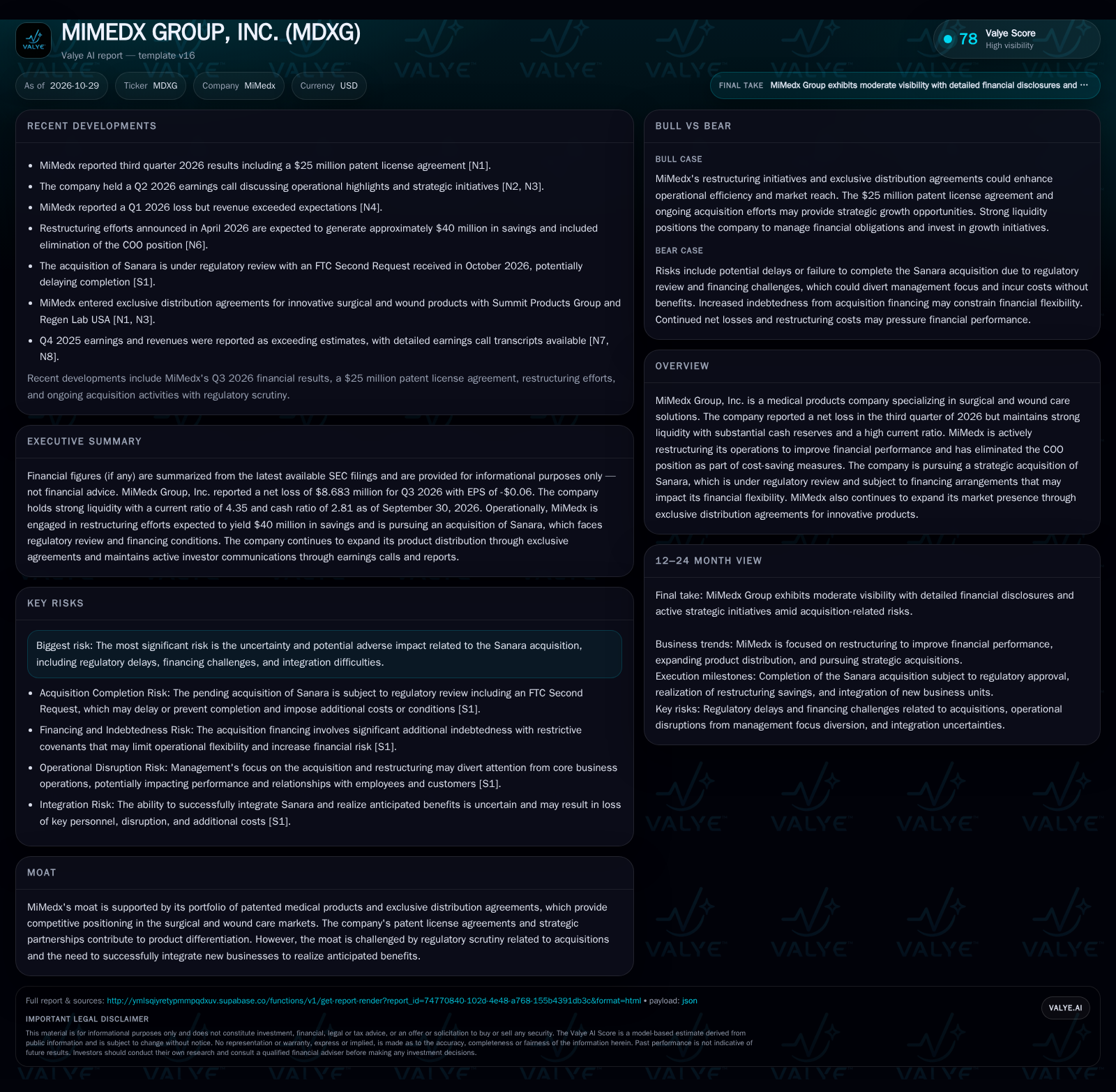
MiMedx reported a Q3 2026 net loss of $8.7 million but maintains a high cash balance and current ratio. The company is restructuring for $40 million in savings, pursuing the acquisition of Sanara under FTC review, and struck a $25 million patent license agreement. Exclusive distribution partnerships broaden its product reach, but increased leverage and integration risks from the acquisition could challenge execution [S1] [N1] [N6].
MiMedx Group, Inc. stands at a strategic crossroads in late 2026. While the company reported a quarterly net loss and continues to operate in the red, it has moved aggressively to reshape its cost structure and pursue new growth avenues. The planned acquisition of Sanara—now under close regulatory scrutiny—could redefine MiMedx’s scale and product breadth, but it also introduces new financial and operational complexities. Meanwhile, sizable cash reserves, a $25 million patent license windfall, and expanded distribution partnerships provide resources and optionality for navigating this transition. The coming quarters will test whether these moves can offset acquisition and integration risks and reverse recent financial losses.
Q3 2026: Financial Performance and Strategic Developments
MiMedx reported a net loss of $8.683 million for the quarter ended September 30, 2026, with basic and diluted EPS of -$0.06 [S1]. Despite the loss, the company’s liquidity metrics remain notable: cash and cash equivalents stood at $120.791 million, supporting a current ratio of 4.35 and a cash ratio of 2.81 as of the end of the quarter [S1]. The company reported cash and liquidity metrics for the period; these figures do not by themselves establish operating runway, investment capacity, financial flexibility, or financing capacity.
The company’s ongoing restructuring, including elimination of the COO position, is projected to yield approximately $40 million in savings [N6]. This initiative underscores management’s focus on cost control amid continued net losses. On the growth front, MiMedx announced a $25 million patent license agreement, providing a significant non-recurring revenue boost [N1].
MiMedx is also pursuing the acquisition of Sanara, a move that is currently under regulatory review following an FTC Second Request [S1]. Financing for this acquisition is tied to a Hayfin Term Loan, which will increase indebtedness and impose new financial covenants [S1]. The combination of these factors—cost-cutting, licensing, acquisition, and expanded distribution—marks a high-stakes inflection point for the company.
Scaling Innovation Within MiMedx’s Business Framework
MiMedx generates revenue primarily through the sale of advanced surgical and wound care products, which are regulated medical devices derived from human placental tissue. Product economics in this sector are shaped by a mix of high gross margins (due to proprietary processing and regulatory barriers), but also substantial fixed costs in R&D, compliance, and commercialization. The company’s restructuring, targeting $40 million in savings, may improve operating leverage by reducing SG&A and overhead relative to revenue [N6].
The $25 million patent license agreement provides a lump-sum revenue event but is not indicative of recurring income [N1]. Sustained profitability will depend on MiMedx’s ability to drive volume growth through its core product lines and new distribution agreements. Exclusive deals with Summit Products Group and Regen Lab USA may unlock new markets or customer segments but the commercial mechanics—such as minimum purchase commitments, pricing power, or margin impact—are not fully disclosed [N1] [N3].
If the Sanara acquisition closes, MiMedx may be able to realize synergies through cross-selling, expanded product offerings, and potential cost reduction. However, the acquisition will also bring increased debt and new financial covenants, which could restrict capital allocation and operational flexibility, especially if integration is slower or more costly than anticipated [S1].
Patents and Partnerships as Defenses Against Industry Giants
MiMedx’s moat is built around its portfolio of patented medical products, FDA-regulated manufacturing processes, and exclusive distribution agreements. These factors provide some protection against generic competition and may support premium pricing. However, the wound care and surgical products space is crowded, with competition from both large diversified medtech companies and specialized biologics players.
The company’s recent patent license agreement suggests that its intellectual property retains value, potentially deterring some competitors or enabling further monetization. Exclusive distribution partnerships could enhance market reach, but similar arrangements are common in the industry and may be quickly replicated by larger or more nimble peers.
The strategic rationale behind acquiring Sanara appears to be product and market expansion, potentially enabling MiMedx to compete more effectively with full-line wound care providers. Yet, integration risks, regulatory scrutiny, and the challenge of aligning product portfolios could erode these potential advantages if not executed well.
Value Creation Through Effective Integration and Market Execution
The most favorable path for MiMedx would see the Sanara acquisition close on reasonable terms, with regulatory approval and minimal divestiture or behavioral remedies. If management successfully integrates Sanara—realizing cost and revenue synergies, cross-selling new products into broader channels, and retaining key personnel—MiMedx could achieve a step-change in scale and competitive positioning.
The company’s restructuring would need to deliver the projected $40 million in cost savings without undermining operational effectiveness or growth initiatives [N6]. Meanwhile, new and existing exclusive distribution agreements could drive higher volumes and improved utilization of fixed assets, amplifying operating leverage.
Confirmation of this scenario would come from sustained revenue growth outpacing cost increases, improved gross and operating margins, and evidence of successful cross-selling or new product launches post-acquisition. Any follow-on patent monetization or additional licensing deals would provide incremental upside.
Cost Reductions from Restructuring Offset by Execution Challenges
The most plausible trajectory for MiMedx sees the company completing its restructuring and realizing a moderate portion of the targeted cost savings, partially offsetting ongoing net losses. The Sanara acquisition may close, but likely after regulatory delays and potential conditions that dilute strategic benefits. Integration could proceed with some friction, limiting the pace of synergy realization.
Revenue continues to be supported by core wound care products and incremental gains from exclusive distribution agreements, but competitive pressure limits pricing power and margin expansion. The $25 million patent license provides a one-time boost but does not recur [N1].
Evidence for this scenario would include gradual improvement in operating margins, stable or modestly growing top-line, and manageable increases in debt service following the acquisition. Lack of major integration failures or customer/channel loss would support a stabilization narrative.
Regulatory, Financial, and Operational Risks in the Acquisition Path
The primary risk is that the Sanara acquisition is either blocked or significantly delayed by regulatory action, or that the deal closes under onerous conditions—such as forced divestitures or behavioral commitments—that erode anticipated benefits [S1]. Even if completed, integration challenges could lead to loss of key personnel, operational disruption, or customer attrition.
The Hayfin Term Loan financing increases financial leverage and imposes covenants that could restrict MiMedx’s ability to invest in R&D, marketing, or additional growth initiatives if operating results deteriorate [S1]. If restructuring savings fall short of targets or are offset by unforeseen integration and transaction costs, net losses could persist or worsen.
Confirmation of this downside would include delayed or failed acquisition closure, missed synergy targets, rising SG&A or integration expenses, and deterioration in liquidity or covenant headroom. Revenue stagnation or product launch setbacks would further compound the challenge.
Factors Determining the Success of MiMedx’s Turnaround and Strategy
Progress and outcome of the Sanara acquisition, including regulatory approval timing, deal terms, and any required divestitures or remedies.
Actual achievement of the $40 million in restructuring savings—reported as realized cost reductions and impact on SG&A, if disclosed.
Revenue growth rates and gross margin trends post-acquisition and post-restructuring, especially by product segment.
Integration milestones: employee retention, cross-selling uptake, and customer retention following the Sanara deal.
Debt service coverage and covenant compliance under the new Hayfin Term Loan structure, as disclosed in future filings.
Additional patent monetization events or new exclusive distribution agreements that could provide incremental revenue.
Operational disruptions or delays in product launches, especially for new or recently licensed wound care solutions.
If disclosed, retention rates or recurring revenue metrics from exclusive distribution partnerships to validate commercial traction.
Disclaimer: This is research-only, informational analysis and not investment advice. It may include AI-generated interpretation and general industry context. Always verify important details using primary sources.

Comments