
Kforce: Adapting to Labor Market Changes and AI Impact in Staffing Services
Kforce’s revenue and earnings have declined in the face of macroeconomic headwinds and shifting client demand, but strategic investments in AI and operational efficiency signal an adaptive approach. With a technology-heavy revenue mix, robust sequential improvement trends, and active capital return, the company’s next act hinges on its ability to align with evolving workforce needs and margin pressures.
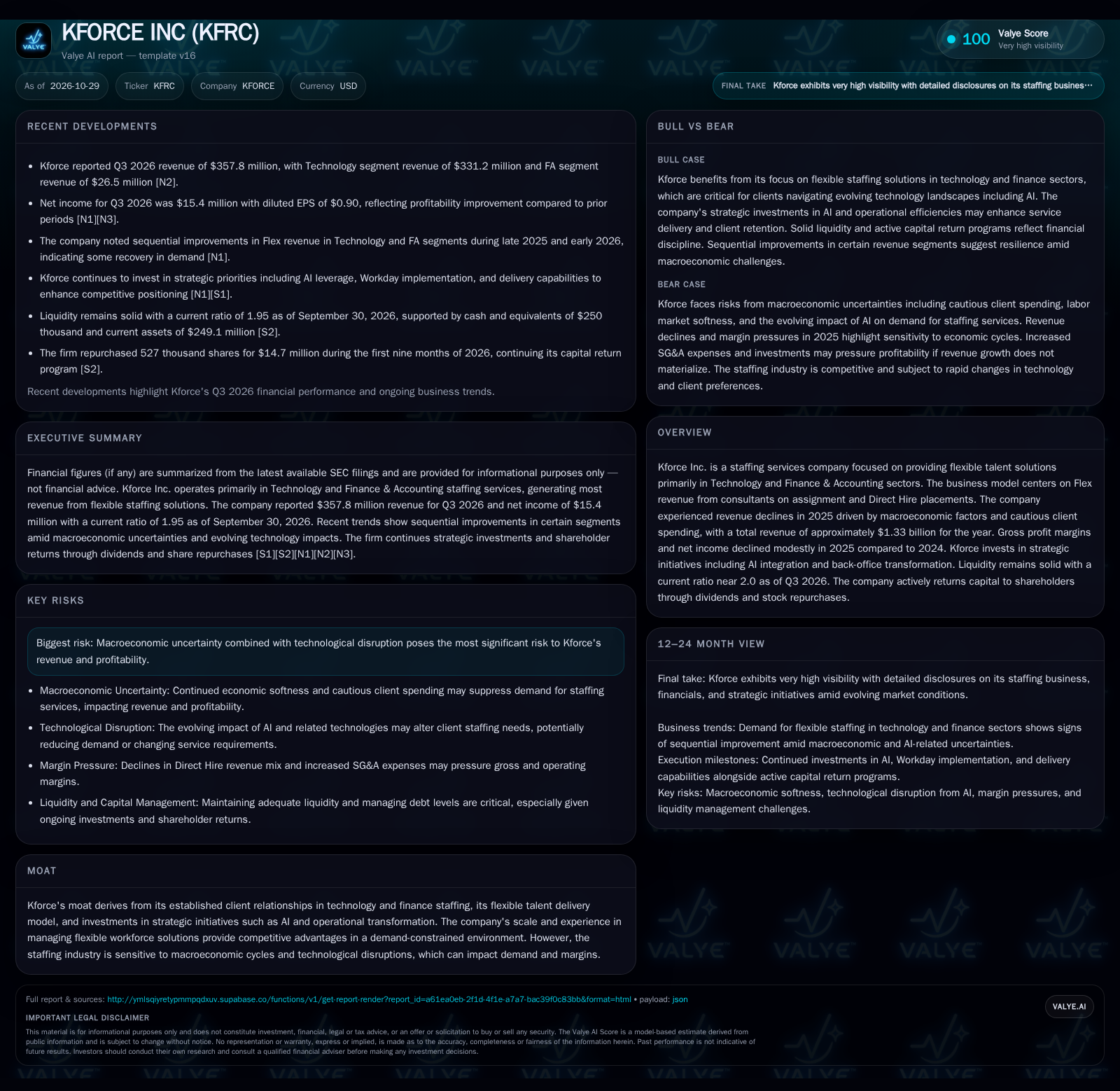
Kforce’s 2025 revenue fell 5.4% amid softer labor markets and AI-driven uncertainty, with net income down nearly a third. Technology staffing remains dominant, while operational investments and capital returns continue. The company’s future will be shaped by its ability to harness AI, manage margin pressures, and adapt to changing client requirements in a competitive, cyclical industry. [S1] [S2] [N2]
Kforce Inc. sits at the intersection of technology workforce trends and rapidly changing client needs, as macroeconomic pressures and the rise of AI reshape the staffing landscape. In 2025, the company saw a notable revenue and earnings decline, reflecting both industry-wide headwinds and the challenges of adapting to new client priorities. Yet, Kforce’s ongoing investments in digital transformation and operational initiatives, coupled with an aggressive capital return policy, suggest a company actively managing through disruption. The critical question: Can Kforce leverage its technology expertise and strategic bets to regain momentum, defend margins, and thrive as staffing models evolve?
Recent Results Reflect Revenue Decline and Focused Strategic Spending
Kforce reported 2025 revenue of $1.33 billion, a 5.4% decrease from the prior year, primarily due to a reduction in consultants on assignment and increased client caution amid macroeconomic and AI-driven shifts [S1]. The Technology segment remained the company’s economic engine, contributing 92.6% of total revenue, while Finance & Accounting (FA) contributed just 7.4% [S1] [S2]. Gross margin slipped slightly to 27.2% as the mix of higher-margin Direct Hire revenue shrank, and SG&A expenses increased to 23.0% of revenue, reflecting ongoing investments in AI capabilities, Workday implementation, and delivery enhancements [S1]. Net income for 2025 was $34.8 million, down 30.9% from 2024, highlighting the combined pressures of revenue contraction and rising costs [S1]. The company reported a current ratio of 1.95 for the period. [S2]
Kforce’s Staffing Approach Manages Margin Challenges and Operating Leverage
Kforce’s business is driven by the placement of temporary (Flex) and permanent (Direct Hire) professionals, with Flex revenue comprising 98.1% of total revenue in 2025 [S1]. Flex staffing typically delivers recurring but lower-margin revenue compared to Direct Hire, which offers higher margins but is more sensitive to hiring cycles. The heavy dependence on Flex placements aligns with clients’ preference for workforce flexibility, especially during economic uncertainty. However, as Direct Hire revenue shrinks, overall gross margins are pressured.
The company’s cost structure is partly variable—consultant costs scale with project volume—but the SG&A line has risen as Kforce invests in technology, AI, and delivery infrastructure. These investments are intended to boost future efficiency and revenue capture but create near-term operating leverage risk if revenue continues to fall. The company reported cash and liquidity metrics for the period; these figures do not by themselves establish operating runway, investment capacity, financial flexibility, or financing capacity. Kforce’s active capital return program, returning over 100% of operating cash flow in 2025, further tightens the margin for error and increases reliance on steady cash conversion from operations [S1] [S2].
Maintaining Market Position Amid Technology-Driven Staffing Fragmentation
Kforce competes in a highly fragmented staffing industry, where barriers to entry are modest and price competition is intense—particularly for commoditized skill sets. Its competitive advantages stem from established relationships in the technology and finance sectors, a flexible delivery model, and growing investment in digital and AI-enabled solutions. However, client loyalty is typically low absent differentiated service or proprietary platforms, and technology-driven disintermediation (e.g., AI-powered recruiting, self-serve talent marketplaces) could erode traditional agency roles.
Major competitors include both large diversified staffing firms and specialized tech staffing boutiques. The rise of internal talent acquisition functions and digital platforms further compresses margins and challenges the value proposition of traditional staffing intermediaries. Kforce’s focus on technology roles is a double-edged sword: it provides exposure to a high-demand segment but also increases vulnerability to tech sector hiring cycles and rapid changes in required skill sets driven by AI adoption.
Growth Opportunities Emerging from AI Adoption and Digital Solutions
If Kforce’s investments in AI, Workday, and delivery capabilities yield tangible improvements in placement speed, candidate quality, and client retention, the company could capture a greater share of evolving staffing budgets. Clients facing AI-driven transformation may increasingly turn to specialized agencies that can source and vet talent for emerging roles, creating new demand pools. A re-acceleration in technology sector hiring, combined with a partial rebound in Direct Hire placements, would support both revenue growth and margin recovery.
Evidence that would confirm this scenario includes a sustained sequential improvement in Technology and FA Flex revenue, stabilization or growth in Direct Hire revenue mix, and a reversal of recent margin compression. Additionally, disclosures of enhanced client wins tied directly to digital/AI capabilities, or higher consultant redeployment rates due to improved delivery, would further validate the thesis.
Demand Volatility Persists as Clients Balance AI Adoption with Economic Factors
The most plausible outcome is continued revenue stabilization with modest sequential improvement, as clients cautiously resume tech and finance hiring but remain wary of long-term commitments. Flex revenue will likely stay dominant, and any recovery in Direct Hire will be gradual. Margin pressure persists as SG&A investments remain elevated and gross margin benefits from mix shift are slow to materialize.
This scenario is confirmed by ongoing but moderate sequential revenue improvements in both Technology and FA segments, persistent low Direct Hire mix, and stable but not expanding gross margins. If SG&A as a percentage of revenue remains elevated without a corresponding increase in productivity or revenue, it would further support this base case.
Extended Tech Sector Slump and AI Disruption Threaten Profitability
A more adverse scenario sees tech sector hiring remain weak or deteriorate further, while clients increasingly adopt internal AI-enabled recruitment tools, reducing reliance on external agencies like Kforce. If the company’s digital investments fail to yield competitive differentiation, Kforce could lose share to both traditional rivals and technology-driven disruptors. Ongoing margin compression, rising SG&A, and persistent declines in Direct Hire would further pressure profitability and cash generation.
Confirmation of this scenario would include continued year-over-year revenue declines, further contraction in Direct Hire mix, increasing SG&A as a percentage of revenue without top-line growth, and signs of client attrition or lost bids to digital-first competitors. Difficulty in maintaining working capital discipline—evidenced by increased receivables or tighter liquidity—would also signal downside risk.
Evaluating Kforce’s Response to Evolving Staffing Industry Dynamics
Quarterly sequential trends in Technology and FA Flex revenue: Sustained improvement would suggest stabilization or recovery; renewed declines could indicate persistent demand weakness.
Direct Hire revenue as a percentage of total: An uptick would signal improved client confidence and margin opportunity; continued shrinkage would reinforce margin pressure.
Gross margin and SG&A as a percentage of revenue: Watch for margin stabilization or expansion as a sign that investments are paying off, or further compression as a red flag.
Consultant redeployment rates and client retention: If disclosed, higher rates would indicate delivery and operational improvements.
Evidence of client wins or expanded relationships tied to AI and digital capabilities: Announcements or disclosures here would validate strategic investment outcomes.
Working capital metrics—particularly days sales outstanding and receivables trends: Deterioration could foreshadow cash flow stress.
Liquidity and capital return discipline: Monitoring whether the company continues to return capital in line with cash generation, or if payout ratios become unsustainable.
Disclaimer: This is research-only, informational analysis and not investment advice. It may include AI-generated interpretation and general industry context. Always verify important details using primary sources.

Comments