
Sonoco’s Portfolio Transformation: Integration Hurdles, Margin Dynamics, and the New Geography of Packaging Leadership
Sonoco’s recent acquisition of Eviosys and divestiture of ThermoSafe mark a high-stakes pivot toward focused core packaging segments, but Q3 2026 results reveal the financial and operational drag of goodwill impairment risks and the challenges of integrating a global metal packaging platform. The next phase hinges on realizing acquisition synergies, managing volatile input costs, and maintaining resilience in a fiercely competitive, margin-sensitive sector.
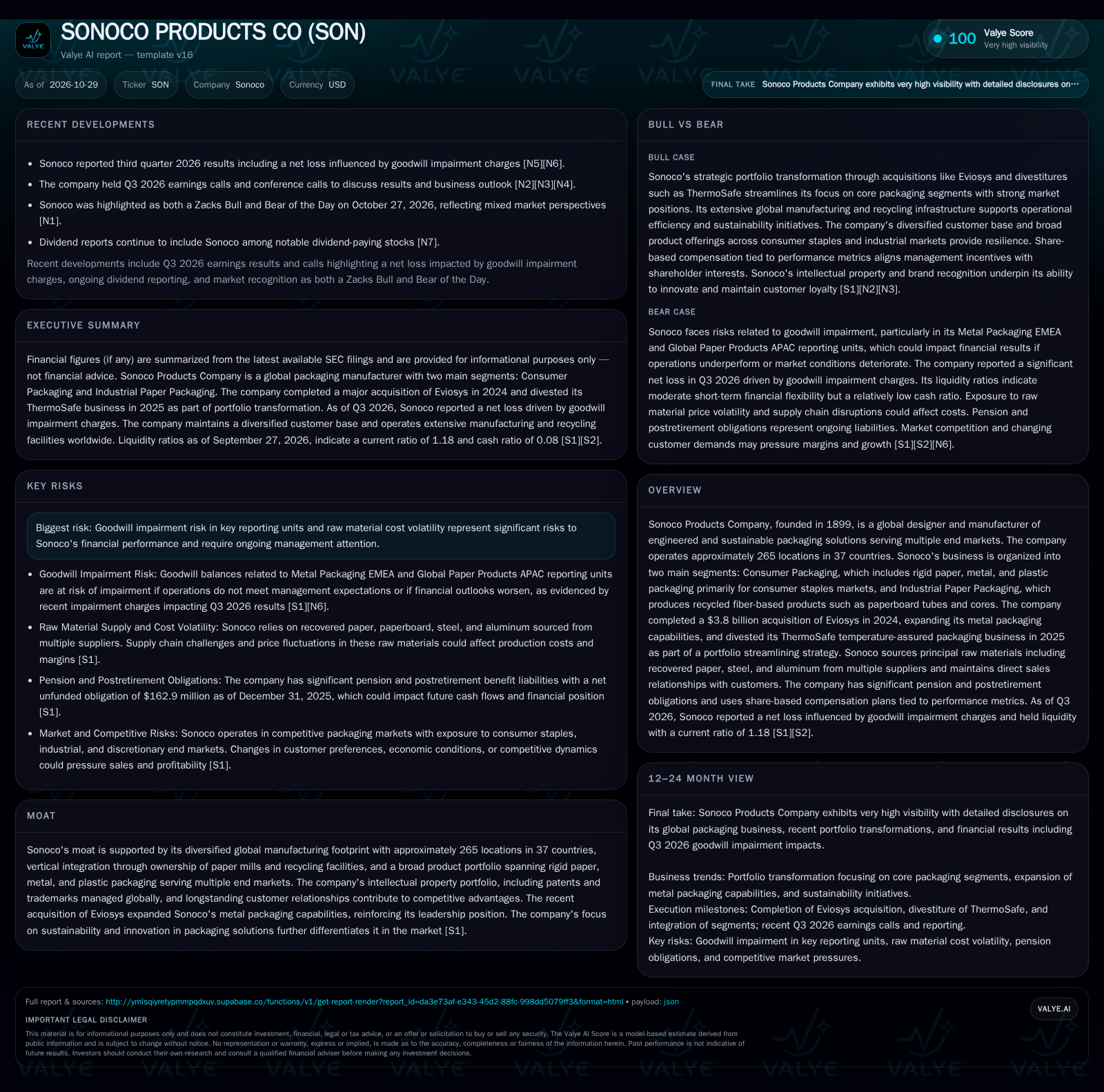
Sonoco has executed a major portfolio shift, acquiring Eviosys for $3.8 billion to expand its metal packaging footprint and selling ThermoSafe to streamline its business. However, significant Q3 2026 goodwill impairment charges have led to a steep net loss, spotlighting both integration risk and the pressure to deliver on promised synergies. The company’s future performance will depend on margin management, successful integration, and its ability to adapt to input cost swings and changing customer demands. [S1] [S2]
Sonoco’s transformation over the past two years—marked by the $3.8 billion Eviosys acquisition and the sale of ThermoSafe—repositions the company as a global leader in rigid packaging, with a sharpened focus on consumer and industrial paper products. Yet, the latest quarter’s $732.1 million net loss, driven by goodwill impairment in newly acquired units, raises the stakes for value creation through integration and operational discipline. The company’s ability to manage input cost volatility, realize acquisition synergies, and preserve margin in a competitive, commodity-driven environment will determine whether this strategic reset delivers on its promise or exposes new vulnerabilities. [S1] [S2] [N6]
Acquisition Integration and Impairment Charges Define the 2026 Landscape
Sonoco’s $3.8 billion acquisition of Eviosys in December 2024 marked a major expansion into European metal packaging, positioning the company as a global leader in rigid packaging for consumer staples such as food and beverage. This move was paired with the divestiture of its ThermoSafe temperature-assured packaging business for $656 million in November 2025, effectively streamlining the portfolio into two core segments: Consumer Packaging (65% of 2025 sales) and Industrial Paper Packaging (30%). [S1]
However, Q3 2026 results were dominated by a net loss of $732.1 million, with the bulk attributable to goodwill impairment in recently acquired units—most notably Metal Packaging EMEA and Global Paper Products APAC, which together held $1.4 billion and $27 million in goodwill, respectively, at year-end 2025. [S2]
Margin Structure, Input Volatility, and the Economics of Scale in Packaging
Sonoco’s business model is capital intensive and scale driven, with cost of goods sold and raw material procurement—especially recovered paper, steel, and aluminum—constituting the largest expenses. The company’s vertical integration, including 19 paper mills and 16 recycling facilities in the U.S., is designed to buffer input volatility, but pricing power is variable and often dictated by broader commodity cycles.
In Consumer Packaging, margins are typically higher due to more value-added processes, brand relationships, and product differentiation, but this segment is still exposed to end-market pricing pressure from large consumer staples customers. The Industrial Paper Packaging segment, by contrast, is more cyclical and commodity-like, with lower margins and higher sensitivity to economic swings.
Recent portfolio moves—acquiring Eviosys and selling ThermoSafe—signal a bet on higher-margin, higher-volume segments, but also increase fixed costs and integration risk. Operating leverage can be significant if volume growth materializes post-acquisition, but impairment charges and integration drag can erode returns if synergies are not achieved quickly. Pension obligations, with a net unfunded liability of $162.9 million as of December 2025, add another layer of fixed cost, limiting potential financial flexibility in downturns. [S1]
How Sonoco Stacks Up: Global Footprint, Diversification, and the Fight for Packaging Share
Sonoco competes in a global, fragmented packaging industry against large multinationals and regional specialists in both consumer and industrial segments. Its competitive strengths include a diversified customer base—no single customer accounted for more than 10% of consolidated revenue in 2025—and a broad product portfolio spanning paper, metal, and plastic packaging. [S1]
The acquisition of Eviosys significantly expands Sonoco’s European presence, giving it scale in metal packaging and access to new customers, but also exposes the company to new competitive dynamics and integration risks. Vertical integration through in-house recycling and paper mills provides some cost advantage and supply security, but also ties margins to recycled fiber and metal input cost cycles.
Brand relationships and intellectual property (patents, trademarks) help support retention in some consumer packaging categories, but switching costs for most customers remain low, and product commoditization is an ongoing threat. The company’s sustainability positioning and ability to innovate in recyclable packaging are differentiators, but must be monetized to counteract price-based competition.
If Synergies Are Realized: Operating Leverage and Margin Expansion Drive Value Creation
The bull case for Sonoco hinges on successful integration of Eviosys, with synergies in procurement, manufacturing, and cross-selling across a broadened customer base. If Sonoco can leverage its expanded scale to negotiate better raw material pricing, optimize capacity utilization, and drive operational efficiencies, operating leverage could enable margin expansion even in a moderately growing market.
Sustained volume growth in consumer staples packaging—especially food and beverage—would increase throughput across facilities, while innovations in sustainable and recyclable packaging could command pricing premiums and deepen customer relationships. The company’s diversified customer base and global reach provide resilience against regional downturns.
Evidence confirming this scenario would include improving segment margins, realization of cost synergies (if disclosed), reduced volatility in quarterly earnings, and stable or growing EPS post-integration. Successful avoidance of additional goodwill impairment and positive free cash flow trends would further support the thesis.
Integration, Input Volatility, and Margin Management in a Maturing Packaging Market
The most plausible outcome is a slog: Sonoco manages to stabilize operations post-Eviosys acquisition, but faces ongoing challenges from input cost volatility and margin compression, especially in the metal packaging segment. Some synergies are realized, but not at the pace or scale originally hoped, and operational complexity—managing 265 locations in 37 countries—limits rapid cost takeout.
Consumer Packaging continues to provide relative stability, given its exposure to food, beverage, and household staples, but Industrial Paper Packaging remains sensitive to economic cycles and commodity price swings.
Confirmation of this scenario would be reflected in quarterly results showing moderate, uneven margin recovery, limited further impairment, and steady (but not rapid) growth in core packaging volumes. Evidence to the contrary would include persistent net losses, additional major impairments, or a sharp deterioration in liquidity.
When Integration Fails: Further Impairments, Margin Erosion, and Liquidity Strain
The bear case materializes if Sonoco cannot deliver on Eviosys integration—either due to cultural, operational, or market misalignment—leading to continued underperformance in acquired units. Additional goodwill impairments would further depress earnings, potentially triggering covenant issues or rating downgrades if liquidity erodes.
Rising raw material costs (steel, aluminum, recovered paper) without offsetting price increases or cost control would compress margins, while customer pushback or loss of major accounts in competitive categories could accelerate revenue declines. Pension and postretirement obligations would become more burdensome in a negative cash flow scenario.
Evidence for this scenario would include additional net losses, further goodwill or asset impairment announcements, deteriorating liquidity ratios, and negative operating cash flow. A spike in customer churn or loss of key contracts (if disclosed) would further validate the downside risk.
Testing the Sonoco Thesis: What Could Confirm or Challenge the Transformation
Quarterly segment margin trends for Consumer Packaging and Industrial Paper Packaging—improvement or deterioration would signal the effectiveness of integration and cost control.
Disclosure of realized cost synergies, integration milestones, or restructuring charges related to the Eviosys acquisition—would help test the pace and success of the portfolio transformation.
Raw material cost trends and Sonoco’s ability to pass through input price changes to customers—a key determinant of margin resilience.
Pension and postretirement obligation updates—rising net liabilities or required contributions could pressure cash flow.
Additional goodwill or asset impairment charges—would confirm continued underperformance or overpayment in recent acquisitions.
Liquidity developments—quarterly cash flow, changes in current and cash ratios, or new financing arrangements would indicate potential financial flexibility or emerging strain.
Customer concentration or churn—if disclosed, changes in the share of revenue from major accounts would reveal shifts in competitive positioning.
Progress on sustainability-driven product innovation—commercial traction or pricing power from new recyclable or eco-friendly packaging lines would support the differentiation thesis.
Disclaimer: This is research-only, informational analysis and not investment advice. It may include AI-generated interpretation and general industry context. Always verify important details using primary sources.

Comments