
FirstEnergy’s Growth Moment: Capital Investment, Demand Shifts, and the Regulatory Utility Dilemma
FirstEnergy posted a 26% year-over-year profit increase in Q3 2026, driven by rising demand—including from data centers—and ongoing grid modernization investments.
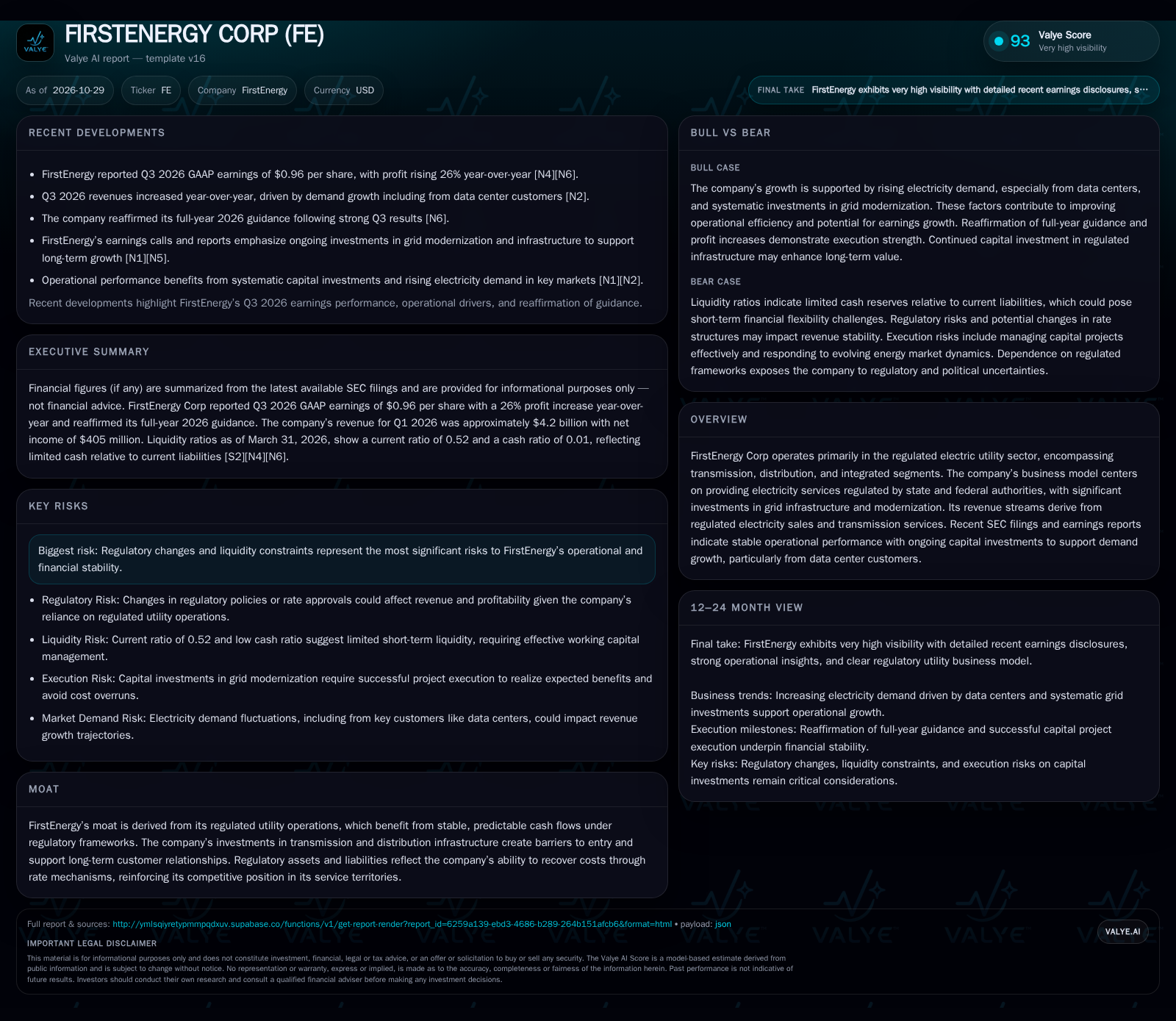
FirstEnergy posted a 26% year-over-year profit increase in Q3 2026, driven by rising demand—including from data centers—and ongoing grid modernization investments. However, with a current ratio of just 0.52 and a cash ratio of 0.01, the company’s short-term liquidity remains tight, underscoring the importance of regulatory stability and disciplined execution of capital projects for sustained earnings growth. Investors must weigh the benefits of its regulated utility model against execution and regulatory risks as infrastructure needs accelerate. [S2] [N2] [N4] [N6]
FirstEnergy Corp’s most recent quarter showcased a sharp 26% year-over-year profit increase and strong revenue momentum, buoyed by surging electricity demand—especially from data centers—and sustained capital investment in grid modernization. The next phase for FirstEnergy will likely be defined by its ability to execute large-scale capital projects, manage working capital tightly, and navigate evolving demand and regulatory environments.
Profit Growth, Demand Drivers, and Liquidity: The Present Snapshot
FirstEnergy reported a 26% year-over-year increase in Q3 2026 profit, with GAAP earnings per share of $0.96 and a reaffirmation of its full-year guidance—signals of strong operational execution and confidence in near-term performance [N4] [N6]. Revenue growth was attributed to rising electricity demand, particularly from data center customers, highlighting a structural demand tailwind in the company’s service areas [N2]. Ongoing investments in grid modernization and infrastructure upgrades remain a strategic focus [N1] [N5]. [S2] These facts frame the company’s current opportunity and risk profile.
How Regulated Utilities Monetize Demand and Deploy Capital
FirstEnergy operates as a regulated electric utility, deriving the bulk of its revenue from electricity transmission and distribution services in territories where rates are set by state and federal regulators [S1]. In this model, the company’s ability to generate returns depends on the regulatory asset base, allowed rates of return, and the prudency of capital expenditures. Rising demand—especially from power-intensive data centers—can justify new capital investments, which are typically recouped through rate cases and regulatory asset additions over multi-year periods.
The economics hinge on a high fixed-cost base: transmission and distribution infrastructure requires substantial upfront and ongoing investment, but incremental usage (volume) often carries low marginal cost. This dynamic creates operating leverage: as demand rises, more revenue flows through to the bottom line, provided that rates and capital recovery are maintained. However, the rate-setting process introduces lag and political risk, as regulators must balance utility returns with customer affordability.
FirstEnergy’s capital needs are significant, particularly as grid modernization and resiliency become more urgent amid changing demand patterns and the integration of distributed energy resources. Limited short-term liquidity suggests that the company will likely rely on access to capital markets, revolving credit, or regulatory mechanisms—such as cost trackers—for working capital and project funding. The business is structurally cash generative over time, but short-term funding mismatches require careful management.
Barriers, Substitutes, and the Evolving Utility Landscape
FirstEnergy’s core advantage is regulatory: exclusive service territories, rate recovery mechanisms, and high entry barriers due to infrastructure scale and public oversight. These features create a stable competitive position within its regions. However, competition is indirect and evolving. Substitutes such as distributed generation, behind-the-meter solar, and private microgrids could erode future load growth, particularly if regulatory models shift to favor decentralization.
Peer utilities face similar demand and regulatory dynamics, but FirstEnergy’s exposure to data center-driven demand growth may offer a near-term advantage if it can capture and serve these loads efficiently. Conversely, utilities with more diversified generation or greater exposure to unregulated businesses may have different risk/reward profiles. Technology substitution—such as battery storage or local renewables—poses a long-term challenge if regulatory and customer preferences accelerate away from traditional grid reliance.
Ultimately, FirstEnergy’s competitive resilience depends on its ability to execute capital projects on time and on budget, maintain constructive regulatory relationships, and adapt to shifting customer and policy expectations around reliability, decarbonization, and cost.
If Data Center Demand and Grid Modernization Deliver Durable Growth
The most favorable outcome for FirstEnergy is a sustained wave of electricity demand—especially from data centers—paired with successful execution of grid modernization projects. In this scenario, the company efficiently invests capital, earns timely regulatory approval for rate recovery, and experiences minimal cost overruns or delays. As load grows, fixed infrastructure costs are leveraged across higher volumes, expanding margins and supporting above-average earnings growth.
Confirmation would require evidence of continued multi-year demand growth from hyperscale and enterprise data center customers, successful completion and regulatory inclusion of capital projects into the rate base, and stable or improving allowed returns from regulators. Additional positive signals would include favorable rate case outcomes, increased cash flows from operations, and a gradual improvement in liquidity metrics—such as current ratio or cash flow coverage—if disclosed.
This scenario could be falsified if data center projects are delayed, regulatory commissions disallow cost recovery, or capital project execution falters, leading to higher costs and lower returns.
Sustained Regulated Growth with Ongoing Capital Discipline
The most plausible path forward is steady, regulated earnings growth supported by ongoing infrastructure investment and moderate demand expansion, offset by the need for disciplined capital management and regulatory navigation. FirstEnergy continues to invest in grid upgrades and responds to data center and broader load growth, but faces periodic regulatory scrutiny, cost inflation, and execution challenges.
Evidence supporting this outcome would include continued reaffirmation of earnings guidance, maintenance of investment-grade credit ratings, successful rate cases, and manageable cost overruns on major projects. Margins remain stable, reflecting both the benefits and constraints of the regulated model. Liquidity remains tight but manageable through access to capital markets and regulatory cost-recovery mechanisms.
This scenario would be challenged if working capital pressures intensify, if regulatory lag becomes more pronounced, or if unforeseen operational or market events disrupt demand or project timelines.
When Liquidity Constraints and Regulatory Friction Erode Stability
If current liabilities cannot be met without costly short-term borrowing or asset sales, the company could face credit rating pressure, higher financing costs, and reduced potential financial flexibility.
Regulatory setbacks—such as unfavorable rate case outcomes, political intervention, or stricter oversight—could further erode earnings and cash flow visibility. If demand from key customers such as data centers proves volatile or overestimated, load growth could disappoint, undermining the investment case for recent and planned capital expenditures.
Confirming evidence would include negative credit actions, missed or revised guidance, material increases in short-term borrowing, or regulatory disallowances.
Milestones and Metrics That Will Shape FirstEnergy’s Next Chapter
Quarterly and annual trends in demand growth, especially from data centers and large commercial/industrial customers, would help test the sustainability of the current growth narrative.
Progress updates and cost performance on major grid modernization and infrastructure projects, including whether expenditures are being incorporated into the regulated rate base on schedule.
Rate case outcomes and regulatory filings, with particular attention to allowed returns, cost recovery mechanisms, and regulatory lag.
Changes in credit ratings or outlooks from rating agencies, which may signal financial stress or resilience.
Evidence of customer adoption of distributed energy resources or grid defection, which could alter demand and revenue forecasts.
Capital market conditions, including the company’s ability to access debt and equity on favorable terms for ongoing investment needs.
Management commentary on hedging strategies, fuel cost recovery, and risk mitigation in a volatile energy and regulatory environment.
Disclaimer: This is research-only, informational analysis and not investment advice. It may include AI-generated interpretation and general industry context. Always verify important details using primary sources.

Comments