
Markel Group’s Diversified Engine: Insurance Profitability, Capital Allocation, and the Next Phase of Specialty Expansion
Strong underwriting results and disciplined portfolio rebalancing underpin Markel Group’s insurance and investment engines, but leadership changes, specialty line expansion, and external volatility test the durability of its long-term value strategy.
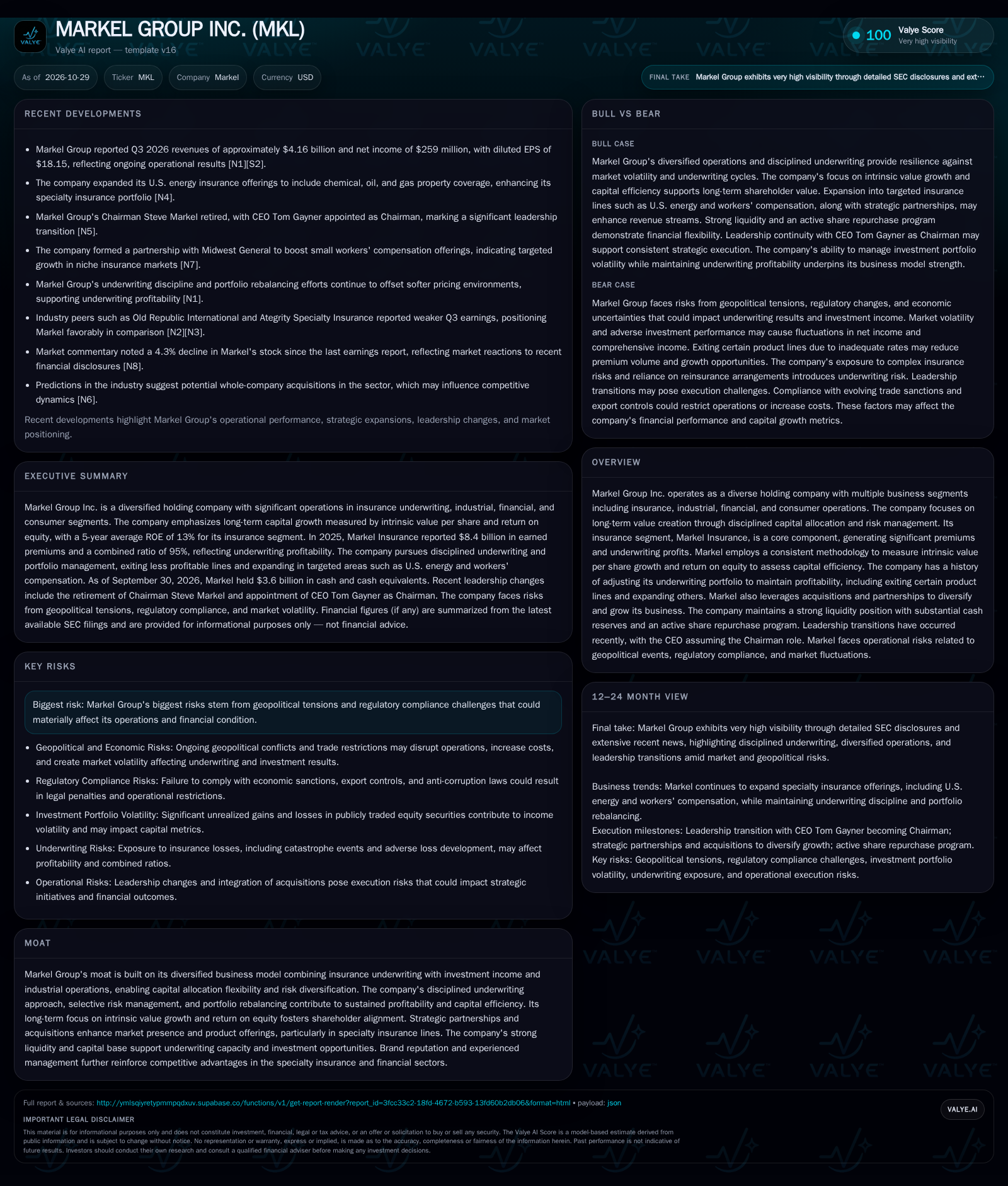
Markel Group’s insurance segment continues to generate underwriting profits, supported by disciplined risk selection and selective exits from underperforming lines. Expansion into U.S. energy and workers’ compensation insurance signals targeted growth, while leadership transitions and market volatility present new execution risks. [S2] [N1] [N4] [N5]
Markel Group’s 2025 and 2026 results reinforce its reputation as a disciplined, diversified holding company anchored by specialty insurance. With $8.4 billion in earned insurance premiums and a 95% combined ratio in 2025, the group’s underwriting engine remains robust. Recent moves—expanding U.S. energy offerings, bolstering workers’ compensation, and executing a significant leadership transition—signal both opportunity and risk as Markel navigates shifting market and regulatory conditions. [S2] [N1] [N4] [N5]
Insurance Profitability and Strategic Shifts Define Markel’s Current Landscape
Markel Insurance reported $8.4 billion in earned premiums for 2025, with an underwriting profit of $455.7 million and a combined ratio of 95%, confirming profitable risk selection in a competitive market. These outcomes support a five-year average ROE of 13% for the insurance segment, underpinning the group’s long-term capital growth ethos. [S2]
Gross premium volume grew by 4% in 2025, driven by targeted expansion in personal lines, international professional liability, programs, marine and energy, and general liability—while the company strategically exited certain risk-managed directors and officers product lines in the U.S. and Europe due to inadequate rates. This signals a willingness to forgo volume for margin protection. [S2]
On the specialty front, Markel expanded U.S. energy insurance offerings to include chemical, oil, and gas property coverage and announced partnerships to boost workers’ compensation business, indicating a focus on complex, potentially higher-margin lines. [N4] [N7]
Leadership transition is underway: Chairman Steve Markel retired, and CEO Tom Gayner now serves as Chairman, tightening executive oversight but also introducing new succession and continuity questions. [N5]
How Markel Monetizes Risk: Underwriting, Investments, and the Role of Capital Discipline
Markel’s core earnings engine is insurance underwriting—where profitability is measured by the combined ratio (expenses and claims as a percentage of premiums). A 95% ratio in 2025 means that for every premium dollar, Markel retained five cents before investment income, reflecting disciplined risk selection and cost control. In specialty insurance, pricing power is often cyclical, so Markel’s willingness to exit underpriced lines helps preserve margin integrity.
Investment income is a key second pillar. Premiums collected are invested—often in a mix of bonds and public equities—creating a ‘float’ that generates returns even before claims are paid. Markel’s portfolio includes a significant allocation to publicly traded equities, which can enhance long-term returns but also introduce mark-to-market volatility. The company’s five-year CAGR in intrinsic value per share (14.5% to 15.7% depending on valuation) reflects both underwriting profit and investment gains. [S2]
Outside insurance, Markel deploys capital into diversified industrial, financial, and consumer operations. These businesses may offer relatively stable cash flows, but their contribution to group earnings is typically less volatile than investment results. The company reported cash and liquidity metrics for the period; these figures do not by themselves establish operating runway, investment capacity, financial flexibility, or financing capacity. [S2]
Operating leverage exists if fixed costs in insurance and industrial operations can be spread over a growing premium or revenue base, magnifying profit growth in expansionary periods. However, exposure to large claims, catastrophe events, or severe investment losses can quickly erode margins, making risk management paramount.
Specialty Focus and Portfolio Flexibility Anchor Markel’s Edge—But Counterforces Are Growing
Markel’s competitive advantage lies in its specialty insurance orientation, disciplined underwriting, and ability to reallocate capital across insurance, investments, and operating businesses. By targeting complex or underserved niches (such as energy, marine, and professional liability), Markel seeks pricing power and lower commoditization compared to standard property/casualty insurers.
The willingness to exit underperforming lines (as seen in directors and officers insurance) demonstrates portfolio agility—a trait not universal among larger, more rigid insurers. This enables Markel to sustain profitability through soft and hard market cycles.
However, counterforces are intensifying. Major global insurers, insurtech upstarts, and alternative capital providers (such as insurance-linked securities funds) are increasingly targeting specialty lines. These entrants can compress margins and erode the informational or relationship advantages that established players like Markel once enjoyed.
Markel’s investment-driven model also faces scrutiny in volatile markets: aggressive equity allocations can boost returns but heighten downside risk. The durability of its competitive edge will be tested by the ability to maintain underwriting discipline, navigate regulatory shifts, and avoid adverse selection as new entrants and capital flows reshape specialty insurance.
Disciplined Growth in Specialty Lines Unlocks Higher Returns—If Execution Remains Tight
The favorable scenario for Markel is one where its specialty insurance expansion—particularly in U.S. energy, workers’ compensation, and international professional liability—delivers above-market premium growth and improved underwriting margins. If Markel can continue its disciplined risk selection, avoid adverse loss development, and successfully integrate new partnerships, the combined ratio could trend toward or below 95%, supporting further ROE expansion. [N4] [N7]
On the investment side, a continued rebound or stability in public equity markets would amplify float returns, enhancing intrinsic value growth and supporting additional share repurchases.
Confirmation of this scenario would come from sustained low combined ratios, robust premium growth in targeted specialty lines, and evidence of successful integration of new business partnerships. Additional signals would include continued increases in five-year CAGR of intrinsic value per share and visible deployment of cash into accretive acquisitions or buybacks.
Falsification would occur if new specialty lines experience higher-than-expected claims, integration stumbles, or if investment gains are offset by large underwriting losses or adverse market events.
Balanced Expansion with Ongoing Volatility: Markel’s Most Likely Route Ahead
The most plausible trajectory is that Markel sustains moderate premium growth—driven by selective specialty line expansion—and continues to generate underwriting profits with a combined ratio near the mid-90s. Investment income remains a meaningful, but volatile, contributor to group earnings given the equity-heavy portfolio.
Periodic exits from underperforming lines offset competitive pricing pressures, allowing Markel to maintain profitability even as some legacy segments shrink. The industrial and consumer businesses provide ballast, but insurance and investments drive the bulk of value creation.
Leadership transition proceeds smoothly, with CEO Tom Gayner’s dual role as Chairman providing continuity but also concentrating oversight. The active share repurchase program is opportunistically deployed, but large cash balances are maintained as a strategic buffer.
This scenario would be confirmed by quarterly results showing stable or improving combined ratios, consistent premium growth in targeted lines, and ongoing capital discipline. Evidence to the contrary would include a material deterioration in underwriting results, failure to grow specialty premiums, or operational missteps related to leadership changes.
External Shocks, Execution Gaps, and Investment Losses Could Derail Markel’s Model
A negative scenario could unfold if Markel’s specialty expansion exposes it to outsized underwriting losses—especially in new, complex energy or workers’ compensation lines where loss development can be unpredictable. If pricing proves inadequate or risk selection falters, the combined ratio could spike above 100%, eroding profitability and capital.
Simultaneously, a major downturn in public equity markets would reduce investment income and could trigger mark-to-market losses, compressing intrinsic value per share and limiting capital available for buybacks or reinvestment.
Leadership transition risk manifests if new strategic initiatives falter, key executives depart, or cultural continuity is lost during the handoff.
This downside would be confirmed by rising combined ratios, slowing or negative premium growth, persistent investment losses, or negative surprises from new specialty lines. Regulatory shocks, adverse geopolitical events, or operational missteps could further amplify financial and reputational risk.
Milestones and Metrics That Will Test Markel’s Specialty Expansion and Capital Discipline
Combined ratio trends in the insurance segment, especially as new specialty lines scale—sustained sub-95% levels would support the thesis; rising ratios would challenge it.
Premium growth rates in targeted specialty segments (energy, workers’ compensation, international professional liability); a useful metric would be segment-level premium and loss ratio disclosure, if provided.
Return on equity and five-year CAGR in intrinsic value per share—continued improvement would confirm management’s capital allocation efficacy.
Investment portfolio performance, particularly realized and unrealized gains/losses in public equities; high volatility or persistent losses would test the model’s resilience.
Cash and share repurchase deployment—tracking how much of the remaining $832.6 million authorization is used, and under what valuation circumstances.
Progress and retention among key executives following the leadership transition; a useful metric would be disclosed management turnover or new long-term incentive grants.
Regulatory and geopolitical developments affecting specialty insurance exposures, particularly in energy and international lines.
Disclaimer: This is research-only, informational analysis and not investment advice. It may include AI-generated interpretation and general industry context. Always verify important details using primary sources.

Comments