
Morningstar’s Next Act: Data Moat, AI Integration, and the Competitive Stakes in Global Investment Intelligence
With $672.1 million in quarterly revenue and an expanding AI footprint, Morningstar’s core challenge is translating its data and technology investments into differentiated, defensible growth amid rising regulatory and competitive pressures.
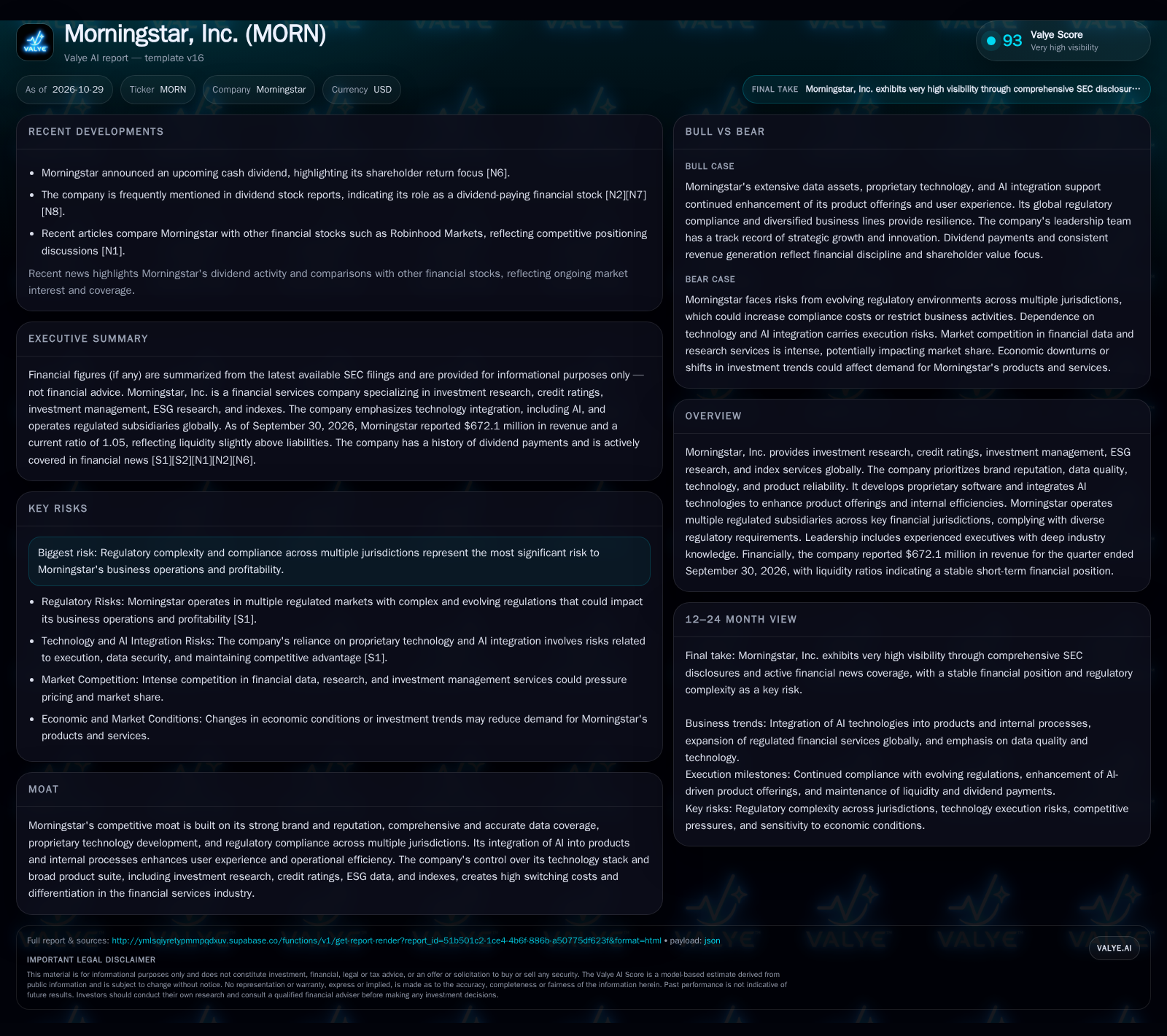
Morningstar reported $672.1 million in revenue for the quarter ended September 30, 2026, and continues to emphasize AI-driven product enhancements and global regulatory compliance. The company’s future trajectory will hinge on the effectiveness of its technology investments and its ability to sustain a moat in a crowded, evolving financial data landscape. Regulatory complexity and execution risks in AI remain the most significant wildcards for the business model’s resilience and scalability. [S2] [N6]
Morningstar, Inc. stands at a critical juncture in the financial data and analytics industry. With quarterly revenue of $672.1 million and a stable, if unspectacular, liquidity position, the company’s strategy now pivots on leveraging its deep data assets and proprietary technology—especially AI—to defend and extend its competitive position. At the same time, Morningstar must navigate a patchwork of evolving global regulations while fending off intensifying competition from both traditional peers and new digital entrants. The question is whether its investments in technology and data can deliver sustainable differentiation and growth, or whether regulatory complexity and market commoditization will erode its edge. [S2] [S1]
Recent Performance and Strategic Priorities: Where Morningstar Stands Today
Morningstar reported $672.1 million in revenue for the quarter ended September 30, 2026, signaling continued demand for its investment research, ratings, and data solutions. Basic EPS for the same period was $3.09, reflecting ongoing profitability. The company reported cash and liquidity metrics for the period; these figures do not by themselves establish operating runway, investment capacity, financial flexibility, or financing capacity. Morningstar’s steady dividend payments remain a focal point for investors, reinforcing a shareholder-return orientation. [S2] [N6] [N8]
Strategically, Morningstar continues to highlight AI integration across its product suite and internal processes, aiming to enhance user experience and operational efficiency. The company’s footprint spans multiple regulated jurisdictions, making regulatory adaptation a continuous operational imperative. [S1]
How Morningstar’s Business Model Converts Data and Technology into Profits
Morningstar’s revenue primarily flows from subscription-based access to its investment research, data analytics, credit ratings, indexes, and investment management services. The company’s economic engine relies on scaling proprietary content and technology across a wide base of institutional and retail clients. In principle, this model offers attractive operating leverage: fixed costs associated with data acquisition, technology development, and regulatory compliance can be spread over a growing subscriber base, while incremental distribution costs remain low.
AI integration may further shift the cost structure by automating research, data gathering, and client-facing workflows, potentially lowering variable costs and enabling new analytics-driven products. However, the return on these investments will depend on successful adoption and the company’s ability to price differentiated features above commoditized alternatives.
Morningstar’s capital requirements are moderate relative to traditional financial institutions, but the need for ongoing investment in technology, data quality, and regulatory compliance is persistent. The cited source reports dividend-related activity; that disclosure alone does not establish dividend-policy continuity, management confidence, or a material constraint on capital flexibility.
The scalability of Morningstar’s subscription model is contingent on its ability to continuously enrich its proprietary datasets and refine its AI algorithms to maintain superior predictive accuracy and relevance. This necessitates a cyclical reinvestment in both data acquisition and talent, especially in data science and regulatory expertise, which can create a dynamic where fixed costs rise alongside the subscriber base if complexity outpaces automation gains. Additionally, the company’s pricing strategy must balance between maximizing revenue per user and avoiding churn in a market where alternative data sources and analytics tools are increasingly accessible. Understanding the price elasticity of demand for different customer segments would help clarify how much premium Morningstar can extract from enhanced AI-driven features without sacrificing volume.
Brand, Data Depth, and Regulatory Trust: Can Morningstar’s Moat Hold?
Morningstar’s competitive position is anchored in its brand reputation, breadth and accuracy of data, proprietary technology stack, and the trust it has built with both regulators and institutional clients. These factors create switching frictions for customers who rely on Morningstar’s analytics for mission-critical investment decisions.
However, the broader financial data and analytics space is crowded, with competitors ranging from established players in financial information (such as index providers, ratings agencies, and financial terminals) to fintech startups leveraging cloud-native architectures and open data. The commoditization of basic financial data, combined with the rapid pace of AI-driven product innovation, raises the bar for differentiation.
Regulatory compliance, while costly, may serve as a partial barrier to entry—especially as data privacy, ESG standards, and credit rating regulations become more stringent. Yet, regulatory complexity also raises the risk of compliance missteps or escalating costs that could erode margins. Morningstar’s ability to maintain its moat will depend on sustaining data quality, delivering unique analytics, and continuously adapting to the regulatory environment.
Morningstar’s moat is increasingly tested by the rapid evolution of AI capabilities that lower barriers to entry for new competitors offering specialized or niche analytics. While brand and regulatory trust remain significant assets, these advantages may erode if competitors develop proprietary AI models that deliver comparable insights more efficiently or at lower cost. Moreover, the company’s ability to integrate and interpret diverse data types—such as unstructured ESG data or alternative financial signals—will be critical to sustaining differentiation. The interplay between regulatory compliance and innovation also creates a paradox: stringent regulations can protect incumbents by raising entry costs, but they can also stifle agility and slow product iteration, potentially ceding ground to more nimble fintech firms in less regulated segments or jurisdictions.
AI-Driven Product Expansion Unlocks Premium Pricing and Client Retention
The most favorable scenario for Morningstar is that its ongoing AI integration yields compelling new products and workflow efficiencies, enabling the company to meaningfully differentiate itself from both legacy and digital-native competitors. If AI-powered analytics, personalized research delivery, and automation of client-facing tasks are widely adopted, Morningstar could expand wallet share within existing clients and attract new segments seeking advanced, actionable insights.
This scenario would be confirmed by accelerating growth in high-margin data and analytics subscriptions, increased client retention rates, and evidence of successful cross-selling of new AI-powered modules. A sustained increase in realized pricing—such as through premium tiers or value-based contracts—would indicate that clients perceive unique value in Morningstar’s offerings. Further, if regulatory changes around ESG, credit ratings, or investment advice drive demand for transparency and compliance tools, Morningstar’s global reach and regulatory expertise could become an additional growth lever.
If Morningstar successfully leverages AI to create highly personalized and context-aware investment insights, it could unlock new revenue streams beyond traditional subscription models, such as outcome-based pricing or embedded analytics within client workflows. This would require not only technological innovation but also deep integration with client systems and a consultative sales approach to demonstrate tangible ROI. Furthermore, the company’s global regulatory footprint could become a competitive advantage if it develops scalable compliance-as-a-service capabilities that clients find difficult to replicate internally or source elsewhere. This would transform a cost center into a value-added service, reinforcing client stickiness and opening cross-selling opportunities across geographies and product lines.
Incremental Improvements as Competitive Pressures and Costs Rise
The most plausible path is that Morningstar continues to grow at a moderate pace, with incremental improvements in its product suite and operational efficiency. AI-driven enhancements may allow for better user experience and some cost savings, but these are partially offset by the need for ongoing technology investment and rising compliance costs in regulated markets.
Revenue growth is likely to track broadly with the expansion of the global financial services sector and the company’s ability to defend its core data and analytics franchises. Margins may remain stable or face mild compression if competitive pricing pressure intensifies or regulatory requirements increase.
In a moderate growth scenario, Morningstar’s AI initiatives may primarily serve to defend existing revenue streams rather than drive significant expansion. Incremental productivity gains could help offset rising compliance and technology costs, but competitive pressures might limit pricing power and slow net new client acquisition. The company may also face challenges in fully realizing synergies between AI-driven products and traditional offerings, resulting in a fragmented customer experience. Sustained investment in regulatory adaptation will be necessary but could divert resources from innovation, leading to a gradual erosion of market share to more specialized or agile competitors. Monitoring the balance between investment in compliance and product development will be key to assessing this scenario’s trajectory.
Regulatory Complexity and Market Commoditization Squeeze Margins and Growth
An adverse scenario would see regulatory complexity and compliance costs rising faster than Morningstar’s ability to adapt, leading to margin compression or even loss of business in key jurisdictions. Simultaneously, if AI-driven commoditization of financial data and analytics outpaces Morningstar’s differentiation—either through open data initiatives, aggressive fintech pricing, or rapid innovation from larger tech entrants—the company could face pricing pressure and client churn.
Confirmation of this scenario would include declining renewal rates, price concessions in core products, higher legal or compliance expenses, and stagnant or falling dividend payouts. Inability to launch or successfully monetize new AI-driven offerings, or regulatory penalties/disruptions in major markets, would further validate downside risks.
Milestones That Will Test Morningstar’s Data Moat, AI Ambitions, and Regulatory Adaptability
Subscription renewal and client retention rates—if disclosed—would indicate the stickiness of Morningstar’s core offerings in the face of competition.
Growth in premium-priced, AI-driven product modules or analytics would help assess whether technology investments are translating into higher-value revenue streams.
Reported operating margins and trends in compliance-related expenses will reveal whether the company can absorb regulatory cost pressures while preserving profitability.
Average revenue per client, if available, would provide signals on pricing power and cross-sell success.
The pace and impact of new product launches, especially those leveraging AI, will illuminate the company’s innovation cycle and market responsiveness.
Any material regulatory actions, investigations, or significant changes in the regulatory landscape for investment data and ratings should be monitored for impact on operations and strategy.
Disclaimer: This is research-only, informational analysis and not investment advice. It may include AI-generated interpretation and general industry context. Always verify important details using primary sources.

Comments