
TOP Financial Group’s Strategic Expansion: Acquisition Leverage, Product Breadth, and the Next Phase in Global Brokerage
TOP Financial Group’s recent acquisitions and capital raise have transformed its operational scale and set the stage for new product launches, including contracts for difference (CFDs) and expanded asset management. The company’s ability to integrate these assets, navigate regulatory complexity, and deliver on its revenue-mix ambitions will determine whether it can translate transactional growth into durable profitability.
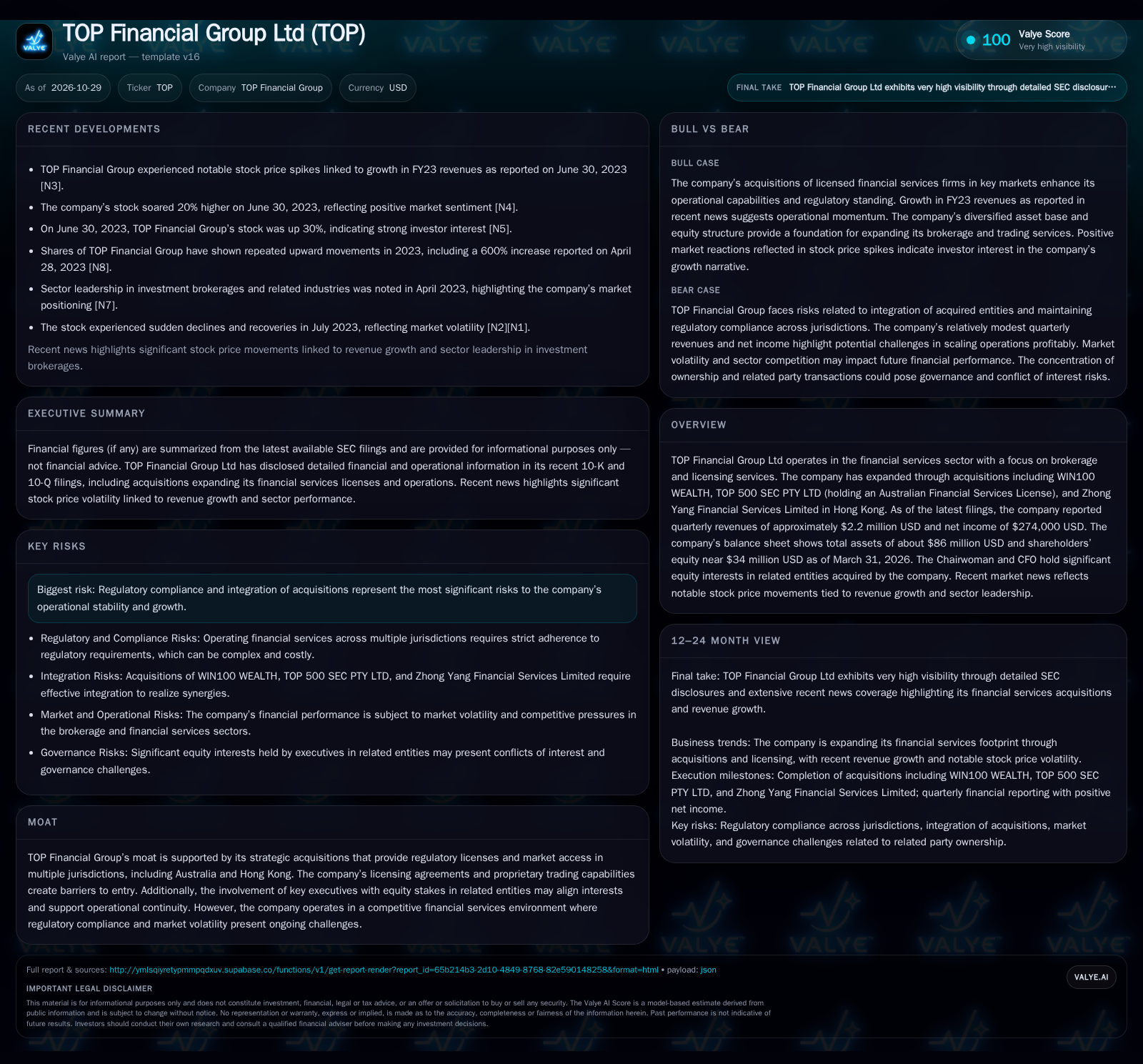
TOP Financial Group has executed a series of acquisitions, expanded its regulatory licenses, and raised $80 million in fresh capital as of July 2026. With quarterly revenues of $2.2 million and net income of $274,000, the company is preparing to launch new CFD products and enhance asset management services. The central question is whether it can scale its new offerings and customer base fast enough to offset rising operating costs and integration risks in a volatile, highly regulated marketplace. [S2]
TOP Financial Group Ltd has rapidly evolved from a regional brokerage into a more diversified financial services platform, fueled by a string of acquisitions and a substantial capital raise. With a growing regulatory footprint spanning Australia and Hong Kong, and ambitions to launch new trading and asset management products, the company now faces a pivotal period: Can it translate its expanded capabilities into sustainable, higher-margin growth, or will integration friction and market volatility blunt the benefits of scale? The next phase hinges on execution across technology, compliance, and customer acquisition.
Transformative Acquisitions and Fresh Capital Set the Stage for Expansion
As of the quarter ending September 30, 2026, TOP Financial Group reported revenues of $2.2 million and net income of $274,000, reflecting modest profitability in the context of aggressive expansion. The company completed significant acquisitions in 2023 and 2025, notably WIN100 WEALTH and TOP 500 SEC PTY LTD (with an Australian Financial Services License), as well as Zhong Yang Financial Services Limited in Hong Kong—each adding regulatory licenses and market access. The company reported cash and liquidity metrics for the period; these figures do not by themselves establish operating runway, investment capacity, financial flexibility, or financing capacity. [S2]
Revenue Mix and Cost Structure: From Brokerage Margins to New Fee Streams
TOP Financial Group’s historical revenue has been driven by online brokerage activities, primarily commissions on trade execution and interest income. These revenue streams tend to be sensitive to trading volumes and market volatility, with relatively thin margins in highly competitive markets. The company’s expansion into new geographies and licenses through acquisitions opens up additional fee-generating opportunities, but also adds complexity and fixed costs—including compliance, technology upgrades, and integration expenses.
Looking forward, the company plans to launch contracts for difference (CFDs) in 2027, aiming to generate revenue through commissions (ranging from $2.25 to $50 per lot), bid/offer spreads, and interest rate differentials. If successfully implemented, CFDs could increase average revenue per user and introduce higher-margin, more recurring revenue streams. However, this is contingent on market adoption, effective risk management, and compliance with evolving regulatory standards. The company’s cost base is likely to rise in the near term as it invests in technology, compliance systems, and service expansion, putting pressure on operating leverage until scale is achieved. [S2]
Licensing, Market Access, and the Challenge of Standing Out in a Crowded Field
TOP Financial Group’s competitive position is underpinned by its ability to secure regulatory licenses in Australia and Hong Kong—jurisdictions with high barriers to entry—through targeted acquisitions. This provides access to both regional and global investor populations, particularly within Asian communities. The breadth of its licenses and regulatory approvals could give it a channel advantage over less credentialed entrants.
However, the brokerage and wealth management sector remains intensely competitive, with established global players, digital-first trading platforms, and local incumbents all vying for share. Technology-led differentiation, breadth of product offering, and the ability to deliver a seamless customer experience will be crucial. The company’s plans to roll out value-added services (such as asset management and trust services) could help diversify revenue, but will require sustained investment in product development and marketing. The presence of significant insider ownership in acquired entities introduces both alignment and potential governance complexity.
Unlocking Margin Expansion Through Product Innovation and Customer Growth
In a favorable scenario, TOP Financial Group successfully integrates its recent acquisitions, leverages its expanded regulatory footprint, and launches new products—especially CFDs and asset management services—that resonate with its target markets. This would allow the company to capture higher-margin revenue streams, increase customer lifetime value, and diversify beyond traditional brokerage commissions. If the company can demonstrate accelerating growth in active accounts, rising average revenue per user, and stable or improving compliance metrics, it could set a foundation for operating leverage and sustained profitability.
Evidence supporting this scenario would include a rapid uptick in CFD trading volumes post-launch, visible growth in managed assets, and improved cross-sell rates across the expanded product suite. Announcements of new licensing wins or technology partnerships could further validate the company’s ability to scale and innovate. Ultimately, sustained top-line growth outpacing expense increases would confirm that the integration and expansion strategy is delivering durable margin improvement.
Integration Complexity Tempers Growth Ambitions
The most plausible near-term outcome is a transitional period in which TOP Financial Group experiences incremental revenue growth from its acquired entities and new licenses, but also faces elevated costs and operational friction from ongoing integration. While the company may achieve moderate expansion in its customer base and product offerings, the full margin impact of new services like CFDs and asset management may take several quarters to materialize, given the need for regulatory approvals, technology rollouts, and customer education.
Evidence supporting this view would include continued modest profitability, gradual increases in operating expenses (especially in compliance and technology), and steady—rather than exponential—growth in transaction volumes. Any delays in product launches or regulatory approvals, or signs of customer attrition during platform migrations, would reinforce the challenges of translating scale into sustained earnings growth.
Integration and Regulatory Friction Undermine Expansion Strategy
In a negative scenario, the complexity of integrating multiple acquisitions across jurisdictions overwhelms management’s capacity, leading to operational disruptions, compliance lapses, or customer dissatisfaction. Regulatory risks—such as delayed approvals for new products, increased scrutiny, or unexpected compliance costs—could delay or derail the launch of CFDs and other services, limiting revenue diversification and exposing the company to fines or reputational damage.
This scenario could be confirmed by rising legal or compliance costs, negative regulatory findings, missed product launch timelines, or a decline in customer activity. Sustained margin compression, unexpected losses, or capital raises to cover operational shortfalls would further indicate that the company’s expansion strategy is failing to deliver the anticipated benefits.
Testing the Integration and Product-Expansion Thesis at TOP Financial Group
Quarterly growth in active customer accounts (if disclosed) would be a direct measure of the company’s ability to expand its user base post-acquisition.
CFD trading volume and commission revenue after the 2027 product launch would provide early evidence of product-market fit and incremental margin potential.
Trends in average revenue per user (ARPU) across brokerage, asset management, and new services would help test whether diversification is driving higher-value relationships.
Operating expense growth, especially in compliance and technology, should be monitored to assess whether scale efficiencies are being realized or whether integration is driving sustained cost inflation.
Regulatory filings or disclosures of new licenses, approvals, or compliance actions in Australia, Hong Kong, or other key markets would signal the company’s ability to navigate regulatory complexity.
Customer retention rates and net promoter scores (if disclosed) would indicate the success of platform integration and service quality.
Timing and execution of planned product launches (CFDs, asset management, trust services) will be crucial milestones for validating the company’s growth strategy.
Any changes in related-party transaction disclosures or governance structures could affect perceptions of alignment and operational transparency.
Disclaimer: This is research-only, informational analysis and not investment advice. It may include AI-generated interpretation and general industry context. Always verify important details using primary sources.

Comments