
Commvault’s Subscription Momentum: Recurring Revenue, SaaS Transition, and the Competitive Stakes in Data Protection
Commvault’s latest quarter highlights a decisive shift toward subscription and SaaS-driven growth, as recurring revenue rises and profitability improves.
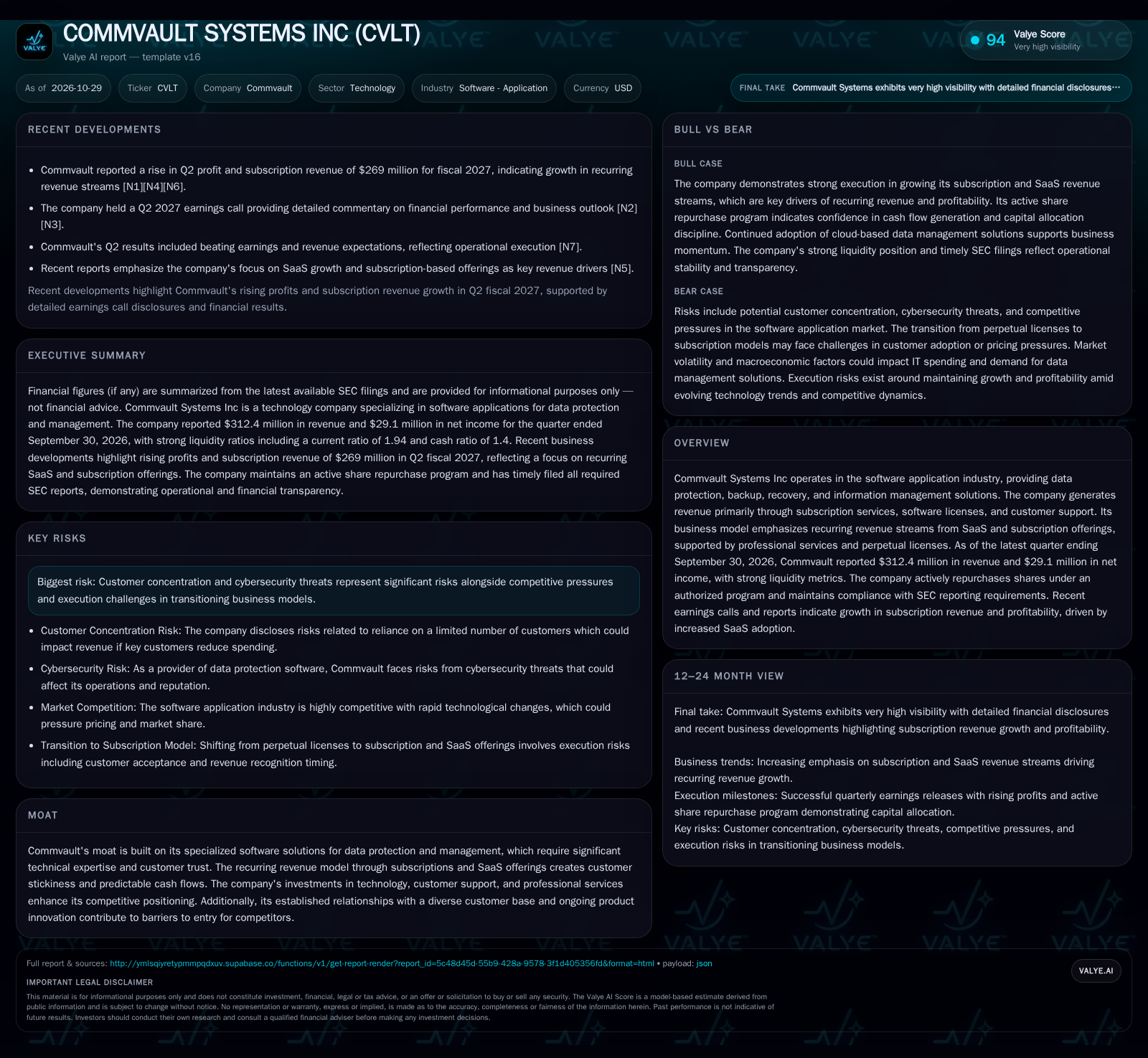
Commvault’s Q2 fiscal 2027 results show substantial progress in growing subscription and SaaS revenue, with $269 million in subscription revenue and $29.1 million in net income on $312.4 million total revenue. Execution in converting legacy customers and maintaining pricing power are crucial watchpoints for the next phase of growth. [S2] [N1] [N4] [N6]
Commvault Systems Inc’s latest results underscore its strategic pivot toward subscription and SaaS-based data protection, with recurring revenue now at the heart of its business model. The company’s $269 million in subscription revenue for Q2 fiscal 2027 outpaces perpetual license sales and supports a $29.1 million net income on $312.4 million total revenue. With a nearly $900 million reported cash balance, ongoing share buybacks, and a record of timely SEC compliance, Commvault enters its next phase with operational stability. The challenge ahead lies in sustaining SaaS adoption, converting legacy customers, and fending off competition in a rapidly evolving market where customer retention and technical differentiation are paramount. [S2] [N1] [N4] [N6]
Subscription Revenue Surges as Commvault Shifts Its Core Business Model
Commvault’s Q2 fiscal 2027 results confirm a marked transition toward recurring revenue, with $269 million generated from subscriptions—now the company’s primary revenue source. Total revenue for the quarter was $312.4 million, and net income reached $29.1 million. This reflects not only topline growth but also improved operational leverage as SaaS and subscriptions scale. The company reported $897 million in cash and equivalents and a current ratio of 1.94 as of September 30, 2026. Commvault’s active share repurchase program, with $130.7 million remaining authorized, further underscores management’s capital allocation discipline. These developments collectively signal a business in transformation, where recurring revenue is now central to both strategy and financial results. [S2] [N1] [N4] [N6]
Recurring Revenue Economics: Predictability, Margin Expansion, and Capital Discipline
Commvault’s pivot to subscription and SaaS revenue fundamentally alters its economic profile. Recurring revenue contracts—typically multi-year in the industry—offer greater predictability and smoother cash flows than legacy perpetual licenses. This shift can drive higher long-term margins if customer retention is strong and support costs do not erode profitability. SaaS delivery, while requiring sustained investment in cloud infrastructure and security, often enables higher gross margins due to software scalability and lower incremental delivery costs after initial deployment.
The company’s ongoing share buyback program and reported cash reserves indicate that it currently holds significant financial resources. However, the economics of SaaS growth often demand continued investment in R&D, customer success, and cybersecurity to reduce churn and defend pricing. Operating leverage may improve as subscription revenue grows, but only if customer acquisition costs (CAC) and support expenses are controlled relative to expansion revenue. The transition from perpetual licenses could create near-term revenue recognition headwinds, but the long-term model should be more resilient to macro shocks if Commvault maintains high renewal rates.
Defending Share in a Fragmented Data Management Market
Commvault competes in a crowded field that includes legacy enterprise backup vendors, cloud-native data protection startups, and hyperscale cloud providers offering bundled data management services. The company’s differentiation rests on the breadth and depth of its data protection and recovery suite, integration capabilities, and customer support. However, as cloud adoption accelerates and hyperscalers bundle backup and recovery with broader infrastructure services, the risk of commoditization rises.
Switching costs in enterprise data protection tend to be high due to data migration complexity and regulatory compliance, but these frictions are less pronounced when customers move to cloud-native solutions. Commvault’s existing customer relationships, technical expertise, and professional services could serve as barriers to entry, but sustained product innovation and demonstrable ROI will be needed to stave off both established and emerging competitors. The company’s disclosed risks around customer concentration and cybersecurity highlight the importance of retaining large accounts and maintaining trust—key ingredients for durable competitive advantage.
Accelerated SaaS Adoption Unlocks Margin Expansion and Higher Retention
If Commvault succeeds in rapidly converting its installed base and new customers to SaaS and subscription models, the company could see further expansion in recurring revenue and margin improvement. Higher SaaS penetration typically translates to lower churn, greater wallet share, and the ability to upsell adjacent services (such as advanced analytics or compliance modules) at attractive gross margins. Evidence of this scenario would include sustained double-digit subscription revenue growth, rising net dollar retention rates (if disclosed), and improving operating margins as support and infrastructure costs scale more efficiently.
Further confirmation would come from public customer wins against cloud hyperscalers or disruptive startups, as well as evidence that Commvault is able to maintain or increase average contract value (ACV) despite the industry’s pricing pressures. A reduction in customer concentration risk—such as a more diversified revenue base—would also validate the company’s ability to scale its platform model.
Sustained Recurring Revenue Growth, with Competitive Friction and Execution Risks
The most plausible outcome is that Commvault continues to grow recurring revenue at a steady pace, driven by incremental SaaS adoption among existing customers and selective wins in new accounts. This trajectory assumes the company can maintain its current profitability profile, balancing ongoing investment in product development and cybersecurity with the efficiency gains of a subscription model.
Growth may moderate as the market matures and competitive offers intensify, especially from cloud-native and hyperscale providers. Evidence confirming this scenario would be continued quarterly growth in subscription revenue, stable or gradually improving operating margins, and no material increase in customer churn or concentration. Falsification would include a sudden slowdown in subscription growth, margin compression due to higher support or acquisition costs, or the loss of major customers to lower-cost competitors.
Execution Stumbles and Competitive Losses Erode Recurring Revenue Base
A negative scenario could unfold if Commvault faces greater-than-anticipated friction converting legacy customers to subscriptions, or if pricing and margin pressure from hyperscalers and cloud-native entrants accelerates. In this case, subscription revenue growth could stall, renewal rates could decline, and operating leverage would deteriorate as fixed costs remain high. Cybersecurity incidents or high-profile customer losses could further damage the company’s reputation, exacerbating churn and increasing customer acquisition costs.
Confirmation of this downside would include quarterly declines in subscription revenue, rising customer concentration, a spike in support or remediation expenses, and public disclosures of lost contracts or data breaches. If the company is forced to discount heavily or invest unsustainably in sales incentives to retain customers, the recurring revenue model could lose its defensive qualities.
Thesis-Testing Developments That Could Shift the Outlook for Commvault
Subscription and SaaS revenue growth rates each quarter, especially relative to total revenue and industry benchmarks.
Net dollar retention or renewal rates, if disclosed, to gauge customer stickiness and the impact of upsells versus churn.
Average contract value (ACV) trends and any disclosures on pricing power or discounting pressure.
Customer concentration metrics: changes in the share of revenue from top customers and any related risk disclosures.
Gross and operating margin trends, as evidence of SaaS model scalability or cost pressure from competition.
Notable customer wins or losses, particularly in competitive takeaways from hyperscalers or disruptive startups.
Cybersecurity incident disclosures or remediation costs, given the company’s core value proposition around data protection.
Share repurchase activity and changes in cash or liquidity position, as signals of capital allocation priorities and balance sheet management.
Disclaimer: This is research-only, informational analysis and not investment advice. It may include AI-generated interpretation and general industry context. Always verify important details using primary sources.

Comments