
BrightSpire Capital’s CRE Credit Model: Flexibility, Earnings Volatility, and the Search for Durable Yield
BrightSpire Capital’s diversified approach to commercial real estate (CRE) credit—anchored in senior mortgage loans, mezzanine debt, and net-leased properties—offers adaptability amid shifting market cycles. Yet recent quarters’ earnings misses spotlight the challenge of balancing risk, leverage, and income consistency in a volatile economic and interest rate environment.
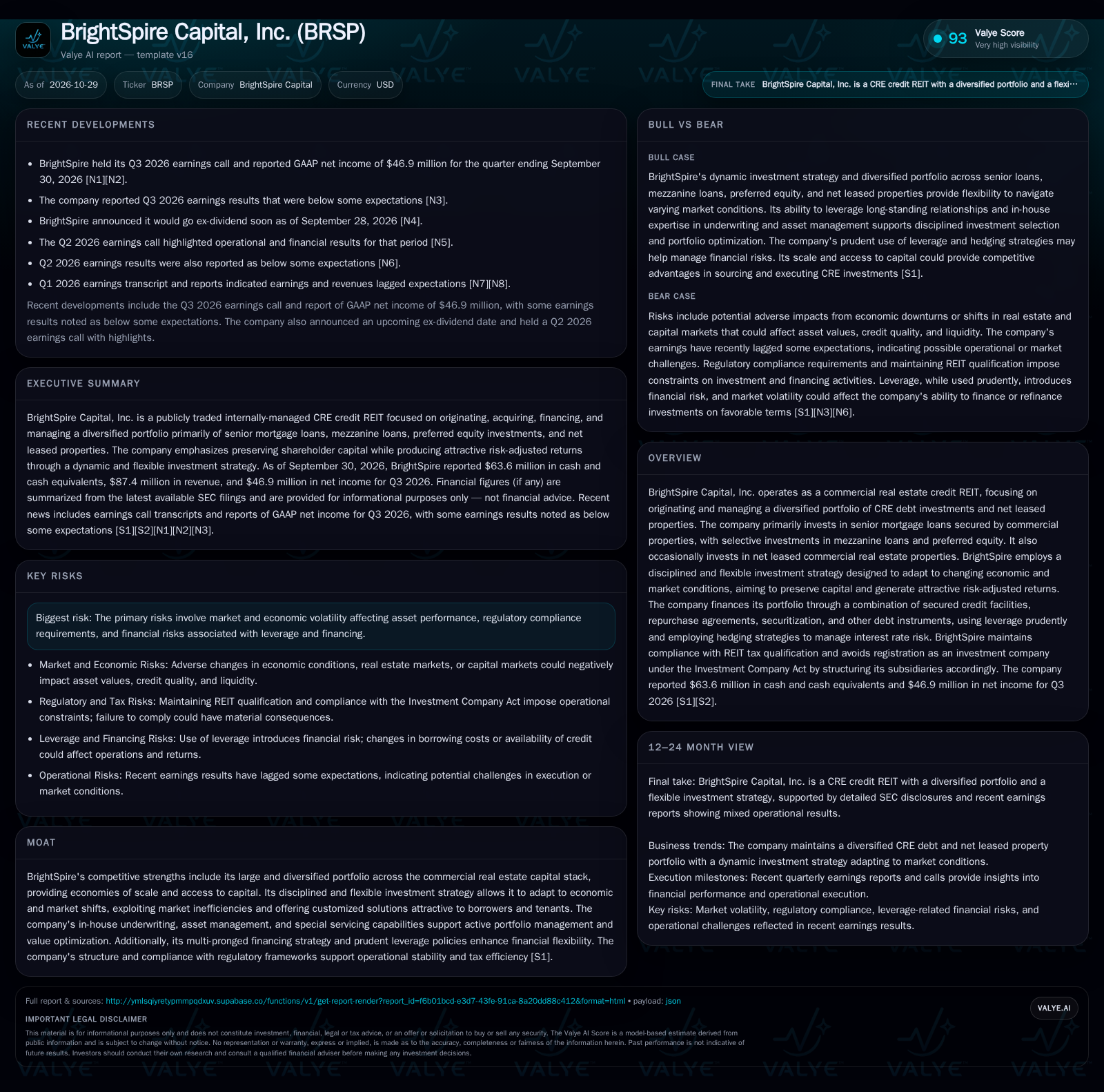
BrightSpire Capital, Inc. (BRSP) is an internally managed commercial real estate credit REIT with a portfolio focused on senior mortgage loans, mezzanine debt, preferred equity, and net leased properties. The company reported $87.4 million in revenue and $46.9 million in net income for Q3 2026, but recent earnings have lagged expectations, reflecting pressures in CRE markets and heightened scrutiny on its risk-return balance and operational execution. The firm’s flexible investment mandate and prudent leverage aim to adapt to evolving market conditions, but uncertainties around credit quality, refinancing, and regulatory compliance remain central to the forward thesis. [S1] [S2] [N1] [N2] [N3] [N6] [N7] [N8]
BrightSpire Capital, Inc. stands at the intersection of flexibility and risk in the commercial real estate credit REIT sector. With a portfolio spanning senior loans, mezzanine debt, preferred equity, and net-leased properties, the firm’s model is designed to adapt to shifting market realities. However, a string of earnings misses in 2026 underscores the sector’s sensitivity to CRE market disruptions and the balancing act required to deliver consistent, attractive risk-adjusted returns while managing leverage and regulatory constraints. As CRE debt markets remain volatile and refinancing risks persist, BrightSpire’s performance will be closely tied to its underwriting discipline, asset selection, and capital markets agility. [S1] [S2] [N1] [N2] [N3] [N6] [N7] [N8]
Recent Earnings Misses Highlight Operating and Market Headwinds
BrightSpire Capital reported $87.4 million in revenue and $46.9 million in GAAP net income for Q3 2026, reflecting positive bottom-line results but a continuation of a trend where quarterly earnings have come in below some analyst expectations. Specifically, Q1, Q2, and Q3 2026 all saw earnings and/or revenues lag consensus, as noted in multiple earnings reports and news summaries. [S2] [N1] [N2] [N3] [N6] [N7] [N8]
This pattern of underperformance suggests that market or operational pressures—such as credit stress in parts of the CRE market, margin compression, or increased funding costs—may be impacting the portfolio. The cited source reports dividend-related activity; that disclosure alone does not establish dividend-policy continuity, management confidence, or a material constraint on capital flexibility. [N4]
With $63.6 million in cash and cash equivalents as of September 30, 2026, BrightSpire has some liquidity, but the focus will be on how it manages asset quality and cash generation in an environment where refinancing risks and property valuations remain highly sensitive to macroeconomic and capital market conditions. [S2]
How BrightSpire Earns: CRE Debt, Net Leases, and the Capital Stack
BrightSpire Capital generates revenue primarily from interest income on senior mortgage loans secured by commercial properties, with incremental yield from mezzanine loans and preferred equity investments. In addition, net leased CRE properties provide rental income streams with the potential for modest rental growth and reduced operating expense risk, as tenants typically bear property-level costs. [S1]
The economic engine of the business relies on the spread between asset yields (interest or rent earned) and funding costs, with the potential for enhanced returns if leverage is used prudently. Senior loans tend to offer lower yields but higher security, while mezzanine and preferred equity positions introduce greater risk but can boost blended portfolio returns. The mix and allocation across these instruments is adjusted dynamically based on market opportunity and risk assessment.
Operating leverage in BrightSpire’s model is relatively modest compared to traditional operating companies, as the REIT structure passes through most cash flows to shareholders via dividends. However, scale can yield some expense efficiencies, particularly in underwriting and asset management. Capital needs are continuous, as repayments, refinancing, or asset sales require reinvestment to maintain income, and the company uses a blend of secured revolving credit, repurchase agreements, and securitizations to finance its portfolio. [S1]
Interest rate movements and credit spreads directly affect both asset yields and the cost of funding. The company employs hedging to mitigate some interest rate risk, but sudden spread widening or credit events can still pressure earnings and book value.
Adapting to CRE Market Shifts: BrightSpire’s Place Among CRE Credit REITs
BrightSpire operates in a highly competitive CRE credit market, facing competition from other publicly traded mortgage REITs, private credit funds, banks, and insurance companies. Its advantages include a diversified portfolio across the capital stack, internal management, and the ability to originate as well as acquire assets, which can create flexibility in sourcing and structuring deals. [S1]
The company’s scale provides some access to capital and potential economies in asset management, while its net lease exposure may offer more stable income compared to pure CRE debt peers. However, this advantage is counterbalanced by sector-wide risks: rising interest rates, weakening property fundamentals in some sectors (such as office), and competition for high-quality lending opportunities can erode margins and increase credit risk.
Switching frictions for borrowers in CRE lending are moderate; relationships and execution certainty matter, but capital is mobile and pricing sensitive. BrightSpire’s ability to offer creative structuring and quick execution may win deals, but it must balance this with credit discipline. Technology substitution is limited in this space, but the rise of private credit funds and non-bank lenders continues to pressure spreads and terms.
Discipline in Underwriting and Market Recovery Drive Outperformance
If BrightSpire’s underwriting discipline results in lower-than-peer credit losses and its dynamic allocation enables timely shifts into higher-yielding or more resilient asset classes, the company could outperform in a CRE market recovery. A stabilization or rebound in property values, combined with successful refinancing of portfolio assets, would support income consistency and book value preservation.
Upside would be confirmed by a reversal of the earnings-miss trend, with sequential improvement in core earnings per share, lower realized credit losses, and evidence of successful redeployment of capital into attractive new investments. Expanding net lease exposure to sectors with strong tenant credit could further enhance stable cash flows.
Falsification would occur if credit losses rise, new originations are limited or come at lower spreads, or if dividend coverage weakens despite apparent market stabilization.
Navigating a Choppy Market: Mixed Results as CRE Headwinds Persist
The most plausible scenario is that BrightSpire continues to deliver mixed results as it manages through a volatile CRE environment. Some legacy assets may face refinancing challenges or credit impairment, but the diversified portfolio and flexible investment mandate allow the company to offset pressures by shifting capital to more attractive opportunities as they arise.
Earnings may remain lumpy, with periodic misses or beats depending on the timing of credit events, asset sales, or new originations. Dividend payments are likely to persist but may be subject to adjustment if core earnings deteriorate.
CRE Market Stress and Funding Cost Surges Pressure Balance Sheet
A severe downside scenario could unfold if CRE market conditions worsen—due to rising interest rates, declining property values, or a wave of tenant defaults—leading to higher credit losses and reduced income. If funding markets tighten and leverage becomes more expensive or less available, BrightSpire could face margin compression and challenges in refinancing its own obligations.
This could be exacerbated by regulatory or tax compliance issues or an inability to maintain REIT qualification, which would have material negative impacts. Confirming evidence for this scenario would include a sharp increase in non-performing assets or credit provisioning, a significant dividend reduction, asset sales at discounts to book value, or covenant breaches on financing lines.
Falsification would require observable resilience in credit metrics and stable access to attractively priced capital even as broader CRE markets struggle.
Signals That Will Test BrightSpire’s CRE Credit Thesis in 2026–2027
Quarterly trends in non-performing loans, credit losses, and provisions—if disclosed—will reveal the true credit quality of the portfolio.
Core earnings per share and dividend coverage ratios, especially after excluding non-recurring items, would help test the sustainability of shareholder returns.
Net asset value (book value) per share trends versus peers: persistent declines may indicate credit stress or asset markdowns.
Volume and pricing of new originations or acquisitions, particularly the yield spread over funding cost, will indicate the company’s ability to find attractive risk-adjusted returns.
Changes in leverage ratios and the terms/availability of secured and unsecured financing facilities could signal shifts in funding risk.
Disclosure of tenant quality, lease duration, and rent collections in the net lease portfolio would clarify the stability of this income stream.
Progress on recycling capital from maturing or underperforming assets into higher-yielding or more defensive investments will be critical for medium-term performance.
Any regulatory, tax, or compliance developments affecting REIT status or investment company exclusions should be monitored for potential structural risks.
Disclaimer: This is research-only, informational analysis and not investment advice. It may include AI-generated interpretation and general industry context. Always verify important details using primary sources.

Comments