
American Water Works: Scale, Regulation, and the Capital-Intensity Dilemma in U.S. Water Utilities
Recent acquisitions and infrastructure investments have expanded American Water Works’ regulated footprint, but the company’s low liquidity ratios underscore the structural capital demands of the business. The core question is whether scale and customer growth can sustainably outpace the sector’s persistent funding and regulatory hurdles.
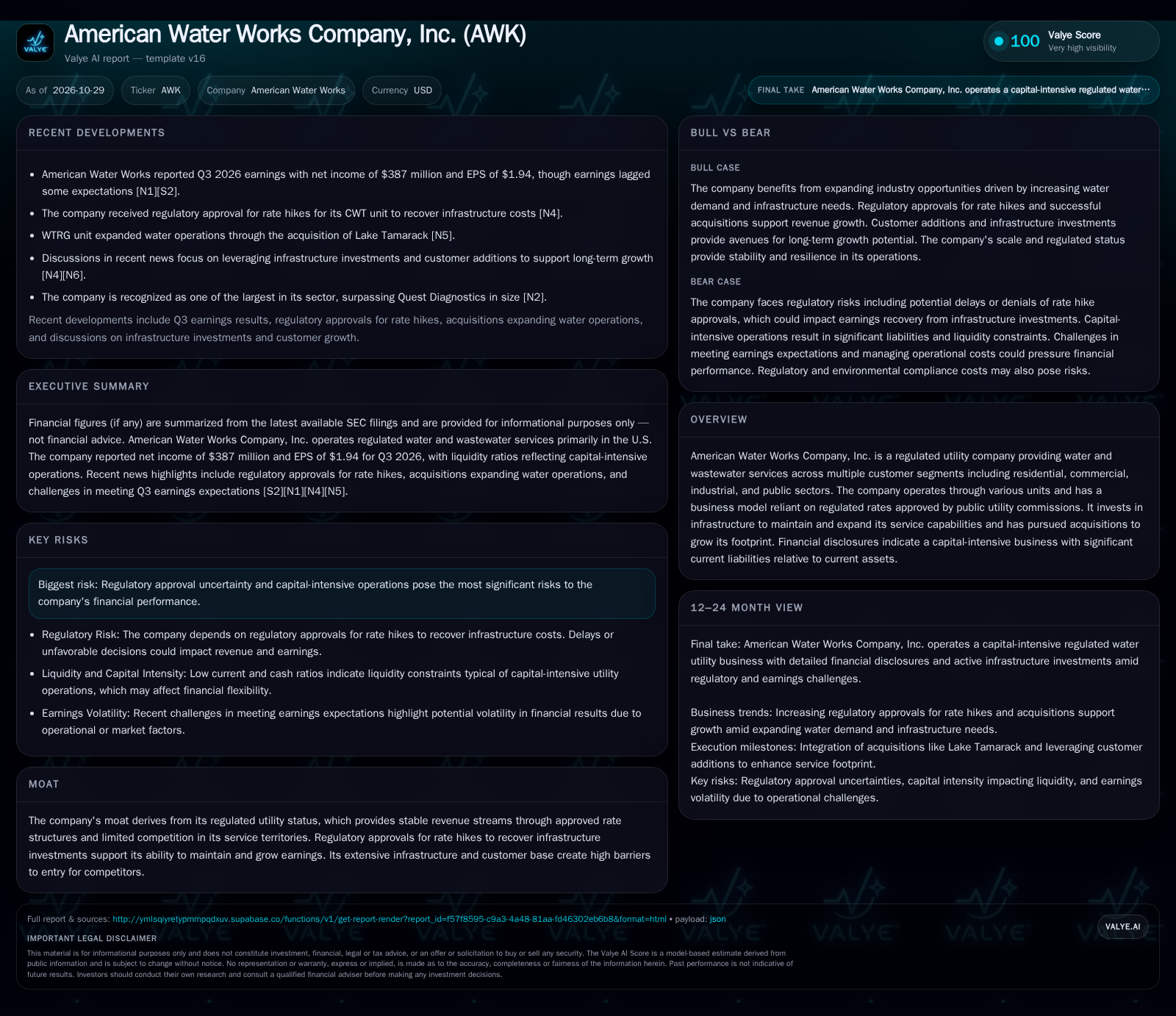
American Water Works remains a leading player in regulated U.S. water and wastewater utilities, recently expanding through acquisitions like the Nexus and Gordon’s Corner deals. Net income for Q3 2026 was $387 million, but liquidity ratios remain low, reflecting heavy capital requirements. The company’s scale and regulatory status offer some resilience, yet execution on integration, rate recovery, and infrastructure returns will determine whether growth can translate into durable shareholder value. [S2]
American Water Works Company, Inc. (AWK) stands as one of the largest regulated water and wastewater utilities in the U.S., recently surpassing notable sector peers in scale. In 2026, the company advanced its growth strategy with multiple acquisitions, most notably the $319 million Nexus deal and the addition of Gordon’s Corner, collectively bringing over 81,000 new customers into its regulated base. The investment case now hinges on whether AWK’s scale and infrastructure strategy can deliver sustainable returns amid regulatory scrutiny and funding constraints. [S2] [N1] [N2]
Recent Acquisitions and Financial Metrics Shape the Strategic Landscape
American Water Works reported net income of $387 million for the quarter ending September 30, 2026, with basic and diluted EPS of $1.94. The company’s acquisition activity was robust, closing the $319 million Nexus deal (adding 47,000 customer connections) and eight other system acquisitions, including Gordon’s Corner, for a combined addition of approximately 81,000 customers year-to-date. Despite these expansions, AWK’s liquidity profile remains tight: as of September 30, 2026, it reported $121 million in cash, current assets of $1.48 billion, and current liabilities of $3.79 billion, yielding a current ratio of 0.39 and a cash ratio of 0.03. These metrics reflect the capital-intensive nature of regulated utilities, with significant short-term obligations and ongoing infrastructure funding needs. [S2]
How Regulated Rates and Infrastructure Spending Drive Earnings—And Strain Cash Flow
American Water Works’ core business model is anchored in regulated water and wastewater services, where revenue is primarily determined by approved service rates and the size of its customer base. Rates are set by state and local regulators, typically allowing for a return on invested capital in infrastructure upgrades and expansions. This creates a direct link between capital spending and long-term revenue growth, but also introduces a lag between investment and recovery, as rate cases can take months or years to resolve.
The company’s cost structure is dominated by fixed costs—depreciation, maintenance, and interest on debt—while variable costs such as chemicals and energy are relatively stable. Acquisitions and new capital projects increase the asset base, raising both the potential rate base and associated depreciation and interest expenses. Operating leverage can be significant: once new infrastructure is in place and approved for rate recovery, incremental customers and usage can drive profitability. However, the need for upfront funding means that American Water Works is perpetually balancing growth ambitions with liquidity management and regulatory timing.
The sector’s capital intensity is structural, and liquidity metrics alone do not capture the underlying asset value or future regulated cash flows—but they do highlight the importance of ongoing access to capital markets and prudent financial management.
The interplay between regulatory approval processes and capital allocation decisions is critical in shaping American Water Works’ financial trajectory. Regulatory lag—the time between capital expenditure and authorized rate recovery—can compress free cash flow, necessitating careful prioritization of projects with the highest strategic and financial returns. In this context, the company must balance short-term liquidity pressures against long-term asset base growth, often relying on external financing to bridge timing gaps. Additionally, the regulatory framework’s emphasis on cost-of-service principles means that inefficiencies or cost overruns in capital projects can directly impact allowed returns, underscoring the importance of disciplined project management and transparent regulatory communication.
Scale, Infrastructure, and Regulatory Barriers: Defining the Competitive Moat
AWK’s primary competitive advantage lies in its scale, established infrastructure, and regulated market position. The company is now among the largest in the sector, recently surpassing Quest Diagnostics in size, and its extensive network of water and wastewater assets creates significant barriers to entry for new competitors. Incumbency in regulated service territories, long-term customer relationships, and the high cost of duplicating physical assets protect AWK from direct competition in most regions.
However, the sector is not immune to counterforces. Regulatory decisions can cap returns or delay cost recovery, and local municipalities may periodically consider municipalization (taking utility operations in-house) or contract with alternative providers. Substitution risk is low, as water provision is an essential service, but customer dissatisfaction or regulatory intervention could still impact growth or returns. Peer competition centers on acquisition of smaller systems and operational efficiency, with other large regulated utilities and select private operators vying for similar assets.
Scale not only provides operational leverage but also enhances American Water Works’ negotiating position with regulators and suppliers. Larger utilities can spread fixed administrative and compliance costs over a broader customer base, potentially achieving lower per-unit costs relative to smaller peers. This scale advantage may also facilitate more sophisticated data analytics and asset management practices, improving system reliability and customer service. However, the complexity of integrating diverse systems and regulatory regimes across multiple jurisdictions can introduce execution risk. The company’s ability to standardize processes and leverage best practices across its footprint will be a key determinant of whether scale translates into sustainable competitive advantage rather than operational complexity.
If Integration and Rate Recovery Outpace Capital Strain, Shareholder Value Could Accelerate
The most favorable scenario for American Water Works involves the successful integration of recent acquisitions—such as Nexus and Gordon’s Corner—combined with timely and favorable regulatory approvals for rate increases. If AWK can demonstrate operational synergies, achieve customer growth, and secure prompt rate base recognition for new investments, the company could realize outsized gains in both earnings and cash flow.
Evidence supporting this scenario would include above-peer growth in regulated asset base, improved operating margins post-acquisition, and a rising trend in allowed returns on equity from regulators. Announcements of regulatory approvals, successful integration milestones, and sustained customer growth rates would help validate this bullish pathway.
If American Water Works can leverage its scale to accelerate innovation in infrastructure management—such as deploying advanced metering, leak detection technologies, or predictive maintenance—it could enhance operational efficiency and reduce non-revenue water losses. These improvements would not only support regulatory arguments for rate base expansion but also improve customer satisfaction and regulatory goodwill. Moreover, demonstrating proactive environmental stewardship and alignment with emerging sustainability standards could position the company favorably in rate cases, potentially unlocking higher allowed returns or expedited approvals. Such strategic initiatives, if effectively communicated and executed, could create a virtuous cycle of investment, regulatory support, and shareholder value creation.
Regulated Growth Continues, but Capital Demands and Regulatory Lag Restrain Upside
The most plausible path forward is one of steady, regulated growth, with AWK continuing to add customers and invest in infrastructure, but facing ongoing liquidity constraints and earnings volatility tied to the timing of regulatory decisions. Acquisitions will expand the customer base and rate base, but integration costs and the lag between investment and rate recovery will temper near-term returns.
This scenario would be confirmed by a consistent cadence of incremental customer additions, stable or modestly improving operating margins, and regulatory outcomes that track in line with historical averages. However, significant upside is capped by the inherent capital intensity and the need for regulatory approval on all major revenue drivers.
In a scenario of steady but constrained growth, American Water Works may face incremental pressure to optimize its capital structure and cost of capital. The capital-intensive nature of the business and regulatory scrutiny on financing costs mean that maintaining an efficient balance between debt and equity financing becomes increasingly important. The company’s ability to access diverse capital sources at competitive rates will influence its capacity to fund infrastructure projects without undue dilution or leverage risk. Additionally, maintaining transparent and constructive engagement with regulators regarding capital plans and financing strategies will be essential to align expectations and mitigate potential pushback on rate recovery mechanisms.
Delayed Rate Recovery or Funding Constraints Could Trigger Earnings and Growth Headwinds
A less favorable outcome could materialize if regulatory bodies delay or deny necessary rate increases, or if capital market conditions tighten, making it more expensive or difficult for AWK to fund ongoing infrastructure investments. In this scenario, the gap between capital outlays and cash recovery would widen, pressuring earnings and potentially forcing a slowdown in growth initiatives or asset sales.
Evidence of this downside would include protracted rate case timelines, regulatory pushback on allowed returns, increasing short-term borrowing costs, or a rise in deferred capital projects.
What Could Shift the Outlook for American Water Works in the Next 12-24 Months?
Progress on integrating the Nexus and Gordon’s Corner acquisitions, including customer retention and cost synergy capture.
Trends in regulatory approvals for rate increases—frequency, magnitude, and lag relative to capital investments.
Access to and pricing of debt/equity capital for ongoing infrastructure programs and acquisitions.
Customer growth rates in existing and newly acquired service territories, if disclosed.
Movement in operating margins and return on equity following major investments or regulatory outcomes.
Any indications of regulatory or municipal challenges to AWK’s service territories or rate structures.
Material changes in capital expenditure plans, including project deferrals or accelerations in response to funding or regulatory developments.
Disclaimer: This is research-only, informational analysis and not investment advice. It may include AI-generated interpretation and general industry context. Always verify important details using primary sources.

Comments