
Franklin BSP Realty Trust: Dual-Segment Diversification Meets Volatile Real Estate Credit Cycles
Franklin BSP Realty Trust combines commercial real estate debt investments with agency multifamily lending and servicing, aiming for risk-adjusted returns through diversified exposures and government-backed channels. Recent net losses, share volatility, and preferred stock yields above 10% highlight both market pressure and the challenge of navigating credit cycles with a leveraged, externally managed platform.
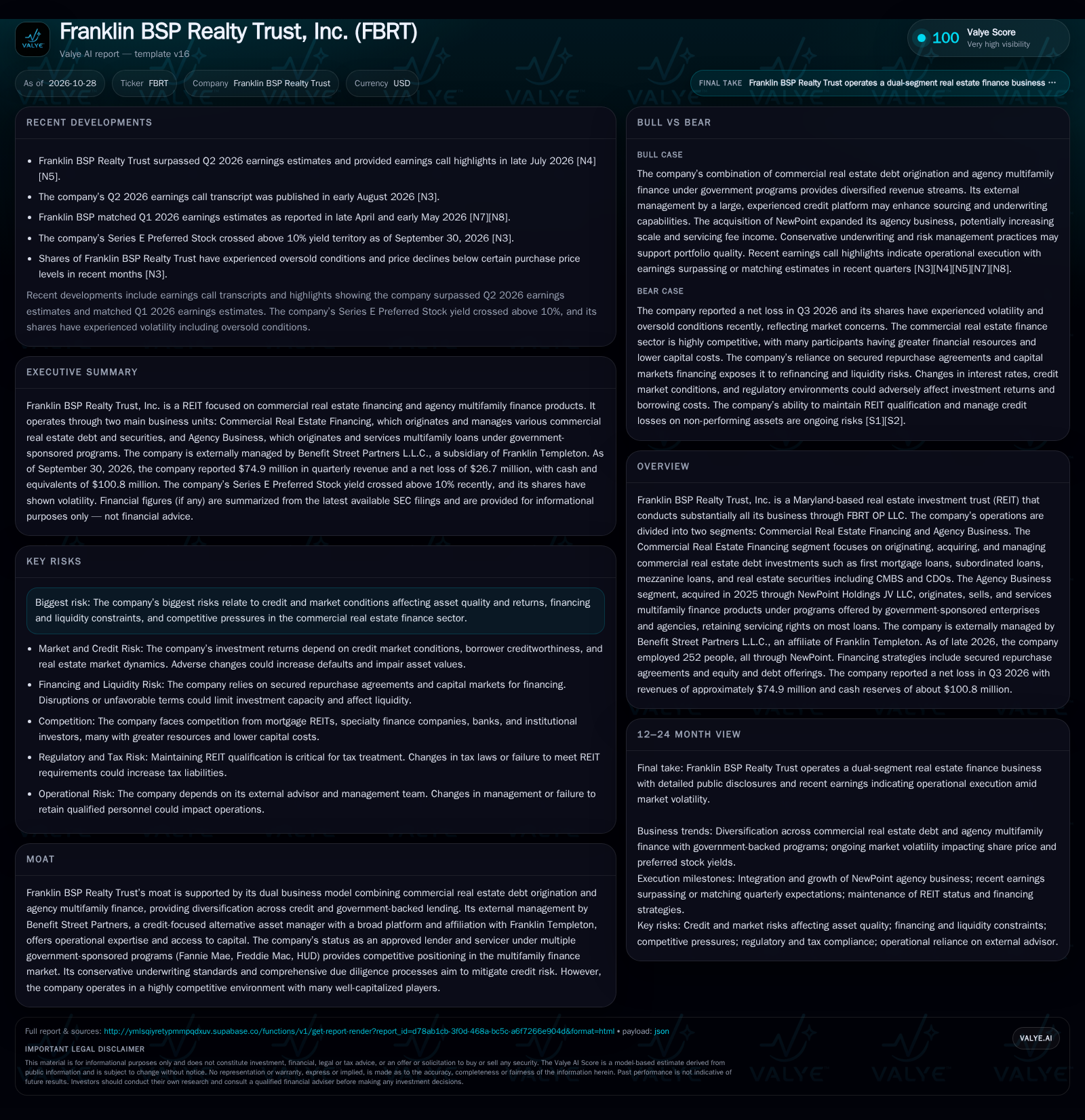
Franklin BSP Realty Trust operates a two-pronged model—commercial real estate debt and agency multifamily lending/servicing—under external management by a Franklin Templeton affiliate. The business recently reported a net loss, volatile common shares, and double-digit preferred yields, underscoring sensitivity to real estate credit cycles and funding markets. The trajectory will depend on asset quality, funding access, and the ability to grow fee-based agency revenues.
Franklin BSP Realty Trust stands at the intersection of commercial real estate credit and government-backed multifamily finance. Its dual-segment model aims to blend risk-adjusted returns from direct lending with more stable fee streams from agency servicing, while external management by a Franklin Templeton affiliate brings institutional scale but also potential alignment frictions. Recent financials—net losses, preferred yields above 10%, and share volatility—underscore the business’s exposure to shifting credit conditions and funding costs. The next phase hinges on asset quality stabilization, the durability of agency servicing economics, and the company's ability to navigate a volatile credit cycle with externally managed, leveraged capital.
Recent Losses and Preferred Stock Yields Signal Market Pressure
Franklin BSP Realty Trust reported a net loss of $26.7 million in Q3 2026 on $74.9 million in revenue, with book value per share at $14.11 and fully converted book value at $14.26 [S2]. This negative result follows a pattern of recent share price volatility, including oversold conditions and declines below certain purchase price levels [N3]. The company’s Series E Preferred Stock yield rose above 10% as of September 30, 2026, a level that typically indicates increased perceived risk by investors or a higher required return for capital [N3]. The company reported cash and liquidity metrics for the period; these figures do not by themselves establish operating runway, investment capacity, financial flexibility, or financing capacity. [S2] These facts collectively highlight an environment where both asset values and funding costs are under pressure, with the market demanding higher compensation for risk and uncertainty about the company’s ability to generate stable returns.
How FBRT’s Dual-Segment Model Drives Revenue—and Exposes Risk
Franklin BSP Realty Trust’s economics are built around two complementary but distinct engines. The Commercial Real Estate Financing unit originates, acquires, and manages a portfolio of loans—first mortgages, subordinated and mezzanine positions, and commercial mortgage-backed securities (CMBS and CDOs). Revenue streams here are driven by net interest income (the spread between loan yields and funding costs), origination fees, and potentially capital gains or losses on asset sales or marks. The business is capital-intensive and typically levered via secured repurchase agreements, amplifying both returns and risk to equity in volatile markets.
The Agency Business, acquired through NewPoint Holdings JV LLC in 2025, originates, sells, and services multifamily loans under programs with Fannie Mae, Freddie Mac, Ginnie Mae, and HUD. Unlike balance-sheet lending, this segment generates fee income from origination, sale, and ongoing servicing, with much lower capital requirements. The company retains servicing rights and asset management responsibilities on most loans originated and sold, creating a recurring fee stream that is less sensitive to credit marks but still exposed to underlying housing market cycles and prepayment/refinancing dynamics. If servicing volumes grow, this segment could provide a buffer against cyclical swings in credit spreads and asset values.
External management by Benefit Street Partners introduces a fee layer, which can pressure net returns to shareholders, particularly in periods of weak asset performance. The company’s funding model—primarily secured repurchase agreements—offers efficiency but increases vulnerability to sudden changes in funding costs or availability. The ability to raise additional equity or unsecured debt provides some flexibility, but market conditions could limit this option, especially if book value erodes or share prices remain volatile.
Competitive Landscape: Scale, GSE Access, and External Management
Franklin BSP Realty Trust faces a highly competitive environment populated by mortgage REITs, specialty finance companies, banks, and institutional investors—many with greater scale, lower funding costs, or vertically integrated origination and servicing platforms. Its dual-segment approach provides some diversification: the agency business leverages GSE approvals and servicing relationships, creating barriers to entry for new competitors and potentially offering more stable, fee-driven revenues.
However, the commercial real estate credit market is characterized by aggressive competition for quality loans and compressing spreads, especially as capital flows back into fixed income. Banks and large non-bank lenders can often outbid for prime assets, while public REITs with higher ratings may access cheaper funding. The company’s affiliation with Franklin Templeton, via Benefit Street Partners, could provide sourcing advantages and institutional credibility, but also means management incentives and priorities may not be perfectly aligned with FBRT public shareholders.
The agency business’s ability to originate and service loans under Fannie Mae, Freddie Mac, and HUD programs is a competitive strength, as GSE approval is not easily replicated. Still, fee compression and regulatory changes in the multifamily finance space remain persistent risks. Overall, the company’s competitive position depends on maintaining strong origination channels, prudent risk management, and the ability to balance leverage with asset quality.
If Credit Markets Stabilize, Agency Growth Could Offset CRE Headwinds
A favorable scenario for Franklin BSP Realty Trust would see stabilization or improvement in commercial real estate credit markets, allowing existing loans to perform or recover value, while origination spreads remain attractive. If the company is able to grow its agency business—expanding the volume of loans originated and serviced for GSEs—recurring fee income could rise, reducing reliance on net interest income and providing ballast against future credit cycles.
Confirmation of this scenario would include a return to profitability, visible growth in agency servicing and origination fee income, and a narrowing of the yield spread on the Series E Preferred Stock (indicating reduced perceived risk). Share price recovery toward or above book value per share would further support this case. Additional evidence might include successful refinancing or extension of secured funding at stable costs, or increased volumes of agency loan originations and servicing rights retained.
Falsification would occur if credit losses accelerate, fee income stagnates, or if funding markets tighten further, leading to continued net losses and persistent share price discounts to book value.
Mixed Outcomes as CRE Cycles Drag and Agency Fees Provide Partial Cushion
The most plausible near-term scenario is one of mixed performance: commercial real estate (CRE) loan portfolios may continue to experience pressure from valuation declines, higher credit losses, or refinancing challenges, particularly in office or retail sectors. The company may offset some of this with steady, though not rapidly growing, agency fee income from multifamily originations and servicing. External management by Benefit Street Partners is likely to keep origination and asset management machinery running efficiently, but the fee drag and potential misalignment may limit upside in weak markets.
In this scenario, Franklin BSP Realty Trust could hover near break-even or modest losses, with book value slowly eroding unless credit conditions improve. Preferred stock yields may remain elevated until sustained profitability and asset quality improvements are evident. Confirmation would come from stable or slightly improving net interest income, consistent agency fee revenue, and maintenance of book value per share within a tight range. Falsification would involve a sharp deterioration in asset quality, a spike in funding costs, or loss of GSE origination/servicing status.
Funding Disruption and Credit Losses Could Pressure Book Value and Survival
In a negative scenario, further deterioration in CRE markets—higher defaults, falling collateral values, and reduced liquidity—could trigger realized losses and write-downs. If funding markets seize up or counterparties tighten terms on secured repurchase agreements, the company could be forced to liquidate assets at distressed prices to meet obligations. A prolonged period of net losses would erode book value per share, potentially triggering breaches of debt covenants or necessitating dilutive equity raises.
If the agency business fails to grow or suffers from regulatory or GSE program changes, fee income could stagnate or shrink, reducing the diversification benefit. Evidence confirming this scenario would include continued net losses, declining book value, rising preferred yields, and negative trends in agency origination or servicing volumes. Falsification would require stabilization or improvement in asset quality, successful funding renewals, and demonstrated growth in agency fee income.
Signals That Will Clarify Franklin BSP Realty Trust’s Resilience and Trajectory
Quarterly trends in net interest income and credit loss provisions—rising credit costs or declining spreads would signal ongoing portfolio stress.
Change in book value per share—persistent declines would indicate asset value impairment or dilution risk.
Volume and profitability of agency loan originations and servicing rights retained (if disclosed)—growth here would suggest diversification is working.
Series E Preferred Stock yield trends—a falling yield would indicate improved market confidence; a sustained rise would signal ongoing risk perceptions.
Refinancing or extension of secured repurchase agreements—favorable terms and maturities would reduce liquidity risk.
Share price discount or premium to book value—a narrowing discount (or premium) would suggest improved investor sentiment and/or asset quality.
Any changes in GSE or agency program participation—loss or expansion of approvals would materially affect the agency business outlook.
Disclaimer: This is research-only, informational analysis and not investment advice. It may include AI-generated interpretation and general industry context. Always verify important details using primary sources.

Comments