
AXIS Capital in 2026: Specialty Underwriting Discipline Meets Shifting Market Dynamics
AXIS Capital Holdings Ltd is navigating moderating pricing, competitive pressures in cyber and property lines, and evolving risk transfer needs with a disciplined underwriting approach. Recent growth in gross premiums, an improved combined ratio, and a significant loss portfolio transfer signal both operational resilience and the complex realities of specialty insurance economics.
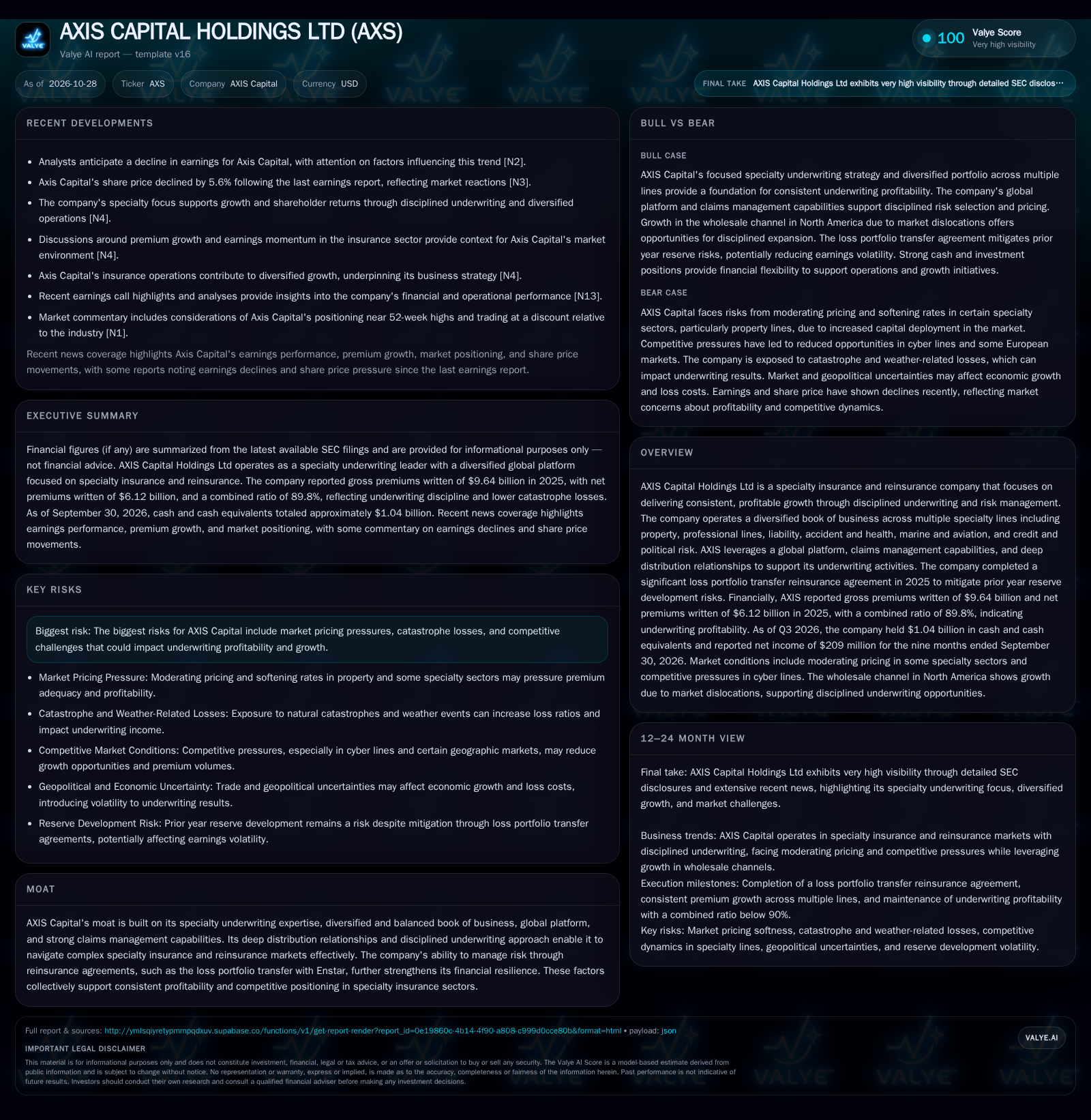
AXIS Capital Holdings reported a 7% increase in gross premiums written to $9.64 billion in 2025 and improved its combined ratio to 89.8%, reflecting disciplined underwriting and lower catastrophe losses. However, the company faces moderating pricing in several specialty lines, ongoing competitive pressures—especially in cyber—and recent analyst expectations of earnings declines. A major loss portfolio transfer with Enstar in 2025 reduced reserve risk exposure, but volatility in underwriting results remains a structural challenge. How AXIS adapts its risk selection, pricing, and capital deployment in a changing re/insurance market will determine its ability to sustain profitable growth. [S1] [S2] [N2] [N3]
AXIS Capital Holdings Ltd exemplifies the complex balancing act of specialty insurance: delivering underwriting profitability in a market where pricing, competition, and risk dynamics are in flux. The company’s 2025 results highlight both operational strengths—premium growth, a sub-90% combined ratio, and proactive risk transfer—and the persistent headwinds of softening rates and competitive intensity, especially in cyber and property lines. With analysts anticipating near-term earnings declines and the wholesale channel offering selective growth, the company’s ability to sustain disciplined risk selection and adapt to shifting market signals will be pivotal.
Recent Performance and Risk Transfer Shape AXIS Capital’s 2026 Outlook
AXIS Capital reported gross premiums written of $9.64 billion in 2025, marking a 7% increase from 2024, with insurance lines such as property, professional, liability, and marine/aviation contributing most of the growth. The combined ratio improved to 89.8% in 2025 from 92.3% in 2024, reflecting effective underwriting discipline and lower catastrophe losses. The company’s net premiums written reached $6.12 billion, up 6% year-over-year. Notably, AXIS completed a loss portfolio transfer reinsurance agreement with Enstar in April 2025, retroceding legacy reinsurance liabilities and reducing exposure to prior year reserve development. As of September 30, 2026, cash and cash equivalents stood at $1.04 billion, and net income for the first nine months of 2026 was $209 million. However, market sentiment has been cautious: analysts expect earnings to decline in the near term, and the share price fell 5.6% following the last earnings report. [S1] [S2] [N2] [N3]
Specialty Insurance Economics: Pricing, Loss Ratios, and the Role of Capital
AXIS Capital’s core economic engine is disciplined underwriting across specialty insurance and reinsurance lines, where profitability hinges on premium adequacy relative to claims, expense control, and prudent capital deployment. The improved combined ratio of 89.8% in 2025 suggests the company generated underwriting profits, with every $1 of premium resulting in less than $0.90 in claims and expenses. This margin is crucial in specialty markets, where loss volatility and catastrophe risk can rapidly erode profits. AXIS supplements underwriting income with investment returns—$766.9 million in 2025—leveraging premiums held before claims are paid. The loss portfolio transfer with Enstar offloads reserve risk from legacy business, potentially stabilizing future earnings and freeing capital for new underwriting. However, the economics are sensitive to market cycles: moderating rates in property and some specialty lines may compress margins, especially as new capital enters the sector and softens pricing. The company’s ability to dynamically adjust risk appetite, re-price business, and manage expense ratios will be critical to sustaining returns above cost of capital. [S1]
Navigating a Fragmented and Competitive Specialty Market
AXIS Capital operates in a highly fragmented specialty insurance and reinsurance landscape, competing with global specialty carriers, Lloyd’s syndicates, and regional/niche underwriters. Its competitive positioning rests on expertise in complex risks, diversified product lines, global reach, and established distribution through wholesale channels. Deep claims management and risk selection capabilities provide a partial moat, as does the company’s ability to offer bespoke solutions in areas like marine, aviation, and professional lines. However, these advantages are under constant pressure: increased capital inflows have softened property rates, and competition in cyber has led to reduced opportunities and pricing pressure. The wholesale channel in North America is a growth lever due to standard market dislocations, but this advantage could diminish if standard carriers re-enter specialty lines or if rate moderation persists. The critical question is whether AXIS can continue to differentiate on underwriting quality and service as commoditization and digital distribution reshape the competitive landscape.
Disciplined Underwriting and Selective Growth Drive Sustainable Profits
The most favorable outcome for AXIS Capital involves maintaining underwriting discipline as market pricing moderates, selectively growing in lines where risk-adjusted returns remain attractive, and leveraging its global platform to exploit dislocations—especially in the North American wholesale channel. If the company continues to improve its combined ratio and avoids outsized catastrophe or reserve shocks, core profitability could be sustained even as topline growth slows. The successful execution of the loss portfolio transfer may further reduce earnings volatility and free up risk capital for new business. Upside confirmation would come from continued combined ratios below 90%, stable or rising net investment income, and visible growth in profitable specialty lines offsetting softness in cyber and property. Evidence of market share gains in targeted niches and renewal rate discipline would also support the upside case.
Managing Through Moderating Rates and Competitive Headwinds
The most plausible near-term scenario is that AXIS Capital’s premium growth moderates as pricing softens in property and some specialty lines, while the company maintains combined ratios in the low 90s through active risk selection and expense control. Earnings may show some quarter-to-quarter volatility as catastrophe losses and reserve development fluctuate, but the loss portfolio transfer should limit major legacy shocks. Investment income remains a stable contributor, but further upside is limited unless interest rates rise or asset allocation shifts. The company’s share price may remain range-bound until there is clearer evidence that underwriting profitability is durable amid competitive pressures. Confirmation of this scenario would be a steady combined ratio in the low 90s, net premiums tracking close to gross premiums (indicating retention), and stable or modestly growing investment income. Deterioration in renewal pricing, loss cost inflation, or a meaningful uptick in catastrophe losses would challenge the base case.
Pricing Compression and Catastrophe Losses Erode Profitability
A more adverse scenario would see AXIS Capital unable to maintain pricing discipline as competition intensifies and capital continues to flow into specialty lines, driving further rate softening and eroding premium adequacy. If the company experiences above-average catastrophe or large loss events, combined ratios could rise above 95%, putting underwriting profitability at risk. Reserve development could re-emerge as a concern if the loss portfolio transfer does not fully insulate the balance sheet from prior year claims. Declining earnings would pressure the share price and could constrain capital deployment for future growth. Evidence supporting this scenario would include a combined ratio drifting upward, negative reserve development, declining net income, and shrinking net premiums written. Persistent analyst downgrades and further share price declines would also confirm market skepticism about the company’s ability to sustain returns.
Signals That Will Test AXIS Capital’s Specialty Insurance Thesis
Combined ratio trends—especially whether the company can maintain sub-90% levels or if loss ratios begin to rise in response to market softening.
Net premiums written growth relative to gross premiums, which would indicate retention and the effectiveness of risk selection.
Performance of the cyber and property lines—if disclosed, monitoring for further contraction or stabilization in premium volumes and pricing.
Impact of catastrophe events on quarterly results, as outsized losses could quickly reverse underwriting gains.
Reserve development—watch for any indications of adverse prior year claims despite the loss portfolio transfer.
Net investment income trajectory, particularly in light of interest rate movements and asset allocation decisions.
Submission and quote activity in the North American wholesale channel, which could signal the persistence or fading of current growth opportunities.
Management commentary on rate adequacy, capital deployment, and competitive dynamics in specialty lines during future disclosures.
Disclaimer: This is research-only, informational analysis and not investment advice. It may include AI-generated interpretation and general industry context. Always verify important details using primary sources.

Comments