
ServiceNow’s AI Workflow Ambition: Platform Leverage Meets Liquidity and Competitive Crosswinds
ServiceNow remains a leader in enterprise AI workflow automation, expanding its platform with autonomous agents, data fabric integration, and recent acquisitions.
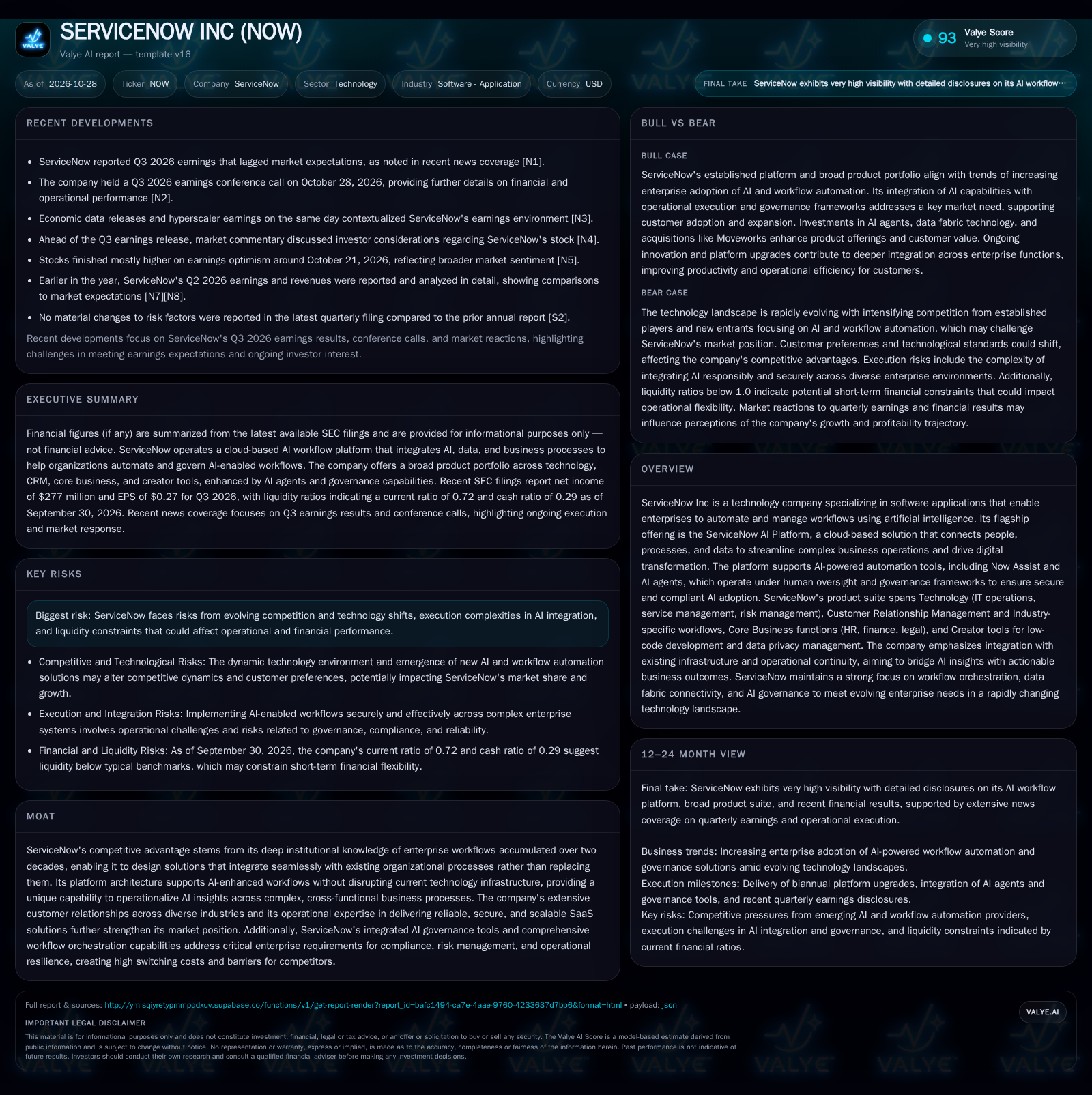
ServiceNow’s platform-centric model continues to drive enterprise workflow automation, integrating AI and governance across a broad product suite. The acquisition of Moveworks and ongoing innovation in AI agents could enhance competitive positioning, but execution risk and intensifying competition remain material counterforces. Watch for evidence of accelerating adoption, margin expansion, and successful integration of new AI capabilities.
ServiceNow sits at the intersection of enterprise digital transformation, offering a cloud-native platform that orchestrates AI-powered workflows across IT, business operations, and industry-specific functions. The company’s core strength lies in its ability to integrate AI, data, and governance into unified workflows, helping organizations automate complex processes while maintaining compliance and operational continuity. The path forward will be defined by ServiceNow’s success in scaling its AI agents, deepening platform integration, and navigating near-term financial constraints.
Earnings Miss and Liquidity Ratios Signal Rising Execution Stakes
ServiceNow reported Q3 2026 net income of $277 million and EPS of $0.27, but earnings lagged market expectations according to recent news coverage [S2] [N1]. The company’s current ratio of 0.72 and cash ratio of 0.29 as of September 30, 2026, are below typical industry comfort zones for short-term liquidity [S2]. While no material changes to risk factors were reported, these financial signals coincide with a pivotal period for the company—including the integration of Moveworks and a continued push into AI-powered workflow automation [S1] [S2]. This context raises the importance of execution and capital discipline as ServiceNow seeks to maintain its leadership in a market facing both technological disruption and cyclical scrutiny.
Platform Economics and the Dynamics of AI-Driven Workflow Automation
ServiceNow’s economic model is built around subscription-based, cloud-delivered workflow solutions that automate and orchestrate complex enterprise processes. Revenue is typically driven by seat-based or usage-based pricing, with upsell and cross-sell opportunities as customers adopt additional modules across IT, CRM, HR, finance, and industry-specific verticals. The platform model enables high gross margins, as incremental users and workflows benefit from significant operating leverage after initial R&D and infrastructure investments.
AI agents and automation tools, including those acquired via Moveworks, may further improve operating efficiency for customers and justify premium pricing or broader adoption. However, the capital intensity of continual platform upgrades, biannual feature releases, and M&A integration creates a need for disciplined cost management—especially in light of current liquidity metrics. If ServiceNow can leverage its existing customer base to expand wallet share and reduce churn, the economics could improve through higher lifetime value and lower per-customer acquisition costs. Conversely, any deceleration in new customer wins or expansion due to macro headwinds or competitive pricing pressure would quickly show in operating leverage and margin compression.
The subscription-based model inherently supports predictable revenue streams, which can be advantageous for forecasting and capital allocation. However, the transition from traditional workflow automation to AI-driven agents introduces complexity in customer value realization and pricing strategies. The effectiveness of AI agents depends heavily on data quality, integration depth, and user adoption rates, all of which can vary significantly across enterprise clients. Consequently, ServiceNow’s ability to standardize and scale AI functionalities without excessive customization will be critical to maintaining operating leverage. Additionally, the interplay between platform extensibility and customer-specific configurations may influence renewal rates and upsell potential, underscoring the importance of modular yet cohesive product design.
Defensible Integration or Erosion? Competitive Pressures in Enterprise Automation
ServiceNow’s core advantage is its ability to integrate AI-enhanced workflow automation with enterprise-grade governance, compliance, and operational continuity. Its platform is architected to layer onto existing infrastructure, reducing switching friction for large organizations and creating high embeddedness. The breadth of its product suite—from ITSM to low-code development—positions it as a one-stop shop for digital transformation.
However, the landscape is shifting rapidly. Incumbent enterprise software players and cloud hyperscalers are embedding generative AI and workflow tools into their platforms, while nimble SaaS upstarts target specific workflow niches with AI-native solutions. The acquisition of Moveworks bolsters ServiceNow’s AI agent and virtual assistant capabilities but does not eliminate the risk of customer fragmentation or best-of-breed substitution. The question is whether ServiceNow can continue to differentiate on integration, security, and compliance, or whether the market will migrate toward modular, interoperable AI tools that commoditize parts of the workflow stack.
The competitive landscape also raises questions about the sustainability of ServiceNow’s integration advantage. As hyperscalers and SaaS specialists invest in open APIs and interoperability standards, customers may increasingly favor ecosystems that enable best-of-breed component assembly over monolithic platforms. This shift could pressure ServiceNow to accelerate its own interoperability initiatives and partner ecosystem development. Moreover, regulatory requirements around data privacy and AI governance could become differentiators if ServiceNow leverages compliance capabilities effectively. However, failure to anticipate evolving standards or to demonstrate transparent AI decision-making could erode trust and complicate adoption in highly regulated sectors.
AI Agents and Data Fabric Drive Deep Enterprise Embedding
If ServiceNow successfully scales its AI agents and data fabric integration, it could become the orchestrator of record for enterprise automation. A positive scenario sees broad customer adoption of end-to-end workflow automation—spanning IT, HR, finance, and industry verticals—underpinned by the platform’s ability to securely govern AI, connect real-time data sources, and automate exception handling. Upsell of new modules and premium AI features could accelerate revenue growth and expand margins, particularly if ServiceNow can demonstrate tangible productivity and compliance benefits to large enterprise clients.
Confirmation would come from reported acceleration in new large-enterprise contracts, higher attach rates for AI-powered modules, and evidence of margin expansion despite elevated R&D and integration spend. Successful integration of Moveworks and visible customer case studies highlighting measurable ROI from AI-driven workflow orchestration would further support the upside thesis.
Sustained Adoption Amid Competitive and Financial Constraints
The most plausible outcome is that ServiceNow maintains steady, if unspectacular, growth as enterprises continue to digitize workflows but face budget scrutiny and a crowded vendor landscape. Existing customers will likely expand usage incrementally, especially where compliance, risk, and cross-functional processes are mission-critical. However, competitive pricing pressure and a shift toward modular AI solutions may slow net new large-customer wins or compress renewal pricing.
In this scenario, ServiceNow manages to integrate new AI capabilities and maintain its platform’s relevance, but margin expansion is capped by ongoing investment needs and the necessity to support a broad, evolving product suite. Confirmation would include recurring revenue stability, moderate expansion in enterprise accounts, and controlled operating expense growth. Margin or revenue contraction, rising churn in legacy modules, or a spike in customer acquisition costs would challenge the base case.
Liquidity Pressure and Competitive Fragmentation Threaten Platform Economics
A negative scenario could unfold if ServiceNow is unable to convert its AI investments into broad-based adoption or if liquidity constraints force a pullback in R&D or customer support. Intensifying competition from both large platform vendors and specialized SaaS disruptors could lead to pricing concessions, lost deals, or higher churn, particularly if customers perceive switching to be less risky or more cost-effective due to advances in interoperability and data portability.
Confirmation would include further deterioration in liquidity ratios, delayed or diluted product releases, missed platform upgrade milestones, or explicit management guidance about cost containment or capital allocation shifts. A sharp slowdown in large enterprise deals, negative renewal trends, or public customer defections would further validate the downside risk.
Testing ServiceNow’s Platform Moat: Evidence to Clarify the Path Forward
Revenue growth and margin trends in AI-powered modules—if disclosed—would help assess the impact of new product rollouts and customer adoption.
New large enterprise contract announcements or customer wins, particularly in regulated verticals, would indicate continued platform relevance.
Reported attach rates or upsell metrics for Moveworks capabilities and AI agent adoption would test integration success.
Any changes in customer churn or renewal rates for core workflow modules would provide an early warning on competitive pressure.
Evidence of biannual platform upgrade delivery and customer feedback on those releases would test ServiceNow’s execution consistency.
Public disclosures on realized customer ROI or productivity improvements from AI-driven automation would validate the value proposition.
Any shifts in management commentary regarding pricing strategy, cost control, or strategic priorities would signal adaptation to external pressures.
Disclaimer: This is research-only, informational analysis and not investment advice. It may include AI-generated interpretation and general industry context. Always verify important details using primary sources.

Comments