
Churchill Downs Inc: Expansion Ambitions, Margin Pressures, and the Leverage Dilemma in Modern Gaming
Churchill Downs Inc’s aggressive venue growth and diversification into wagering platforms and gaming have driven record revenues, but rising operating expenses, asset impairments, and high financial leverage complicate the sustainability of this momentum. The company’s ability to translate scale into durable margin expansion and cash flow is being tested by capital intensity and shifting industry economics.
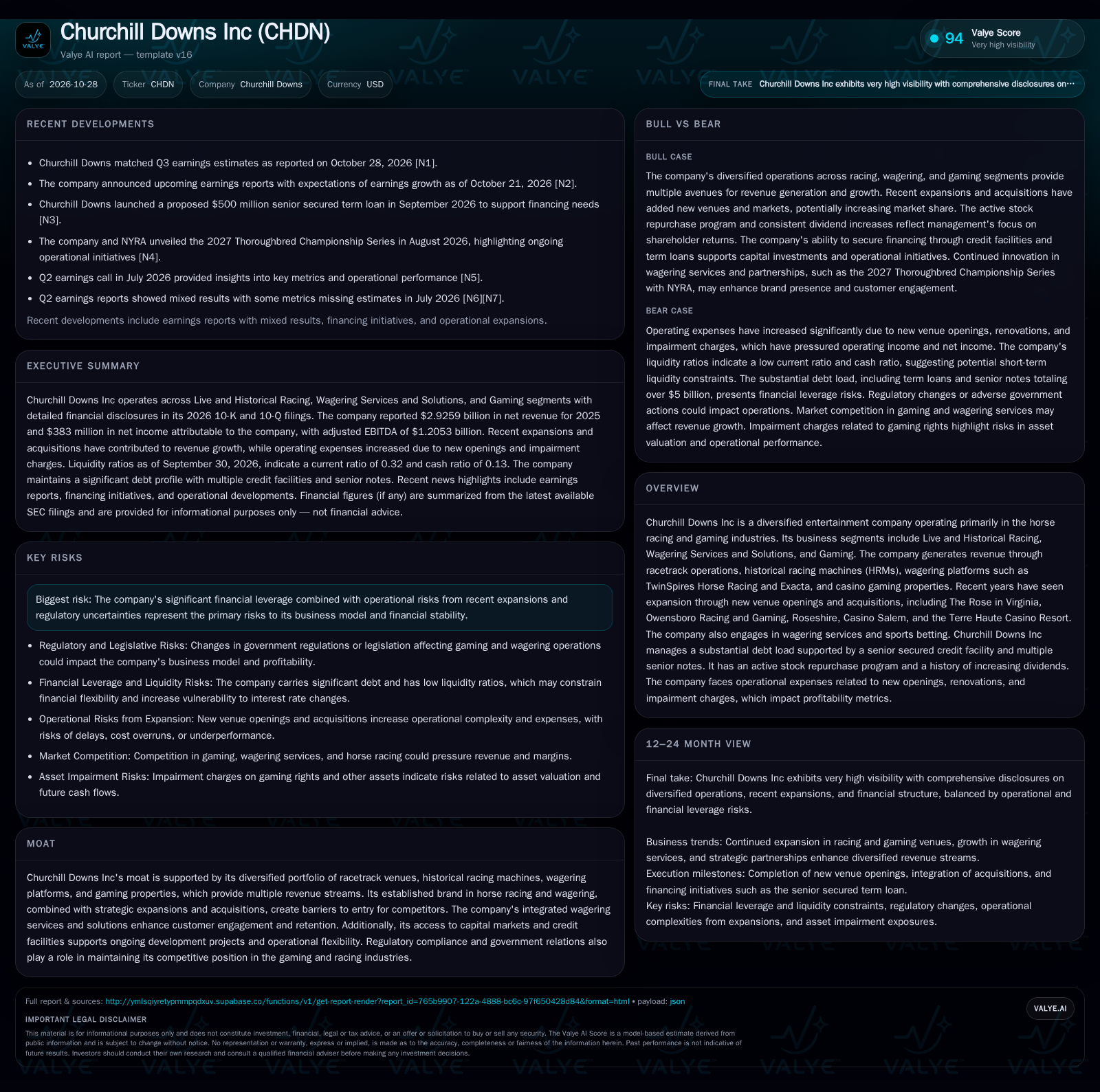
Churchill Downs Inc posted $2.93 billion in 2025 revenue, with recent venue openings and acquisitions fueling top-line growth across Live and Historical Racing, Wagering Services, and Gaming. However, EBITDA growth was uneven, net income declined due to impairments and rising expenses, and the company’s liquidity ratios remain low against a $5+ billion debt load. The thesis now hinges on whether Churchill Downs can convert its expanded footprint into sustained margin, cash flow, and competitive resilience before leverage and operational complexity become constraints. [S1] [S2]
Churchill Downs Inc is navigating a pivotal moment: its strategy of rapid expansion across new racing and gaming venues, combined with digital wagering initiatives, has propelled revenue to new highs and fortified its brand in a rapidly evolving sector. Yet, the company’s financial profile is increasingly defined by mounting operating costs, asset impairments, and a sizable debt burden. As Churchill Downs seeks to solidify its position as a diversified gaming and wagering powerhouse, the next chapters will be defined by its ability to extract sustainable profitability and cash flow from its expanded platform before leverage and cost pressures erode its competitive advantages.
Recent Expansions Drive Revenue, But Margin and Liquidity Pressures Emerge
Churchill Downs Inc reported $2.93 billion in net revenue for 2025, with Live and Historical Racing contributing $1.44 billion, Gaming $1.05 billion, and Wagering Services and Solutions $526 million. Adjusted EBITDA climbed to $1.21 billion, but net income dropped to $383 million from $427 million in 2024 due to impairment charges and increased operating expenses. Recent high-profile venue launches—including The Rose in Virginia, Owensboro Racing and Gaming, Roseshire, Casino Salem, and Terre Haute Casino Resort—were key growth drivers but also required significant capital outlays and led to higher costs. As of Q3 2026, liquidity metrics are tight: $167 million in cash and a current ratio of only 0.32, with total debt exceeding $5 billion. The company has also maintained shareholder return strategies, with a $500 million buyback program and a 7% dividend increase in 2026. [S1] [S2]
Decoding the Economics of Scale: Capital Intensity, Margin Dynamics, and Cash Flow Conversion
Churchill Downs’ business model is fundamentally capital intensive: new venues, renovations, and acquisitions require substantial upfront investment, both for physical assets and regulatory compliance. These investments aim to create durable, high-traffic entertainment destinations that combine traditional horse racing with casino gaming and historical racing machines (HRMs), supported by digital wagering platforms. Revenue growth is largely volume-driven, as new venues expand the addressable market and cross-sell opportunities between live events, gaming, and digital wagering.
However, the cost structure is characterized by high fixed costs—property, payroll, regulatory fees, and marketing—while variable expenses increase with scale. This creates potential for operating leverage if new venues ramp quickly and utilization rates are high, but also exposes the company to significant downside if ramp-up is slow or if demand softens. The recent increase in operating expenses, including impairment charges on gaming rights, suggests that returns on some recent projects have not met expectations.
Cash flow conversion is a critical challenge given the heavy debt service burden. The company’s ability to generate consistent free cash flow will depend on margin stabilization, successful ramp-up of new venues, and disciplined capital allocation—especially as higher interest rates could further compress net income.
Differentiation in a Crowded Field: Brand, Platform, and Regulatory Moats vs. Industry Headwinds
Churchill Downs occupies a unique niche as both a legacy horse racing brand and a diversified operator in gaming and digital wagering. Its competitive position benefits from several factors: established racing venues with historical significance, proprietary wagering platforms (such as TwinSpires), and an expanding portfolio of gaming properties. This breadth offers some insulation from localized regulatory or economic shocks and enables cross-segment customer engagement.
However, the company faces intense competition from regional casinos, digital-first gaming operators, state lotteries, and other sports betting platforms. Many rivals are pursuing aggressive digital strategies, leveraging technology to drive lower costs and higher customer retention. Regulatory barriers can provide local moats, but they also create compliance risk and can limit expansion in certain markets. Churchill Downs’ scale and brand recognition are assets, but the ability to innovate in digital engagement and maximize venue utilization will be critical to maintaining its edge as the industry evolves.
If Venue Ramp and Digital Integration Unlock Operating Leverage
The optimistic scenario is that Churchill Downs’ recent investments in new venues and digital wagering platforms achieve strong utilization, driving both top-line growth and margin expansion. If the company can fill new casinos and racetracks quickly, cross-promote digital and physical offerings, and manage costs as a percentage of revenue, operating leverage could accelerate adjusted EBITDA and free cash flow growth.
Confirmation would come from several quarters of sequential margin improvement, rapid growth in digital wagering handle, and evidence that new venues are reaching or exceeding targeted payback periods. A reduction in impairment charges and stabilization (or improvement) in net income despite ongoing debt service would further support the case that scale is being converted into durable profitability. Conversely, persistent cost overruns, slow ramp-up, or continued asset write-downs would undermine this scenario.
Expansion Brings Growth, But Margin and Cash Flow Remain Under Pressure
The most plausible outcome is that Churchill Downs continues to grow revenue through new venue launches and digital initiatives, but operating margins remain constrained by higher expenses and the realities of a capital-intensive, regulated industry. The company’s diversified business mix helps buffer against local shocks, yet the pace of margin recovery is gradual as new projects take time to achieve optimal utilization and as impairment risks linger.
Evidence for this middle path would include steady—but not accelerating—revenue growth, stable or slightly improving EBITDA margins, and ongoing attention to cost management without dramatic improvement in free cash flow. Liquidity remains tight, with refinancing needs periodically resurfacing, and net income fluctuates depending on the timing of impairments and debt service costs. This scenario would be falsified by either a sharp margin rebound (upside) or a significant deterioration in cash flow and credit metrics (downside).
When Leverage and Operational Complexity Outrun Growth
The adverse scenario centers on Churchill Downs’ leverage and expansion outpacing its ability to generate sufficient cash flow. If new venues underperform, face regulatory delays, or require further investment to achieve projected returns, the company could encounter ongoing impairment charges, margin compression, and constrained ability to service debt. Rising interest rates or a tightening credit environment would exacerbate these risks.
This scenario would manifest as declining EBITDA margins, persistent (or growing) net losses, increased asset write-downs, and possible covenant breaches or the need for asset sales to generate liquidity. Early warning signs would include continued increases in operating expenses outpacing revenue, further deterioration in liquidity ratios, and negative trends in digital wagering or gaming visitation.
What Will Determine Churchill Downs’ Ability to Sustain Expansion and Profitability?
Sequential quarterly trends in adjusted EBITDA margin, especially as new venues mature, would help assess whether operating leverage is materializing.
Venue-level performance metrics—such as visitation, HRM handle, and gaming revenue per location—if disclosed, would clarify the ramp-up pace and return on invested capital.
Digital wagering handle and user engagement growth rates would signal whether the company’s online platforms are gaining market share and cross-promoting effectively with physical venues.
Net cash provided by operating activities and free cash flow conversion, especially after maintenance capital expenditures and debt service, would test the sustainability of the company’s growth model.
Trends in impairment charges and asset write-downs would indicate whether expansion projects are hitting or missing management’s return targets.
Changes in regulatory environments or local gaming legislation could materially affect both existing operations and the viability of new projects.
Debt refinancing terms, interest coverage ratios, and any amendments to credit facilities would reveal the company’s ongoing access to capital and its vulnerability to shifts in the credit market.
Dividend and buyback activity, while a sign of shareholder return focus, should be monitored for potential trade-offs with balance sheet strength if cash generation lags.
Disclaimer: This is research-only, informational analysis and not investment advice. It may include AI-generated interpretation and general industry context. Always verify important details using primary sources.

Comments