
State Street’s Scale, Platform Ambitions, and the Challenge of Evolving Fee Dynamics
With record assets under custody and administration and rising profits, State Street’s business model remains formidable. But as technology and regulatory pressures reshape the industry, the company’s ability to translate scale and platform integration into sustainable margin expansion is increasingly tested.
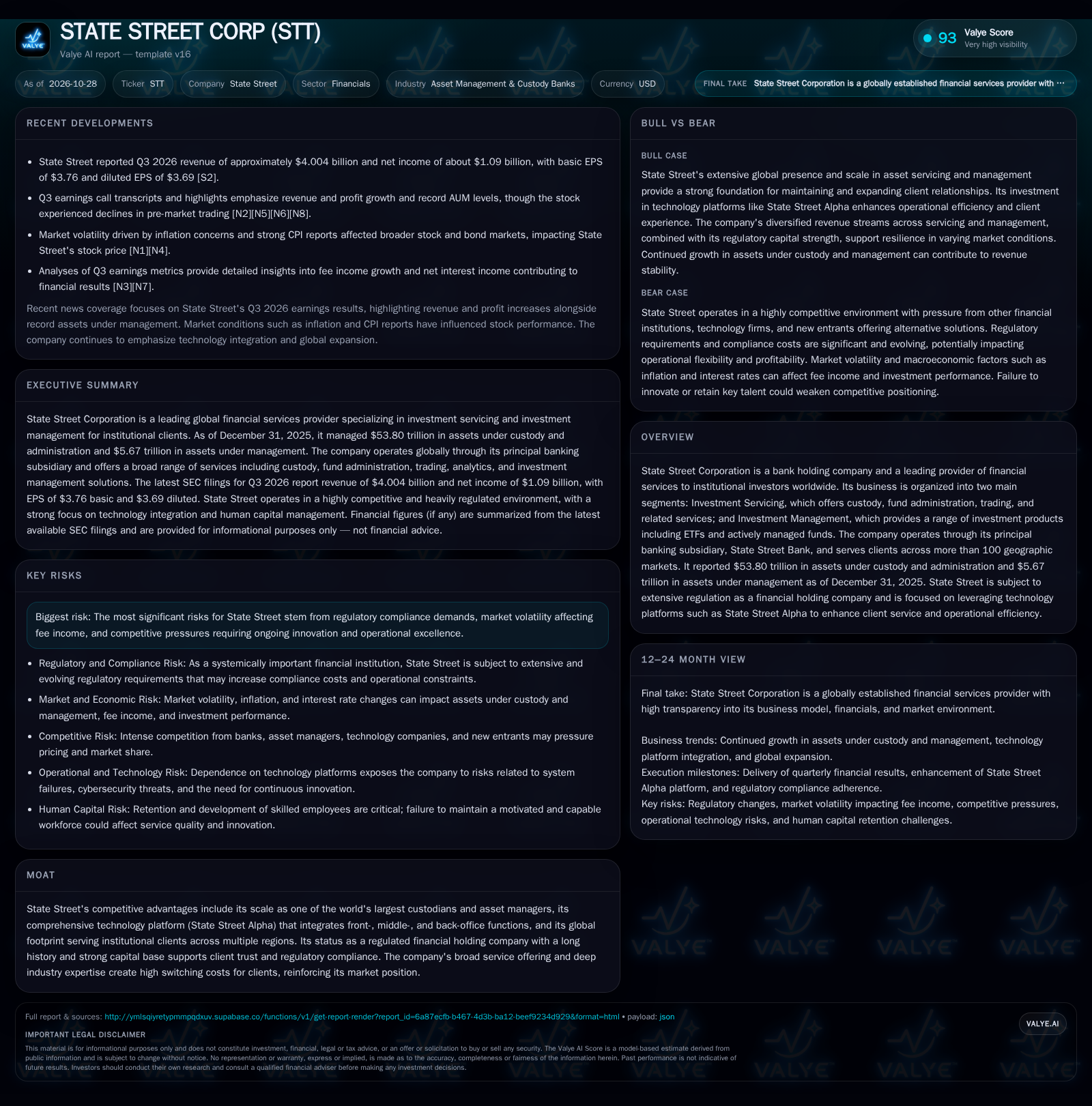
State Street reported $53.80 trillion in assets under custody and administration and $5.67 trillion in assets under management at year-end 2025, with Q3 2026 revenue of $4.004 billion and net income of $1.09 billion [S1] [S2]. While the company’s global reach and integrated technology platform support its competitive positioning, the durability of its fee-based revenues and ability to manage compliance and innovation costs are central to the long-term thesis.
State Street Corporation stands at the intersection of global financial infrastructure and institutional asset management, boasting record assets under custody and administration as well as surging profits in its latest quarter. Yet, as the competitive landscape broadens to include not only traditional custodians but also technology and data firms, the durability of State Street’s fee model and the effectiveness of its technology-centric strategy are increasingly under scrutiny. The company’s future will be defined by its ability to convert scale, integration, and operational leverage into sustainable margin expansion, all while navigating regulatory and innovation headwinds.
Recent Results Highlight Scale and Resilience, But Market Reaction Is Cautious
State Street reported approximately $53.80 trillion in assets under custody and administration (AUC/A) and $5.67 trillion in assets under management (AUM) as of December 31, 2025, reinforcing its status as a global leader in institutional finance [S1]. In Q3 2026, it posted revenue of $4.004 billion and net income of $1.09 billion, with basic EPS of $3.76 and diluted EPS of $3.69 [S2]. These metrics reflect not only the company’s immense scale but also its ability to generate robust profits despite industry headwinds. However, recent news indicates that the stock declined in pre-market trading following the Q3 earnings release, even as the company achieved record AUM and rising profits [N6] [N8]. This suggests that investors are weighing the sustainability of fee income and margin expansion against macroeconomic and competitive risks.
How State Street Earns: Fee-Based Revenue and the Pursuit of Operating Leverage
State Street’s economics are fundamentally driven by scale-based fee income from its Investment Servicing and Investment Management segments. The majority of revenue comes from servicing fees—typically recurring, asset-based charges for custodial, fund administration, and related services—while a smaller but material portion is derived from investment management fees linked to AUM. Net interest income, generated from the float on client balances and securities finance activities, provides an additional revenue lever, albeit one sensitive to interest rate cycles.
Because fixed costs (technology infrastructure, regulatory compliance, and human capital) are high, incremental assets under custody, administration, or management can contribute meaningfully to margin expansion if pricing holds. However, downward fee pressure—driven by client consolidation, competitive bidding, and increased transparency—can erode this operating leverage. The company’s investment in platforms like State Street Alpha is intended to lower marginal servicing costs, enhance client stickiness, and enable cross-selling, but the upfront and ongoing capex/opex for such technology can be substantial. The economic thesis hinges on State Street’s ability to grow assets, maintain pricing discipline, and continuously automate operations to offset labor and compliance cost inflation.
Defending the Moat: Integration, Switching Frictions, and the Expanding Set of Rivals
State Street’s traditional competitive advantage lies in its global reach, regulatory standing, and the breadth of its integrated service model. Its Alpha platform, which aims to unify portfolio management, trading, analytics, and compliance for institutional clients, is designed to could raise switching costs and embed State Street deeper into client workflows [S1]. For large asset managers and owners, migration to a new custodian or platform is operationally complex and risky, reinforcing client retention.
However, the competitive set is broadening. In addition to other global custodians and asset managers, State Street now contends with technology, data, and analytics firms seeking to disintermediate traditional services or offer modular alternatives. Pricing competition is intense, especially for basic custody, and technology-led entrants can undercut or unbundle legacy service bundles. State Street’s challenge is to stay ahead on platform integration and data capabilities while maintaining compliance and trust—attributes that new entrants may lack but are rapidly building.
If Platform Integration and Asset Growth Drive Sustained Margin Expansion
A favorable scenario for State Street would see continued growth in global institutional assets, further adoption of the Alpha platform, and successful automation of servicing operations. If Alpha achieves industry-standard status and becomes deeply embedded in client front-to-back operations, switching frictions could increase, enabling State Street to defend or even modestly raise fee rates despite competitive pressure. This would allow incremental AUC/A and AUM to drop through at high incremental margins, especially if technology investments yield tangible cost efficiencies.
Upside evidence would include clear disclosures of Alpha adoption rates, demonstrable reductions in unit servicing costs, and resilience or improvement in fee revenue yields per dollar of assets serviced. Sustained net inflows and new client wins, particularly in markets where State Street is underpenetrated, would further validate the positive thesis.
Sustaining Scale, Managing Fee Compression, and Navigating Regulatory Complexity
The most plausible trajectory is one where State Street maintains its leadership in AUC/A and AUM, but faces ongoing fee rate compression offset by operational efficiency gains and selective platform adoption. Technology investments continue, but their margin impact is gradual rather than transformative. Regulatory and compliance costs remain elevated, but manageable through process automation and global resource allocation. Net interest income may fluctuate with macro conditions, but core servicing and management fee revenues remain stable.
Confirmation of this middle path would include relatively stable fee yields (declining only modestly), steady or slightly growing AUC/A and AUM, and consistent expense management disclosures. Falsification would come from sharp declines in fee rates, loss of marquee clients, or persistent cost overruns on technology initiatives.
Accelerated Fee Pressure and Technology Disruption Challenge the Margin Model
A negative scenario could unfold if pricing wars intensify, clients aggressively renegotiate terms, and technology-driven competitors successfully unbundle or commoditize core services. In this world, State Street’s scale does not translate into pricing power, and technology investments fail to deliver the expected cost savings or client stickiness. Regulatory or compliance shocks—such as new capital requirements or cyber incidents—could further raise costs or erode client trust.
Downside evidence would include accelerating declines in servicing fee yields, publicized client losses or migrations to competitors, and rising expense ratios despite technology spending. Regulatory actions or negative headlines around operational failures would further confirm the bear thesis.
What Will Determine Whether State Street’s Platform Ambition Delivers Durable Advantage?
Net changes in assets under custody and administration (AUC/A) and assets under management (AUM), as disclosed quarterly, to track scale and client retention.
Fee revenue yields (fees as a percentage of AUC/A and AUM), if disclosed, to assess pricing pressure and revenue model durability.
Adoption rates and client wins for the State Street Alpha platform, if disclosed, as evidence of technology-driven differentiation and switching cost creation.
Operating expense trends and technology investment disclosures to monitor efficiency gains and the impact of automation.
Net interest income contribution and sensitivity to rate cycles, as shifts in the macro environment can materially affect profitability.
Regulatory developments or compliance expense disclosures, particularly any new requirements that could impact capital or cost structure.
Employee productivity metrics or human capital disclosures, given the global workforce and importance of talent to service quality and innovation.
Publicized client wins, renewals, or losses—especially among large institutional clients—as signals of competitive positioning.
Disclaimer: This is research-only, informational analysis and not investment advice. It may include AI-generated interpretation and general industry context. Always verify important details using primary sources.

Comments