
Honeywell Aerospace: Independent Flight, Profit Leverage, and the Post-Spin Challenge
Newly spun off, Honeywell Aerospace enters its first quarters as a standalone aerospace and defense supplier with solid profitability, analyst attention, and a liquidity buffer. The company inherits deep sector expertise, but must now prove its ability to sustain earnings and navigate industry cyclicality without the Honeywell conglomerate’s umbrella.
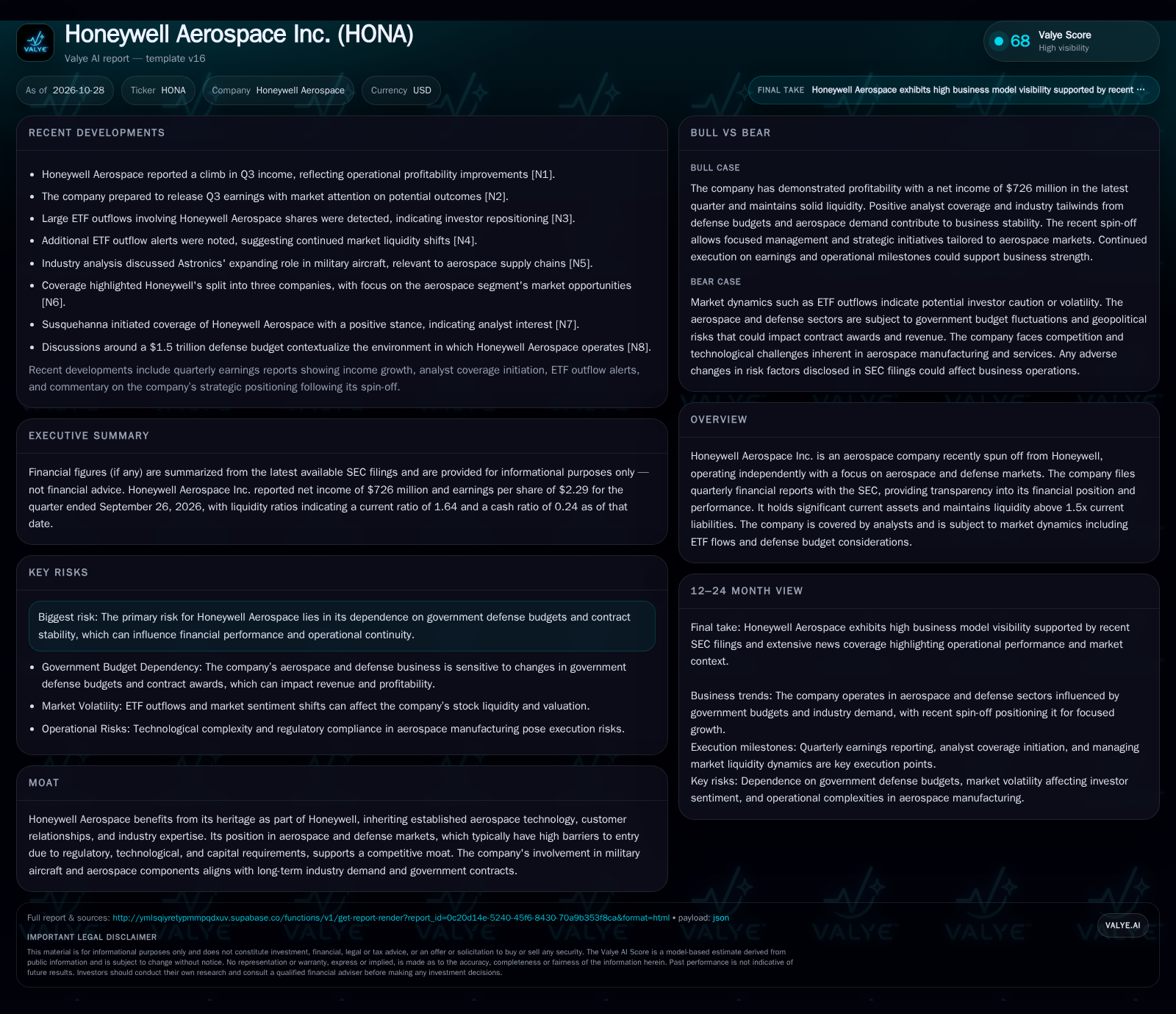
Honeywell Aerospace reported $726 million in net income and a $2.29 EPS for Q3 2026, maintaining a current ratio of 1.64 following its recent spin-off. The business benefits from established aerospace and defense positions, but faces investor repositioning and defense budget dependency as near-term hurdles. Analyst coverage is constructive, yet ETF outflows highlight market caution. The company's ability to deliver consistent earnings and manage government contract volatility will define its next phase. [S1] [N1] [N3] [N7]
Honeywell Aerospace, now operating independently after its spin-off from the broader Honeywell organization, enters a critical proving ground as a dedicated aerospace and defense supplier. Reporting $726 million in quarterly net income and maintaining a current ratio of 1.64, the company demonstrates immediate profitability and liquidity following its separation. However, ETF outflows and the sector’s reliance on government spending inject uncertainty into the narrative. Honeywell Aerospace’s challenge now is to convert inherited strengths into sustainable competitive advantages while managing investor expectations and industry cyclicality. [S1] [N1] [N3]
Spin-Off Momentum, Profitability, and Market Perception in Focus
Honeywell Aerospace’s first quarters as a standalone entity are marked by solid profitability: $726 million in Q3 net income and an EPS of $2.29, with $1.558 billion in cash on hand and a current ratio of 1.64 as of September 2026. These results point to operational effectiveness post-spin, with the company navigating its new independence with a liquidity buffer. However, recent ETF outflows involving Honeywell Aerospace shares signal investor repositioning, possibly reflecting broader market caution or sector rotation. Meanwhile, Susquehanna’s initiation of coverage with a positive stance suggests that analyst sentiment is constructive, but the company must validate this optimism with sustained performance and resilience to sector headwinds. [S1] [N1] [N3] [N7]
Earnings Power, Cost Structure, and Capital Demands in Aerospace Supply
Honeywell Aerospace’s core economics are shaped by high fixed costs, significant capital requirements, and the long-cycle nature of aerospace and defense contracts. The company’s recent net income suggests meaningful operating leverage, as incremental revenue from government and commercial contracts can disproportionately boost earnings once fixed costs are covered. Pricing in this sector is often set by multi-year contracts with built-in escalation clauses or by competitive procurement, which can limit near-term pricing power but provide revenue visibility if renewals and contract wins are consistent. The capital intensity and regulatory requirements of aerospace manufacturing mean that working capital swings can be significant, particularly if contract timing or supply chain disruptions occur. [S1]
The capital demands in aerospace supply chains also extend beyond manufacturing into long-term maintenance, repair, and overhaul (MRO) services, which can provide recurring revenue streams but require sustained investment in specialized facilities and skilled labor. If Honeywell Aerospace can effectively balance capital allocation between new product development and aftermarket services, it could enhance its cash flow stability and mitigate some cyclicality inherent in new aircraft production cycles. Moreover, the company’s ability to manage working capital efficiently—such as negotiating favorable payment terms with suppliers and customers—will directly impact its liquidity and potential financial flexibility, especially during periods of contract timing variability or macroeconomic uncertainty.
Cost structure dynamics in aerospace are also influenced by regulatory compliance and quality assurance requirements, which tend to be non-negotiable fixed expenses. Any shifts in regulatory frameworks or heightened certification standards could increase compliance costs or delay product launches, thus compressing margins if not anticipated. Conversely, improvements in manufacturing automation or supply chain digitization could offer cost reduction opportunities over time, but these require upfront capital and organizational change. Honeywell Aerospace’s post-spin independence means it must now internalize these investments and risks, making capital allocation decisions more critical to balancing short-term profitability against longer-term competitiveness.
Inherited Moat Meets Sector Rivalry and Innovation Pressure
Honeywell Aerospace inherits a formidable industry position, leveraging decades of technology, established customer relationships, and regulatory know-how from its former parent. These attributes create high switching costs for customers, particularly in military and commercial aviation where qualification cycles are long and reliability is paramount. However, the company now faces direct exposure to competitive forces from other aerospace OEMs, tier-1 suppliers, and defense contractors, many of whom are scaling up digital and advanced manufacturing capabilities. Substitution risk remains low in critical avionics and propulsion systems, but emerging technologies—such as electric propulsion, autonomous flight, or alternative materials—could erode traditional advantages if Honeywell Aerospace does not keep pace. The sector’s barriers to entry are high, but the pace of innovation and customer procurement cycles will pressure even well-established players to continually invest and adapt.
Focused Execution Unlocks Margin Expansion and Contract Wins
The most favorable scenario for Honeywell Aerospace is one in which the spin-off enables sharper strategic focus, leading to operational improvements, cost discipline, and accelerated R&D tailored to aerospace and defense customers. If the company leverages its balance sheet to invest in next-generation systems and wins new contracts—particularly in military or next-gen commercial programs—incremental revenue could drive significant operating leverage. Evidence for this scenario would include a rising backlog of awarded contracts, improved gross and operating margins, and continued net income growth over successive quarters. Analyst upgrades, new customer announcements, or technological breakthroughs would further validate this trajectory. Falsification would come from margin stagnation, missed contract bids, or evidence that R&D spending is not translating into market share gains.
Sector Cyclicality and Execution Discipline Define the Middle Ground
The most plausible path forward is one where Honeywell Aerospace delivers steady, if unspectacular, growth and profitability, largely tracking the broader aerospace and defense sector. The company’s results would fluctuate with government budget cycles, commercial aerospace demand, and supply chain conditions. Modest margin improvement could materialize if cost controls hold and the company avoids major execution missteps. Confirming evidence would include stable earnings, cash flows, and contract win rates, with no material changes in disclosed risk factors. Conversely, if external shocks—such as defense spending cuts or major supply disruptions—begin to impact quarterly results, the company’s performance could revert to sector averages or underperform peers.
Budget Shocks and Investor Flight Disrupt the Post-Spin Thesis
In a less favorable scenario, Honeywell Aerospace is hit by a contraction in government defense budgets or heightened geopolitical risk that delays or cancels major contracts. If ETF outflows deepen and market sentiment sours, the company could face a higher cost of capital and reduced flexibility for investment. Operationally, execution missteps—such as delays in product certification, cost overruns, or supply chain bottlenecks—could erode margins and trigger downward earnings revisions. Evidence of this scenario would include declining net income or EPS, a deteriorating current ratio (if disclosed), negative analyst revisions, or a shrinking backlog of awarded contracts. Further ETF outflows or sector downgrades would support the case that investor confidence is waning.
Testing Honeywell Aerospace’s Post-Spin Advantage: Concrete Milestones and External Triggers
Quarterly trends in net income, EPS, and margin progression—especially as the company cycles through its first full year post-spin—will reveal whether operating leverage is sustainable. [S1]
Contract award announcements, backlog growth, or major program wins (if disclosed) would help test whether the company is translating its legacy position into new business.
Disclosures on R&D spending and the pace of new product introductions would clarify whether Honeywell Aerospace is investing sufficiently to defend or grow its moat.
Any updates on government defense budgets or major procurement cycles affecting the company’s addressable market would be material.
ETF flow data and analyst rating changes, especially if they signal persistent investor caution or renewed confidence, will be important external sentiment indicators. [N3] [N7]
Disclosures of operational risks or material changes in risk factors in future SEC filings would help test the resilience of the current thesis.
Disclaimer: This is research-only, informational analysis and not investment advice. It may include AI-generated interpretation and general industry context. Always verify important details using primary sources.

Comments