
ClearPoint Neuro: Facility Build-Out, Fixed Commitments, and the Search for Scalable Neurosurgery Economics
ClearPoint Neuro is making a high-stakes push into preclinical CRO services while managing persistent net losses and long-term lease obligations. The company’s ability to convert capital-intensive investments into differentiated revenue streams will define its trajectory amid evolving demand for advanced neurosurgery and cell/gene therapy solutions.
ClearPoint Neuro’s investment in the CAL preclinical CRO facility marks a strategic move to diversify beyond neurosurgery navigation devices. The key question is whether ClearPoint can scale this new revenue stream fast enough to justify its capital outlay and offset fixed lease commitments, all while contending with established medical device and preclinical service competitors. [S2]
ClearPoint Neuro stands at a pivotal inflection point, blending its established neurosurgery navigation product line with an ambitious bet on preclinical CRO services. The ongoing build-out of the capital-intensive CAL facility is intended to tap into the growing demand for GLP-compliant preclinical research among biopharmaceutical firms. However, this diversification comes amid persistent net losses and rising fixed obligations from long-term leases. The company’s future will hinge on its ability to translate these investments into scalable, differentiated revenue streams before financial or operational risks compromise its position in a competitive medical devices and services landscape. [S2]
Liquidity, Losses, and Facility Expansion Define the 2026 Landscape
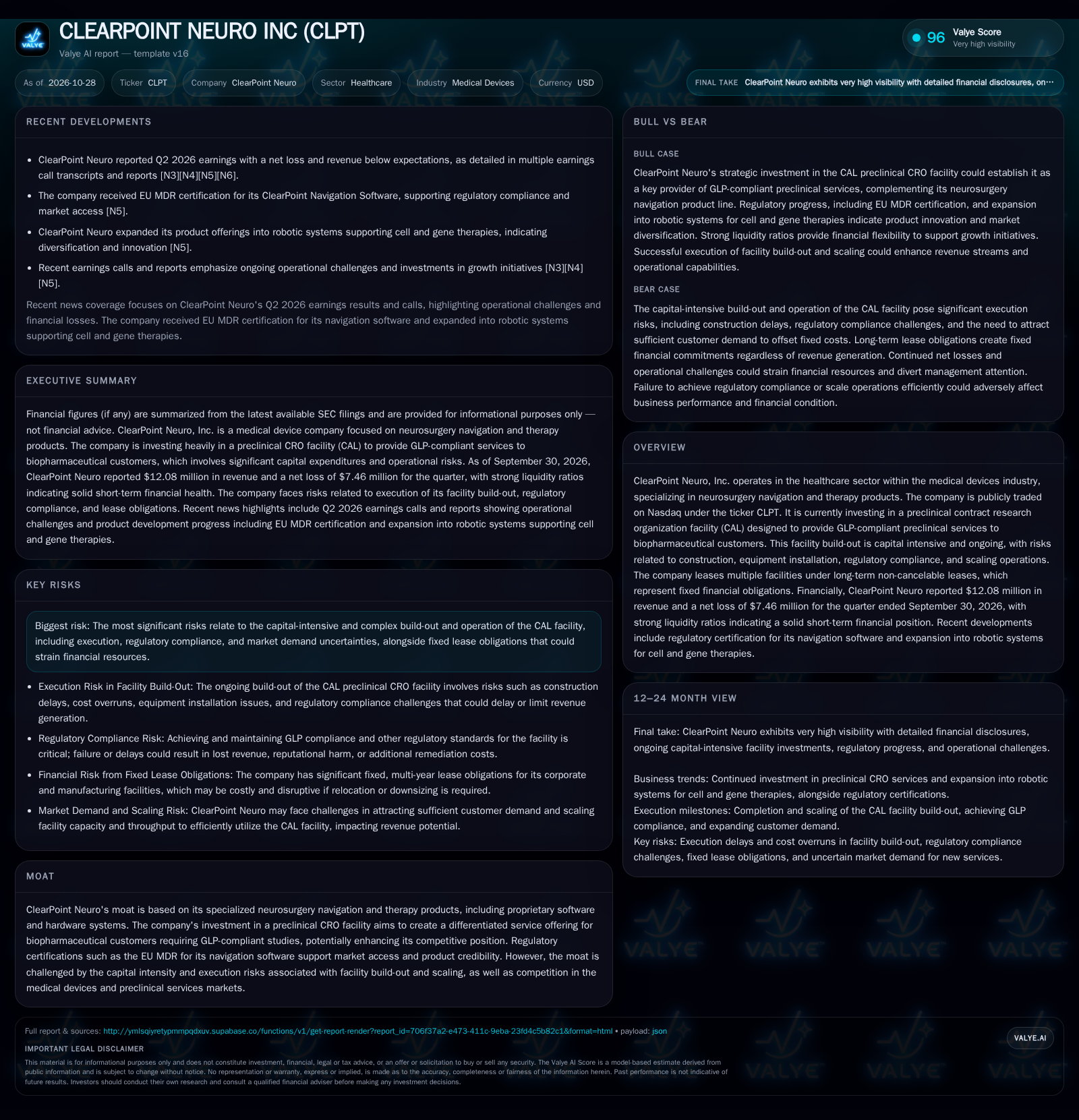
As of September 30, 2026, ClearPoint Neuro reported $12.08 million in quarterly revenue and a net loss of $7.46 million, with basic and diluted EPS at -$0.24. The company’s liquidity metrics are notable, with $46.18 million in cash and a current ratio of 6.76, reflecting a strong short-term financial position. The company reported cash and liquidity metrics for the period; these figures do not by themselves establish operating runway, investment capacity, financial flexibility, or financing capacity. The company’s current strategic focus is the build-out of its CAL preclinical CRO facility, which is incurring significant capital expenditures and fixed costs, particularly as delays in construction and regulatory hurdles could postpone service capacity and revenue generation. Additionally, ClearPoint is locked into long-term, non-cancelable leases for its headquarters and manufacturing spaces, creating substantial fixed financial commitments regardless of future revenue performance. [S2]
Capital Intensity and the Economics of Diversification
ClearPoint Neuro’s business model is evolving from a pure-play neurosurgery device provider toward a hybrid of product sales and high-value service offerings. The company’s core navigation and therapy products likely rely on a mix of capital equipment sales, disposable instruments, and potentially recurring software or support contracts—a structure common to medical device firms but often challenged by hospital budget cycles and reimbursement dynamics. The CAL facility introduces a different economic profile: contract research services are typically project-based, with revenue recognized upon completion of GLP-compliant studies for biopharma clients. This model can offer higher margins and more predictable cash flows if capacity is fully utilized, but it is also highly sensitive to throughput and customer acquisition.
The fixed-cost base is rising, both from the capital-intensive facility build-out and from multi-year lease payments. This amplifies the importance of operating leverage: if the CAL facility ramps up quickly and achieves high utilization, incremental revenues could flow through at attractive margins. Conversely, underutilization would leave ClearPoint exposed to negative operating leverage, with fixed costs eroding profitability. The need for ongoing investment in equipment, compliance, and skilled personnel further raises the break-even threshold and increases the risk profile of this diversification.
Specialization, Differentiation, and Market Pressures in Neurosurgery and CRO Services
ClearPoint Neuro’s historic strength lies in its specialized neurosurgery navigation and therapy platforms, which may offer technical differentiation—such as proprietary imaging integration or workflow enhancements—over general-purpose surgical systems. However, the neurosurgery device market is populated by large, entrenched players and innovative startups, making sustained pricing power or exclusive hospital adoption difficult without clear clinical or economic superiority.
The move into preclinical CRO services pits ClearPoint against a different set of competitors: established CROs with extensive track records, regulatory expertise, and broad customer relationships. The company’s ability to win share will depend on demonstrating unique value—such as integrating its neurosurgical expertise into preclinical models for cell and gene therapy, or offering faster, more reliable GLP-compliant studies. If the CAL facility can develop a reputation for quality and reliability, ClearPoint could carve out a defensible niche, but barriers to entry in CRO services are lower than in regulated medical devices, and price competition is intense.
Facility Execution and Biopharma Adoption Drive Accelerated Margin Expansion
A favorable scenario unfolds if ClearPoint successfully completes the CAL facility build-out on schedule, secures GLP certification, and quickly attracts a robust pipeline of biopharmaceutical customers seeking preclinical services. Early customer wins would both validate the company’s strategic pivot and drive high facility utilization, allowing fixed costs to be spread over a growing revenue base. As throughput increases, operating leverage would kick in, potentially transforming the company’s margin profile and accelerating the path to profitability.
Visible evidence for this scenario would include: announcements of multi-year service contracts with leading biopharma firms; disclosure of rising facility utilization rates; and sequential revenue growth from the CRO segment outpacing medical device sales. Successful integration of robotic systems for cell and gene therapies could further differentiate ClearPoint’s offering and create cross-selling opportunities between device and service lines. [N5]
Incremental Growth Amid Execution Challenges and Competitive Headwinds
The most plausible near-term path is one of gradual progress and persistent challenges. ClearPoint may complete the CAL facility with minor delays, achieving GLP compliance and beginning to onboard customers. However, ramping up utilization could prove slow, given the competitive landscape and the time required to establish credibility with biopharma clients. Revenue growth would be incremental, with the new CRO segment contributing but not yet offsetting ongoing net losses from the device business and rising fixed costs.
In this scenario, financial performance would show modest revenue gains, continued net losses, and steady but not dramatic improvement in operating metrics. Confirmation would come from sequential quarterly growth in service revenue, customer testimonials or case studies, and progress updates on facility throughput. Falsifying evidence would include persistent underutilization of the CAL facility, customer acquisition delays, or cost overruns that erode gross margins.
Facility Delays, Customer Gaps, and Fixed Costs Trigger Financial Stress
ClearPoint’s risk profile is defined by the potential for execution missteps and market resistance. In a downside scenario, construction or regulatory delays drag out the CAL facility build-out, pushing back service launch and leaving capital tied up in an underutilized asset. If customer demand falls short—due to either insufficient differentiation or entrenched CRO incumbents—facility utilization remains low, and the anticipated revenue uplift fails to materialize.
Meanwhile, fixed financial obligations from leases and capital investments continue to accrue, widening net losses and potentially forcing the company to seek additional financing or restructure operations. This scenario would be confirmed by repeated downward revisions to revenue guidance, negative operating cash flow trends, and disclosures of cost containment or restructuring measures. Persistent net losses despite facility completion would signal that the new business line is not scaling as hoped.
Milestones That Will Define ClearPoint Neuro’s Strategic Bet
Progress on CAL facility construction and regulatory milestones: Delays or successful achievement of GLP compliance will be critical leading indicators. [S2]
Facility utilization rates and throughput: If disclosed, these metrics would show whether new capital is being converted into revenue-generating activity.
Service contract announcements with biopharma customers: Evidence of early traction in the CRO segment would validate the company’s diversification strategy.
Revenue mix shift: Quarterly segment reporting that shows increasing contribution from preclinical services would help test the scaling thesis.
Operating leverage and margin trends: Improvement in gross and operating margins, especially as fixed costs are absorbed by new service revenue, would indicate successful scaling.
Net cash flow and liquidity trends: Monitoring whether reported liquidity position persists as capital is deployed and operating losses continue.
Lease obligation disclosures: Any changes to lease commitments or moves to renegotiate terms would be a sign of financial or operational stress.
Disclaimer: This is research-only, informational analysis and not investment advice. It may include AI-generated interpretation and general industry context. Always verify important details using primary sources.

Comments