
Flowserve in 2026: Backlog, Cyclicality, and Enduring Industrial Flow Control Dynamics
Flowserve’s $2.9 billion backlog and recent profitability highlight strong near-term visibility, but the company’s performance remains tethered to volatile capital spending cycles, commodity cost pressures, and intensifying global competition. The path forward hinges on realizing its order book, managing economic and supply chain swings, and translating technology investments into sustainable differentiation.
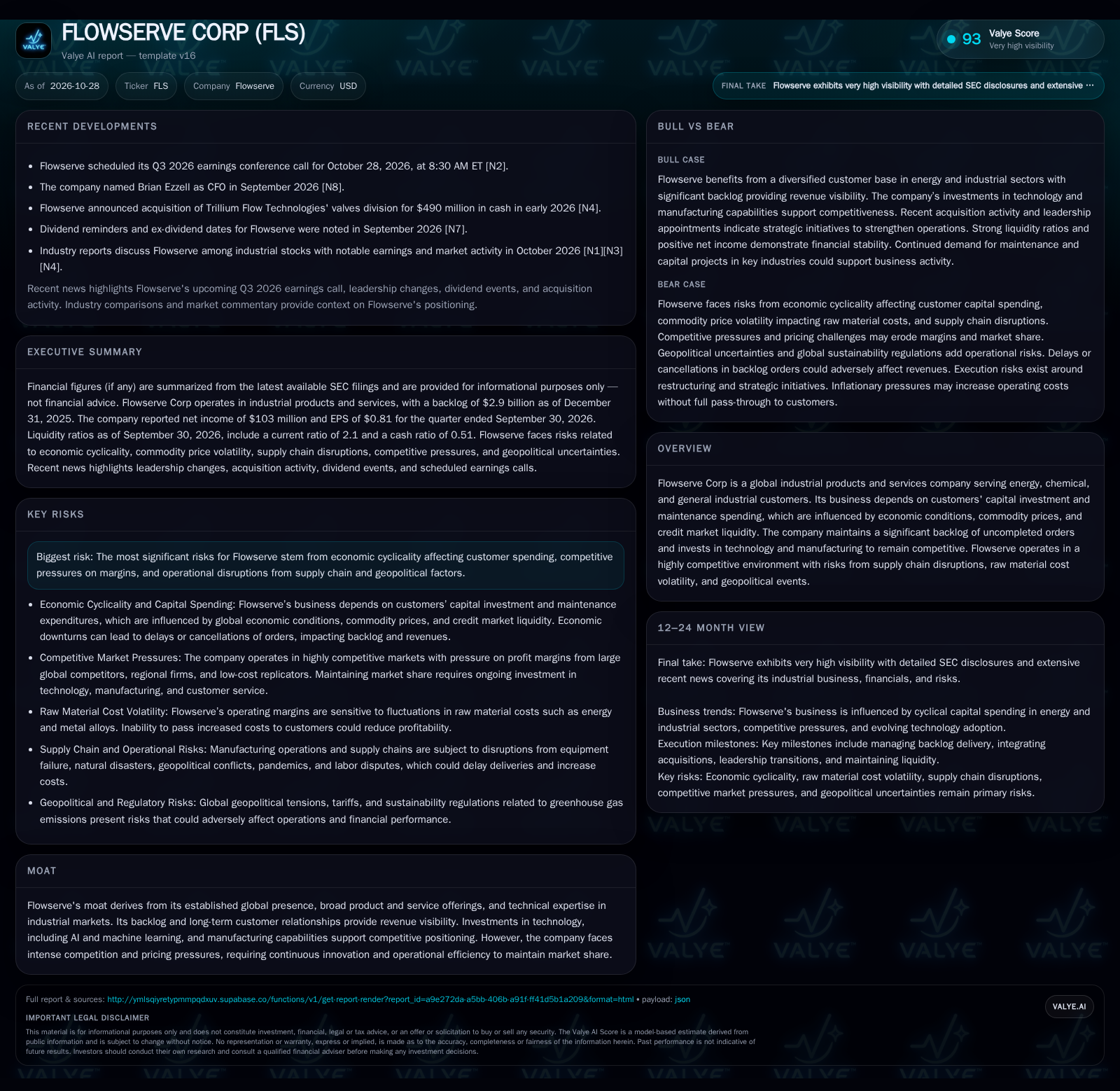
Flowserve enters late 2026 with a sizable $2.9 billion backlog, positive quarterly earnings, and liquidity well above current liabilities. However, its dependence on cyclical customer spending, risk of order delays or cancellations, and exposure to raw material and geopolitical volatility underscore the fragility of its visibility. The company’s ability to convert backlog, defend margins, and leverage investments in technology will determine whether it can outperform peers in a structurally competitive sector.
Flowserve’s industrial flow control business stands at a crossroads in 2026. A strong backlog and recent profitability offer tangible evidence of demand and operational execution, yet the company’s fate is tightly linked to the unpredictable cycles of its energy and industrial customers. As new leadership steps in and technology investments accelerate, Flowserve must navigate intensifying competition, raw material swings, and the ever-present risk of project delays or cancellations. The question is not just whether Flowserve can deliver on its order book, but whether it can build a more resilient, differentiated business model amid structural industry headwinds.
Near-Term Visibility from Backlog and Profitability Offers Limited Protection
As of December 31, 2025, Flowserve’s backlog stood at $2.9 billion, reflecting uncompleted customer orders and anchoring near-term revenue expectations [S1]. For the quarter ended September 30, 2026, the company reported net income of $103 million and EPS of $0.81, with a current ratio of 2.1 and a cash ratio of 0.51 as of the same date [S2]. These metrics suggest operational momentum and readiness to fulfill existing orders. However, the company’s exposure to customer capital cycles, commodity price swings, and order execution risk means that backlog visibility does not guarantee sustained performance. The recent appointment of Brian Ezzell as CFO in September 2026 signals a potential shift in financial strategy or operational priorities [N8].
Revenues Driven by Orders Amid Fixed Cost Challenges and Margin Pressure
Flowserve’s core economics are governed by the flow and mix of capital equipment orders and ongoing maintenance/service contracts. Revenues are heavily influenced by the timing and scale of large project awards, which can lead to pronounced volatility in top-line results. High fixed costs in manufacturing and engineering create significant operating leverage, amplifying both upside and downside swings depending on order volume. The ability to convert backlog into profitable revenue depends on cost control, supply chain reliability, and pricing discipline—each vulnerable to external shocks such as raw material inflation or logistics disruptions.
Variable costs, particularly those tied to metals, energy, and specialized labor, can erode margins if not effectively hedged or passed through to customers. Flowserve’s investments in automation, AI, and advanced manufacturing are intended to mitigate these pressures, but the real test lies in capturing cost efficiencies faster than rivals and embedding those gains in sustainable contract structures. Capital needs are moderate relative to heavy industrial peers, but substantial working capital is required to support project-based business cycles and inventory buffers.
Price Competition Tests Flowserve’s Technical Strength in a Tough Market
Flowserve competes against a spectrum of global conglomerates, regional manufacturers, low-cost replicators, and even the in-house maintenance divisions of major industrial customers. Its traditional advantages—broad installed base, technical know-how, and reputation—are necessary but insufficient moats in markets where price, delivery speed, and reliability are table stakes. Technical differentiation is challenged by rapid advances among both established and emerging players, many of whom are investing aggressively in digitalization, predictive maintenance, and integrated service offerings.
Switching costs for customers are real but not insurmountable, especially when procurement departments seek lower-cost alternatives or when new projects allow for vendor substitution. Flowserve’s product breadth, global service footprint, and history with large customers provide some inertia, but these can be eroded if the company fails to match the pace of innovation or if economic stress tips decisions toward price over pedigree. The rise of AI-driven diagnostics and remote monitoring introduces new vectors of competition, potentially favoring those who can offer superior analytics and uptime guarantees.
Potential Gains from Faster Backlog Conversion and Technology Leverage
The most favorable pathway for Flowserve is one in which global capital spending in energy, chemicals, and process industries remains robust, enabling the company to convert its $2.9 billion backlog into revenue at favorable margins. If investments in AI, automation, and advanced manufacturing yield measurable cost reductions or enable premium pricing for differentiated services, Flowserve could defend or even expand gross margins despite input cost volatility.
Evidence confirming this scenario would include above-peer revenue growth, margin expansion during periods of raw material inflation, and new contract wins that specify digital or value-added services. Conversely, if backlog conversion lags, or if technology investments fail to translate into higher customer retention or pricing power, the upside case would be undermined.
Most Likely Scenario Centers on Order Fluctuations and Margin Challenges
The most plausible trajectory for Flowserve is one of steady backlog execution punctuated by episodic swings in order intake and margin performance, reflecting the inherent cyclicality of its end markets. Revenues are likely to track the pace of global industrial and energy capital spending, with periodic headwinds from project deferrals, commodity price volatility, and supply chain bottlenecks.
In this scenario, Flowserve maintains its share in core markets but faces periodic margin pressure from input cost inflation and intensified competition. Investments in technology and manufacturing enable incremental efficiency gains but do not radically alter the company’s competitive position. Confirmation would come from stable or slightly improving operating margins and a backlog that remains within historical ranges. Falsification would be indicated by significant backlog attrition, persistent margin erosion, or the emergence of disruptive competitors capturing major contract awards.
Risks Arise from Project Delays, Margin Compression, and Backlog Weakness
Adverse outcomes could materialize if a global economic slowdown or sharp commodity price correction leads to widespread project delays, cancellations, or renegotiations—directly impacting the realization of Flowserve’s backlog. In this scenario, operating leverage turns negative, with fixed costs weighing on profitability as revenue conversion falters. Raw material and logistics cost inflation, if not offset by pricing power, could compress margins further.
Evidence for this downside would include rising order cancellations, backlog declining well below the $2.9 billion level, negative operating leverage, and declining cash balances. Persistent supply chain disruptions or regulatory/geopolitical shocks could amplify these effects, especially if Flowserve is unable to adjust its cost structure rapidly. Should new leadership struggle to execute or strategic initiatives falter, the company’s vulnerability to share loss and financial strain would intensify.
Strategic Developments and Performance Signals Influencing Flowserve’s Path
Quarterly backlog levels: Sustained backlog above historical norms would support revenue visibility, while significant declines or rising cancellations would signal execution or demand risks.
Gross and operating margin trends: Improvement during periods of raw material volatility would indicate successful cost management or pricing power; erosion would highlight vulnerability.
Order intake and project win announcements: Above-trend order flow, especially for digitally enabled or value-added solutions, would confirm competitive traction.
Conversion rate of backlog to revenue: A useful metric would be the percentage of backlog realized as sales within 12 months, testing both operational execution and demand durability.
Customer concentration and retention metrics: If disclosed, trends in customer renewal rates, contract duration, or share of wallet would help assess switching costs and revenue resilience.
Supply chain and input cost disclosures: Updates on logistics, inventory turns, and hedging effectiveness would provide early warning of emerging cost or delivery pressures.
Impact of technology initiatives: Evidence of cost reductions, new service lines, or premium-priced contracts attributable to AI and automation would help validate the investment thesis.
Leadership and strategic integration outcomes: Progress on CFO-led initiatives or post-acquisition integration, if disclosed, would reveal management’s ability to execute through transitions.
Disclaimer: This is research-only, informational analysis and not investment advice. It may include AI-generated interpretation and general industry context. Always verify important details using primary sources.

Comments