
Landstar System: Asset-Light Flexibility Meets Cyclical Freight Markets in 2026
Landstar System continues to demonstrate resilient revenue and profitability through its asset-light, contractor-driven trucking model, but faces external pressures from economic cycles, industry competition, and regulatory complexity. The company’s strong Q3 2026 results underscore its operational strengths, yet the durability of its network and margin structure will be tested as freight markets evolve.
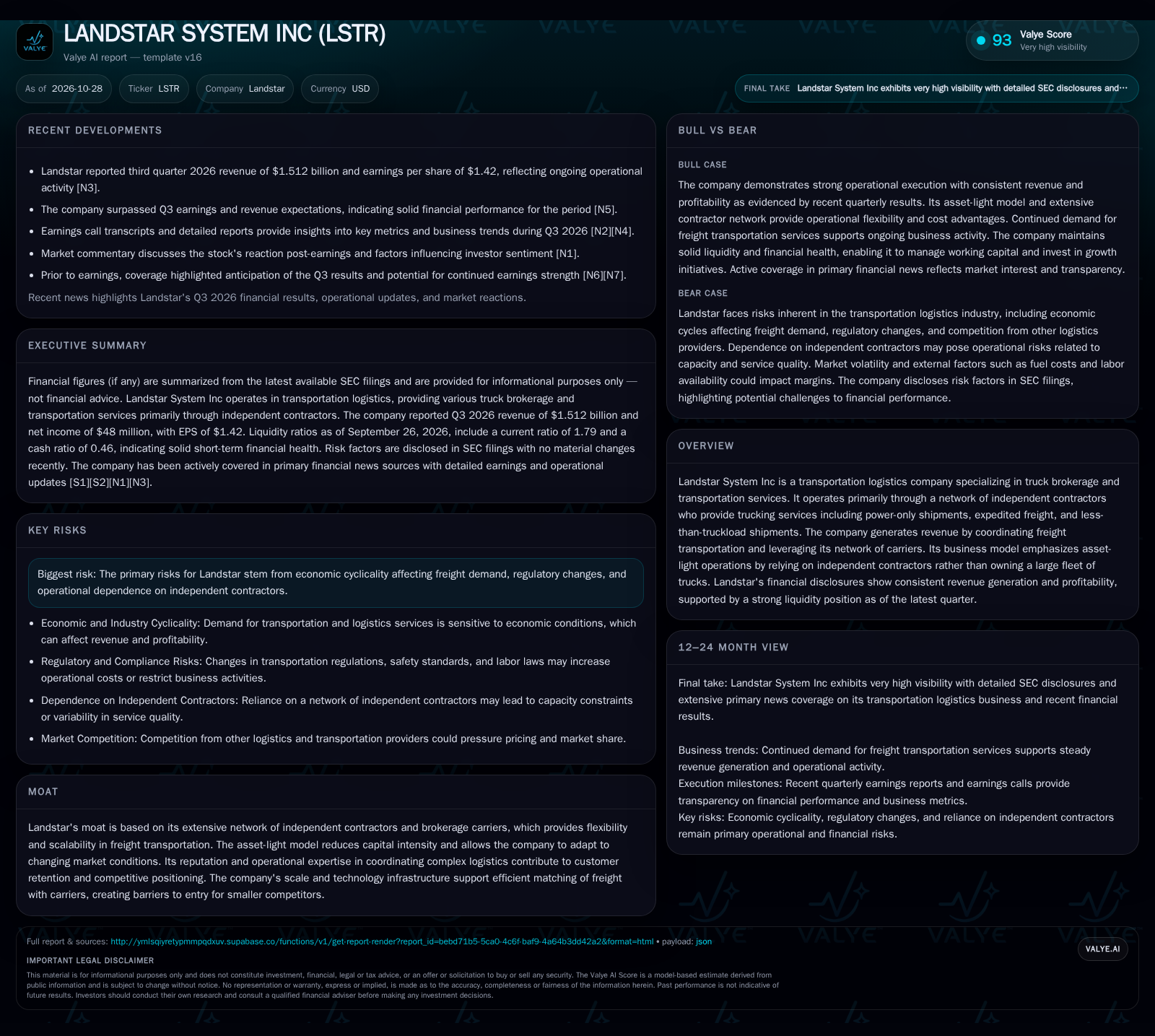
Landstar System reported Q3 2026 revenue of $1.512 billion and net income of $48 million, reflecting solid execution of its asset-light logistics model. The company’s reliance on independent contractors provides flexibility but exposes it to industry cyclicality and labor dynamics. While liquidity remains robust, competitive and regulatory headwinds could impact both growth and profitability in coming quarters. Key watchpoints include contractor retention, pricing discipline, and freight demand signals. [S2] [N3]
Landstar System’s Q3 2026 results highlight the company’s ability to deliver solid revenue and profitability despite a turbulent freight environment. By operating through a vast network of independent contractors and focusing on brokerage rather than asset ownership, Landstar maintains a flexible cost structure and scalable capacity. However, this model also leaves the company exposed to swings in freight demand, labor availability, and regulatory shifts. As the transportation logistics sector faces ongoing economic and competitive pressures, the sustainability of Landstar’s performance will hinge on its ability to retain contractor loyalty, maintain pricing power, and adapt to evolving industry dynamics. [S2] [N3] [N5]
Q3 2026 Performance: Strong Revenue Amid Market Volatility
Landstar System reported Q3 2026 revenue of $1.512 billion and net income of $48 million, translating to earnings per share of $1.42. These figures surpassed pre-earnings expectations and indicate that the company continues to execute well within its asset-light logistics framework. The company held $297 million in cash and cash equivalents and short-term investments of $53.7 million as of September 26, 2026. Its current ratio of 1.79 reflects a reported liquidity position. There were no material changes in risk disclosures compared to the prior annual report, suggesting stability in the company’s risk profile for now. The market has responded with active discussion and analysis in primary financial news outlets, focusing on both the short-term outperformance and the longer-term challenges Landstar faces in a cyclical industry. [S2] [N3] [N5]
The Economics of Asset-Light Truck Brokerage
Landstar’s revenue model centers on coordinating freight shipments through a network of independent contractor drivers and third-party brokerage carriers. The company earns a commission or margin on each load, with the majority of variable costs—driver pay, fuel, equipment maintenance—borne by the contractors themselves. This structure reduces fixed costs and capital requirements, enabling Landstar to scale up or down rapidly in response to demand. Operating leverage is primarily driven by technology, personnel, and administrative costs, which are relatively modest compared to companies that own large fleets.
Revenue growth depends on both shipment volume and pricing discipline. In strong freight markets, Landstar can command higher brokerage margins as capacity tightens; in soft markets, competition and excess capacity can compress those margins. The company’s ability to maintain profitability thus hinges on efficiently matching loads to available contractors and maintaining a high utilization rate for its network. Capital needs are lower than asset-intensive peers, but investments in technology, compliance systems, and contractor recruitment remain critical for sustaining the platform’s competitive edge.
Contractor Network Scale as Differentiator—But Not an Impregnable Moat
Landstar’s principal advantage lies in its extensive network of vetted independent contractors and brokerage relationships. This allows the company to offer a broad array of truckload, less-than-truckload, and specialized freight services with high geographic and modal flexibility. The asset-light model enables rapid adaptation to market shifts and reduces exposure to equipment depreciation and ownership risk.
However, this model is not unique—many large logistics providers and digital freight platforms employ similar structures. Competitive pressure comes from both traditional freight brokers and tech-enabled entrants pursuing automation, dynamic pricing, and direct shipper-carrier connections. Switching costs for shippers and contractors are moderate; while Landstar’s reputation and technology infrastructure foster some stickiness, there is little to prevent customers or contractors from multi-homing or switching, especially if pricing or service quality falter.
The company’s technology stack and operational expertise in matching loads to capacity remain differentiators, but these advantages could erode if competitors succeed in improving digital platforms or offer better economics to contractors or shippers.
Favorable Freight Cycle and Network Loyalty Drive Margin Expansion
If freight demand strengthens—due to economic recovery, supply chain normalization, or modal share shifts—Landstar could benefit from both higher shipment volumes and improved brokerage margins. The asset-light structure would allow incremental revenue to flow disproportionately to the bottom line, enhancing operating leverage. Contractor loyalty and retention would be critical; if Landstar can maintain or grow its network without meaningfully increasing contractor compensation or incentives, it could capture more loads and leverage its technology for higher efficiency.
Evidence for this scenario would include sustained or rising load volumes, margin expansion in quarterly results, and commentary indicating strong contractor engagement and minimal capacity constraints. Confirmation would also come from Landstar outpacing peer volume or margin trends, or from management signaling successful technology upgrades that improve match rates and reduce deadhead miles.
Stable Performance Amid Freight Market Normalization
The most plausible scenario is that Landstar maintains a steady level of revenue and profitability, with modest fluctuations reflecting the broader freight market’s cyclical nature. The company’s flexible cost structure enables it to weather moderate downturns without severe margin compression, while continued investment in technology and compliance helps retain contractor and customer relationships.
In this scenario, Landstar’s financials would show stable or gradually improving load counts, relatively consistent brokerage margins, and ongoing positive net income. Evidence supporting this view would include flat or modestly rising quarterly revenue, stable ratios of contractors to available loads, and commentary highlighting continued demand from core shipper customers. Falsification would involve a sharp, sustained drop in load volumes, margin compression outpacing peers, or significant contractor attrition.
Capacity Constraints and Weak Freight Demand Pressure Margins
If the freight market softens further due to economic downturn, inventory destocking, or modal shifts away from trucking, Landstar could face a double bind: lower shipment volumes and heightened competition for loads. In this environment, independent contractors may exit the platform for lack of work or seek higher-paying alternatives, creating capacity bottlenecks and forcing Landstar to offer higher incentives or accept lower margins to retain critical network density.
Additional downside risks include regulatory changes increasing the cost of engaging independent contractors, or technology-enabled competitors undercutting brokerage fees. Evidence confirming this scenario would include declining load counts, shrinking brokerage margins, rising contractor churn, or commentary about increased competitive pricing pressure. A rapid deterioration in liquidity or working capital metrics would further validate downside stress.
Testing Landstar’s Resilience: What Could Shift the Thesis in 2027 and Beyond
Quarterly load volume growth or contraction—if disclosed—would provide direct evidence of underlying demand and network utilization.
Brokerage gross margin trends are critical to assess pricing discipline and competitive pressure; sustained erosion would signal structural challenges.
Contractor network size and retention rates, if reported, would help test the durability of Landstar’s flexible capacity model.
Customer concentration metrics—such as the share of revenue from top shippers—would illuminate risks from potential shipper churn.
Technology investment levels and platform adoption rates among contractors and shippers would indicate the company’s progress in digital differentiation.
Any regulatory or legal developments regarding the classification of independent contractors could materially impact cost structures and operational flexibility.
Management guidance and commentary on freight demand outlook, capacity constraints, or competitive responses would help triangulate future performance.
Disclaimer: This is research-only, informational analysis and not investment advice. It may include AI-generated interpretation and general industry context. Always verify important details using primary sources.

Comments