
PPG Industries in Late 2026: Aerospace Momentum, Strategic Investment, and the Challenge of Cyclical Markets
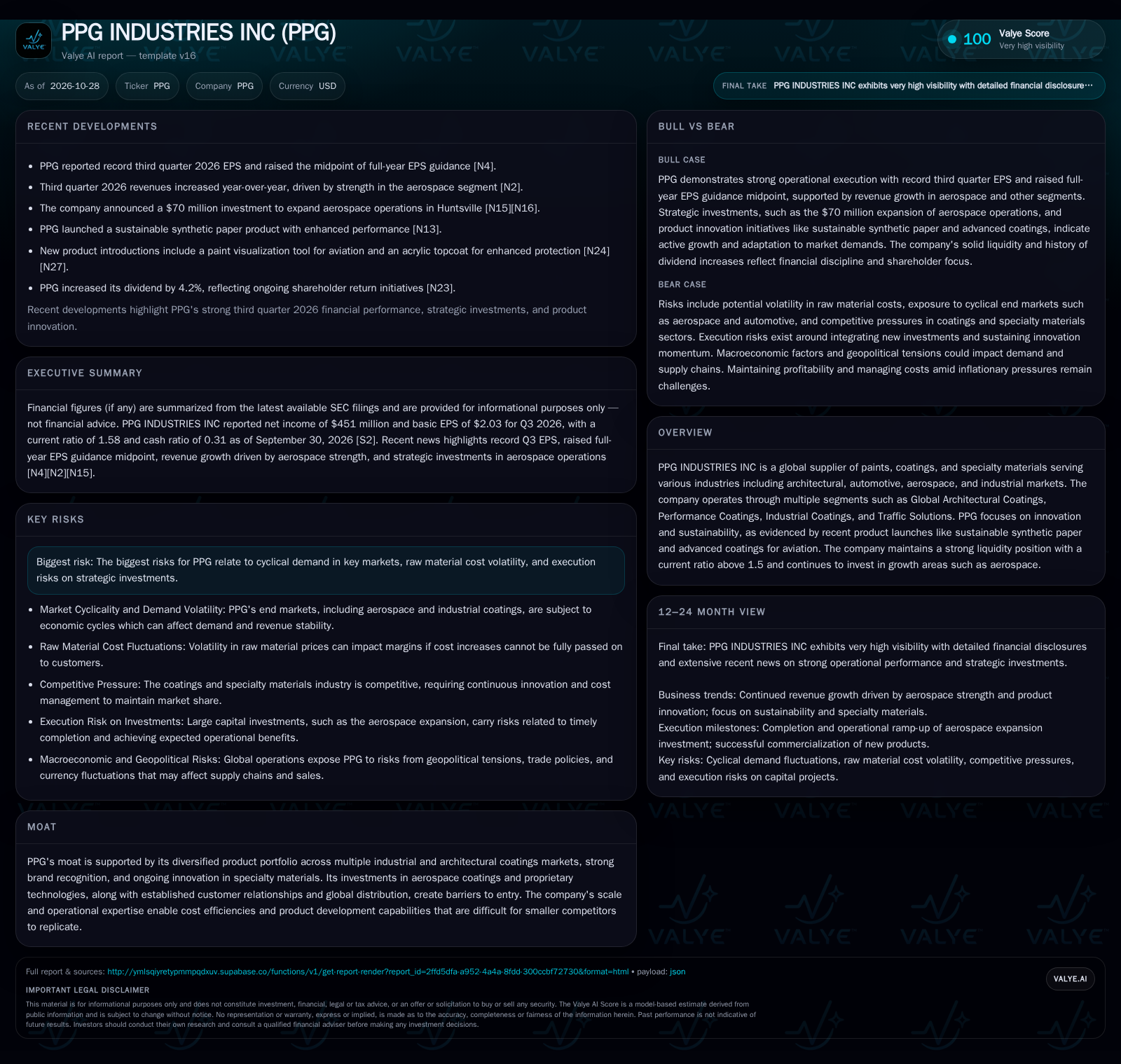
PPG Industries posts record Q3 2026 EPS and raises full-year guidance, with aerospace coatings driving revenue strength and a $70 million expansion in Huntsville signaling strategic capital deployment. The company’s diversified portfolio and innovation focus underpin resilience, but raw material volatility and cyclical demand in end markets remain central risks.
PPG Industries delivered record Q3 2026 EPS, raised its full-year guidance midpoint, and grew revenues year-over-year—primarily on aerospace segment strength. The $70 million Huntsville expansion underscores a strategic bet on aerospace coatings. Innovation and execution on new investments are key to sustaining growth.
PPG Industries enters late 2026 with strong momentum, posting record third quarter EPS and lifting its full-year earnings guidance midpoint. The company’s year-over-year revenue growth is notably propelled by its aerospace segment, a trend reinforced by a $70 million capital commitment to expand operations in Huntsville. While PPG’s diversified coatings and specialty materials portfolio supports resilience, its core exposures—to cyclical end markets and commodity cost swings—could shape the sustainability of this current performance. Execution on strategic investments and continued product innovation will be decisive over the next several quarters.
Recent Performance: Record EPS, Aerospace Outperformance, and Strategic Expansion
PPG Industries reported record third quarter 2026 EPS and raised the midpoint of its full-year guidance, reflecting robust operational execution [N4]. The company’s Q3 net income was $451 million, with basic EPS of $2.03 [S2]. Revenue growth for the quarter was driven primarily by ongoing strength in the aerospace coatings segment [N2]. In a clear signal of strategic focus, PPG announced a $70 million investment to expand its aerospace operations in Huntsville, Alabama, aiming to capture further growth in this high-value sector. The company reported cash and liquidity metrics for the period; these figures do not by themselves establish operating runway, investment capacity, financial flexibility, or financing capacity. [S2] These developments together highlight a company executing on both operational and strategic fronts, with aerospace now a core growth engine.
How PPG’s Portfolio and Investment Strategy Shape Its Economic Model
PPG’s business model centers on producing and distributing coatings and specialty materials across a range of end markets—architectural, industrial, automotive, and aerospace. Each segment exhibits distinct pricing and volume dynamics. Aerospace coatings, currently the standout performer, generally command higher margins and face less price sensitivity than architectural or general industrial coatings, owing to stringent performance requirements and qualification barriers. Fixed costs are significant, especially in manufacturing and R&D, but scale enables operational leverage when volumes rise. Variable costs are dominated by raw materials—resins, pigments, and solvents—exposing the company to commodity price swings. Capital needs are episodic, with large investments like the $70 million Huntsville expansion directed toward higher-value, higher-growth niches. In periods of demand expansion, PPG can realize leverage through asset utilization and incremental margin capture, but in downturns, high fixed costs and raw material volatility can erode profitability.
The interplay between fixed and variable costs in PPG’s business model means that the company’s profitability is highly sensitive to volume fluctuations. When demand expands, fixed costs such as manufacturing overhead and R&D investments are spread over a larger revenue base, enhancing operating leverage and boosting margins. Conversely, during downturns, these fixed costs become a heavier burden, compressing profitability. This dynamic underscores the importance of maintaining diversified end-market exposure to smooth demand cycles. Additionally, PPG’s reliance on raw materials exposes it to commodity price volatility, which can be partially mitigated through strategic sourcing, long-term supplier contracts, and passing costs to customers when market conditions allow. However, the effectiveness of these mitigants varies by segment and competitive environment, affecting margin stability.
Defending Share in a Fragmented, Innovation-Driven Coatings Industry
PPG operates in a highly competitive global coatings market, facing multinational rivals as well as regional specialists. Its competitive advantages stem from product breadth, brand recognition, and established customer relationships across diversified geographies and industries. In aerospace, barriers to entry are particularly high due to regulatory qualifications, performance certifications, and long customer approval cycles, making new entrants less likely and supporting stickier revenue streams. However, in architectural and industrial coatings, price competition can be fierce and switching costs lower, especially for commoditized products. PPG’s ongoing investments in specialty materials, sustainability, and product innovation help differentiate its offerings but require continuous R&D and capital allocation. Substitution risk exists from both new materials and lower-cost competitors, particularly in regions where price sensitivity dominates.
In highly regulated sectors like aerospace, PPG’s competitive moat is reinforced by the lengthy and costly qualification processes for new coatings, which act as significant barriers to entry. This creates a more stable revenue base and allows for premium pricing but also requires sustained investment in compliance and innovation. In contrast, segments such as architectural coatings face more commoditized demand with lower switching costs, making price competition and customer retention more challenging. This bifurcation in market dynamics necessitates a tailored competitive strategy, where PPG must balance innovation and cost efficiency in mature markets while leveraging technological differentiation and regulatory compliance in aerospace and specialty segments to maintain and grow market share.
Aerospace Expansion and Product Innovation Unlock Margin Upside
If PPG’s $70 million Huntsville expansion is executed on time and on budget, the company could further entrench itself as a leading supplier in the aerospace coatings market. Successful commercialization of new products—such as advanced acrylic topcoats or sustainable synthetic papers—could drive incremental share gains and premium pricing. In this scenario, the aerospace and specialty segments deliver above-cycle growth, offsetting any softness in cyclical markets like automotive or general industrial. Evidence supporting this upside would include sustained double-digit revenue growth in aerospace, improved consolidated gross margins, and a demonstrated ability to pass raw material costs through to customers. Accelerated adoption of next-generation, eco-friendly coatings in regulated markets would further validate this thesis.
The potential for margin expansion through aerospace growth is contingent on several factors aligning. Efficient scale-up of the Huntsville facility must coincide with robust aerospace demand to fully leverage fixed costs and generate incremental margin. Furthermore, successful product innovation that meets evolving customer requirements—such as lighter, more durable, or environmentally friendly coatings—can justify premium pricing and reduce substitution risk. If PPG can also demonstrate agility in managing raw material costs through improved procurement strategies or formulation adjustments, it could further enhance profitability. However, these outcomes depend on stable macroeconomic conditions and sustained capital investment, highlighting the conditional nature of the upside thesis.
Diversification Balances Cyclical Swings, but Margin Gains Are Incremental
The most plausible outlook is that PPG continues to benefit from its diversified portfolio, with aerospace remaining a growth driver but not fully insulating results from broader cyclical swings in automotive, architectural, and general industrial markets. Margins may expand modestly if price increases in specialty coatings offset input cost inflation, but significant operating leverage is likely only if overall end-market demand remains robust. Evidence confirming this scenario would include stable or gradually rising gross margins, moderate top-line growth across segments, and continued investment in R&D and selective capital projects. Signs of lagging demand in any major segment, or an inability to offset rising costs, would challenge this base case.
Input Cost Spikes and End-Market Contraction Pressure Profitability
A negative scenario could play out if raw material costs spike and PPG is unable to fully pass these increases onto customers, compressing gross margins. Simultaneously, a pronounced downturn in key cyclical end markets—such as automotive, construction, or industrial—would reduce volumes, undermining fixed-cost absorption and eroding profitability. Execution delays or cost overruns in the Huntsville aerospace expansion could further strain returns on invested capital. Evidence for this scenario would be a sudden drop in segmental sales, margin contraction quarter-over-quarter, and below-guidance EPS revisions. Early warning signs also include inventory build-ups and reduced capital spending as management responds defensively to weaker demand.
Testing PPG’s Resilience: What Will Matter Most for the Thesis
Quarterly aerospace segment revenue growth rates, especially relative to overall company growth, will clarify whether the segment remains the key engine.
Consolidated and segment-level gross margin trends, particularly in the context of raw material cost movements, will indicate pricing power and cost pass-through effectiveness.
Progress milestones and cost discipline on the $70 million Huntsville aerospace expansion, including on-time delivery and ramp-up of commercial output.
Evidence of new product commercialization, adoption rates, and incremental revenue from innovation initiatives, particularly in sustainable or high-performance coatings.
Organic volume growth or contraction in core end markets (architectural, automotive, industrial) as a signal of underlying demand health.
Inventory and working capital trends, which can signal either confidence in future demand or emerging demand weakness.
Updates to full-year EPS guidance and management commentary on end-market outlooks, raw material inflation, and competitive dynamics.
Disclaimer: This is research-only, informational analysis and not investment advice. It may include AI-generated interpretation and general industry context. Always verify important details using primary sources.

Comments