
Franklin Electric in 2026: Integrating Acquisitions and Navigating Margin Pressure in Global Water and Energy Systems
Franklin Electric's 2026 performance reflects strong segmental growth, strategic acquisition-driven expansion, and robust balance sheet flexibility. Yet, margin compression and market cyclicality point to critical tests ahead for sustainable operating leverage and competitive positioning.
Franklin Electric posted solid top-line growth in 2026, fueled by acquisitions across water treatment and pump lines, volume gains, and pricing actions. Despite this, gross margins came under modest pressure, reflecting inflation and mix shifts. The company's diversified end-markets, global reach, and acquisition integration will be pivotal for maintaining earnings momentum amid housing and energy sector volatility.
Franklin Electric enters late 2026 with a blend of expansion and challenge: its top-line is buoyed by a spate of acquisitions and healthy demand across water and energy pumping systems, yet profitability is squeezed by rising input costs and evolving product mix.
2026: Acquisition-Driven Growth Meets Margin Headwinds
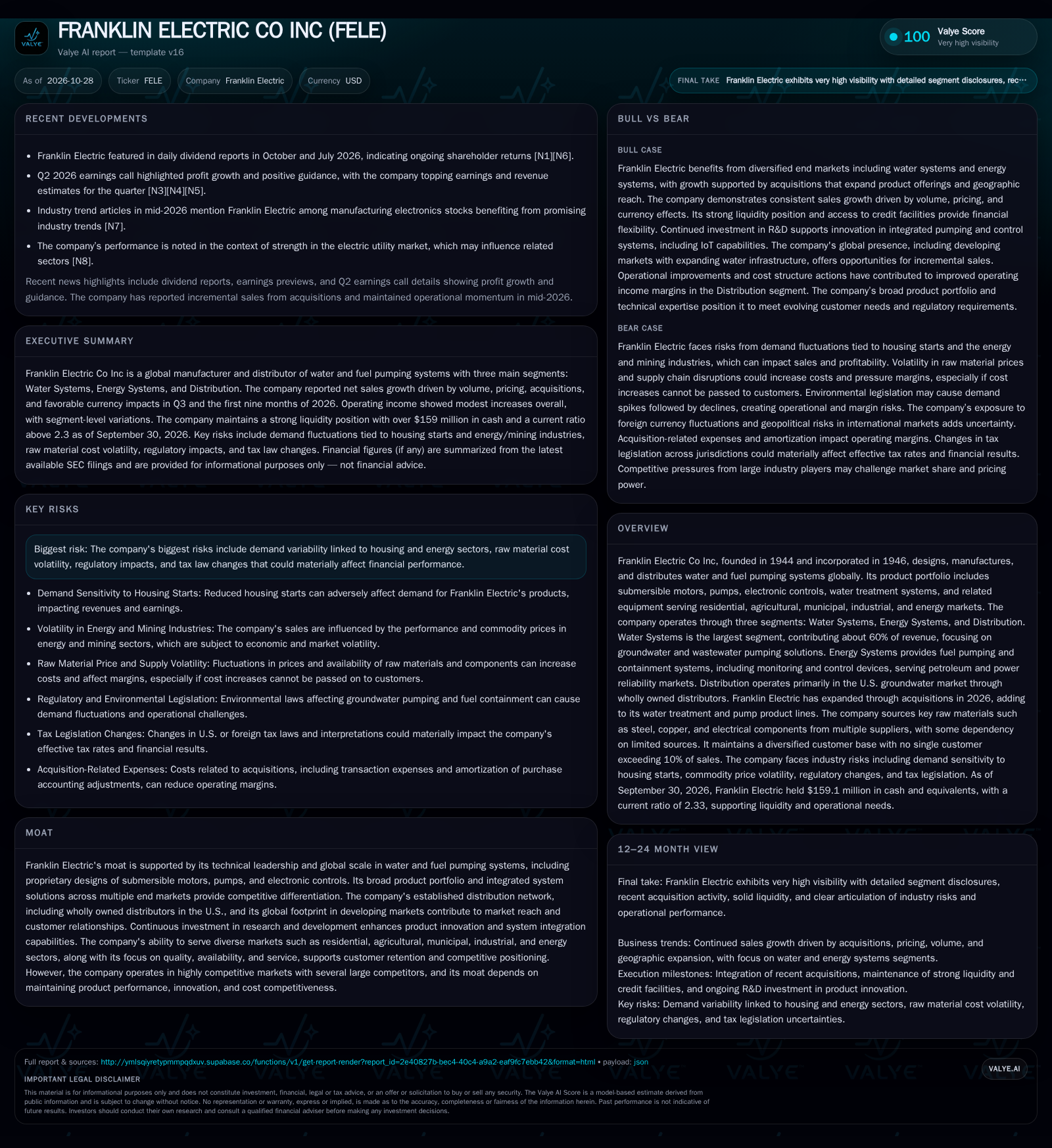
Franklin Electric’s reported net sales increased by 9% in Q3 and 8% in the first nine months of 2026, with growth attributed to a combination of higher volumes, effective pricing, contributions from recent acquisitions, and a tailwind from foreign currency translation [S2]. Notably, the company executed a string of acquisitions in 2026—Benson Pump, Wood Brothers Industries, Maynard's Water Conditioning, and Cat Pumps—adding both scale and product breadth in water treatment and pump systems [S2]. Segment sales growth was strongest in Distribution (+15%) and Energy Systems (+15%), while Water Systems, still the largest contributor, grew by a more modest 5% [S2]. Despite this strong revenue performance, gross margins edged down to 35.4% in Q3, with management citing inflationary pressures and shifts in product and geographic mix [S2]. The company reported a current ratio of 2.33 for the period. [S2]
Earnings Power: Multi-Segment Revenue Streams and Cost Structure Dynamics
Franklin Electric’s business economics are defined by a mix of manufacturing and distribution activities across three segments: Water Systems, Energy Systems, and Distribution. Water Systems, which constitutes about 60% of revenue, is capital intensive but benefits from scale efficiencies in manufacturing submersible motors and pumps. Energy Systems (fuel pumping and containment) and Distribution (Headwater Companies’ groundwater focus) offer both product and channel leverage, but are exposed to different end-market cycles [S1] [S2].
Revenue is driven by a blend of volume, price, and inorganic growth, with pricing power influenced by product differentiation and the ability to pass through input cost increases. The recent acquisitions expand Franklin’s addressable market, particularly in specialty pump niches and water treatment, but initial integration costs and amortization can weigh on near-term operating margins [S2].
Gross margins (35.4% in Q3 2026) reflect both variable input costs—such as steel, copper, and electronics—and the mix between higher-margin proprietary products and lower-margin distribution activities. Operating leverage depends on the company’s ability to grow volumes faster than fixed costs, but recent inflation and mix shifts have tightened this margin. The company reported cash and liquidity metrics for the period; these figures do not by themselves establish operating runway, investment capacity, financial flexibility, or financing capacity.
Integrated Systems, Broad Reach, and the Challenge of Differentiation
Franklin Electric’s competitive position is rooted in its technical know-how, proprietary pump and motor designs, and a broad portfolio spanning water, fuel, and distribution solutions. Its global footprint and direct distribution network (notably through Headwater in the U.S.) provide market reach and some control over channel economics. The company’s ability to serve a diversified set of end markets—residential, agricultural, municipal, industrial, and energy—mitigates overexposure to any single sector or customer, with no customer exceeding 10% of sales in recent years [S1].
However, the competitive landscape is crowded and includes both large, diversified industrials and specialized pump/system manufacturers. Barriers to entry in proprietary submersible motors and integrated control systems can offer some insulation, but price-based competition is intense, especially in commoditized segments. The risk of substitution from municipal water systems (reducing private well demand) and regulatory-driven technology shifts in energy systems could challenge legacy product lines. The real test will be Franklin’s ability to innovate—particularly in smart/IoT-enabled systems—and to leverage its expanded product range post-acquisition to deepen customer relationships and defend margins.
If Integration Delivers Synergy and Technology Drives New Demand
The bull case for Franklin Electric hinges on successful integration of its recent acquisitions, unlocking cross-selling opportunities and operational synergies that drive both revenue growth and margin improvement. If the company can leverage its expanded water treatment and specialty pump lines across its distribution network, it could accelerate share gains in both core and adjacent markets.
A scenario where inflation moderates, allowing for better pass-through of input costs, would support a rebound in gross margins. Additionally, ongoing R&D investment could result in higher-margin, differentiated products—such as IoT-enabled controls or advanced monitoring systems—expanding wallet share with existing customers and opening new markets. Confirmation of this scenario would include sustained double-digit growth in Distribution and Energy Systems, stabilization or improvement in Water Systems margins, and evidence of cross-segment product adoption. Falsification would come from persistent integration costs, margin slippage, or signs of acquisition-related disruption.
Sustained Growth Amid Cyclical Pressures and Margin Volatility
The most plausible outcome is continued modest top-line growth, with Franklin Electric maintaining its diversified revenue mix and integrating recent acquisitions at a measured pace. Sales are likely to benefit from gradual recovery or stability in housing, agricultural, and energy capex cycles, while pricing actions help offset at least some input cost inflation.
Gross margins may remain slightly below recent historical averages, reflecting ongoing cost pressures and evolving mix toward lower-margin distribution. Operating income could show modest gains, but upside will be capped unless integration synergies materialize or cost structure actions gain traction. Evidence supporting this scenario would be steady mid-to-high single-digit revenue growth, stable segment mix, and no significant deterioration in operating margins. Signs of divergence—such as margin compression outpacing sales growth or integration delays—would challenge the base case.
Margin Erosion and Demand Shocks from Construction or Energy Slumps
The bear case centers on a combination of cyclical downturns (e.g., sharp drops in housing starts or energy sector spending) and persistent input cost inflation that Franklin cannot fully pass through. In this scenario, Water Systems and Distribution volumes soften, while Energy Systems faces demand volatility tied to petroleum and power reliability markets.
If raw material shortages or price spikes coincide with supply chain disruptions, gross margins could come under significant pressure, especially if mix shifts further toward lower-margin channels. Integration of acquisitions could become a distraction, leading to operational inefficiencies and increased SG&A costs. Regulatory changes—such as stricter groundwater or fuel containment rules—could trigger abrupt shifts in demand, forcing product redesigns or compliance spending. This scenario would be confirmed by declining revenue, sustained margin compression, and evidence of working capital strain or higher debt drawdowns.
What Will Separate Resilience from Regression for Franklin Electric?
Sustained gross margin trends: A key test is whether margins stabilize or rebound post-integration and as inflationary pressures evolve.
Integration progress for 2026 acquisitions: Any disclosed cost synergies, cross-selling metrics, or integration milestones would clarify the success of recent portfolio expansion.
Segment-level sales and operating income: Divergence in growth or profitability between Water, Energy, and Distribution segments would reveal structural strengths or vulnerabilities.
Raw material cost and supply chain dynamics: Updates on sourcing stability, pricing pass-through, and supplier diversification would help assess margin risk.
End-market demand indicators: Housing starts, agricultural investment trends, and energy sector capex are external factors that could materially affect sales trajectories.
Product innovation pipeline: Evidence of new product launches (especially IoT-enabled or regulatory-driven solutions) would indicate future margin and revenue potential.
Working capital and credit facility usage: While current liquidity is ample, rising inventories or receivables, or increased reliance on debt, would signal emerging stress.
Regulatory and environmental developments: Any changes in water, energy, or environmental policy that impact demand or compliance costs must be closely monitored.
Disclaimer: This is research-only, informational analysis and not investment advice. It may include AI-generated interpretation and general industry context. Always verify important details using primary sources.

Comments