
SLB in 2026: Production Systems Growth and the Challenge of Market Volatility
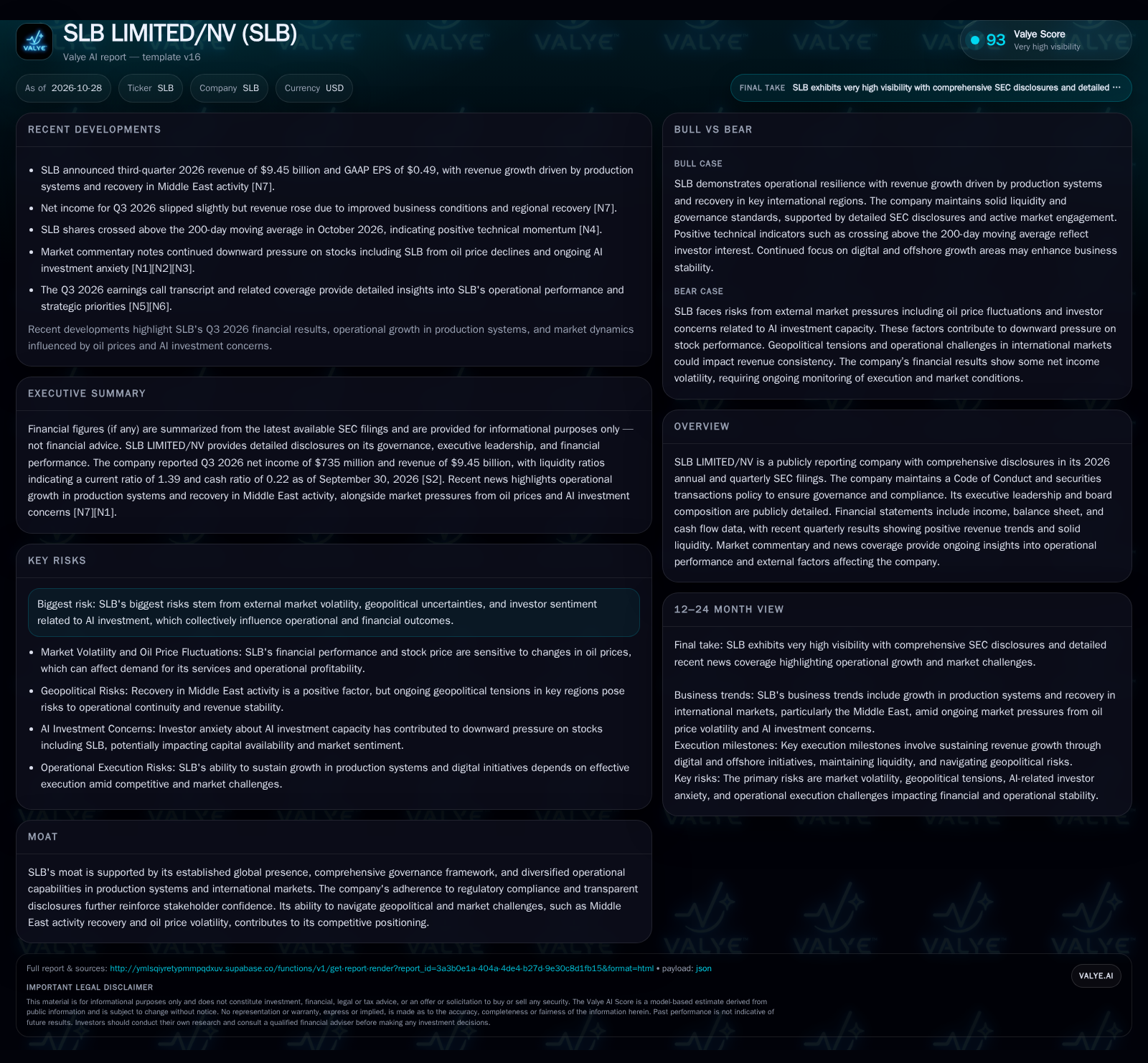
SLB LIMITED/NV reported Q3 2026 net income of $735 million on rising revenues, buoyed by production systems recovery and international demand. Yet, oil price fluctuations and AI investment anxieties continue to weigh on investor sentiment and future capital allocation.
SLB’s recent financials show revenue growth from production systems and international market recovery, with Q3 2026 net income at $735 million. However, persistent oil price volatility and concerns about AI investment capacity remain headwinds, shaping both operational priorities and market perception. Ongoing geopolitical and execution risks could drive future performance divergence. [S2] [N7]
SLB LIMITED/NV enters late 2026 with a mix of operational momentum and macroeconomic headwinds. The company’s Q3 results reveal robust revenue expansion tied to production systems and regional recoveries, especially in international markets, with net income landing at $735 million. While technical indicators such as crossing the 200-day moving average suggest renewed market interest, ongoing oil price swings and anxieties over AI investment allocation continue to cloud the outlook. [S2] [N4] [N7]
Q3 2026 Results Spotlight Revenue Growth and Ongoing Volatility
SLB reported Q3 2026 net income of $735 million, with revenue growth attributed to improved business conditions and a recovery in production systems, particularly in international markets. The company’s current assets stood at $20.5 billion against current liabilities of $14.8 billion, resulting in a current ratio of 1.39 and a cash ratio of 0.22 as of September 30, 2026. This indicates reported liquidity position for ongoing operations, though not an excess reported cash balance. Notably, SLB’s shares crossed above the 200-day moving average in October 2026, suggesting a positive short-term technical sentiment. However, market commentary continues to highlight persistent downward pressure on the stock from oil price fluctuations and investor concerns around AI investment capacity, reflecting the external volatility shaping SLB’s near-term prospects. [S2] [N4] [N7]
How SLB Monetizes: Service Depth, Volume Leverage, and Capital Discipline
SLB’s business model is anchored in providing equipment, technology, and integrated services to the global energy sector, with revenue streams spanning production systems, drilling, digital solutions, and reservoir management. The company’s economics benefit from a mix of high-value, technology-driven projects and recurring service contracts, though the precise contract structure and revenue recognition mechanics are not disclosed. Revenue growth in Q3 2026 was driven by production systems and regional recovery, likely due to increased offshore and international activity, which tend to offer higher margins and longer-cycle visibility compared to North American onshore work. Capital intensity is significant, as SLB must invest in equipment, R&D, and regional infrastructure, with operating leverage materializing as volumes recover and fixed costs are absorbed across a larger revenue base.
Pricing power is partially cyclical, tied to customer capital budgets, oil prices, and competitive dynamics. When oil prices are robust, SLB can command premium pricing for advanced services and technologies; in downturns, pricing pressure intensifies and customers defer projects. The company reported cash and liquidity metrics for the period; these figures do not by themselves establish operating runway, investment capacity, financial flexibility, or financing capacity. Future economics will depend on the mix shift toward higher-margin digital and integrated offerings and the pace of international market recovery. [S2] [N7]
Global Reach Meets a Crowded Field: SLB’s Strategic Advantages and Threats
SLB’s competitive position is underpinned by its global scale, technological breadth, and diversified service portfolio, enabling it to serve both international oil companies and national oil companies across multiple regions. Its established relationships and regulatory compliance framework provide a degree of customer stickiness, especially in complex, high-barrier environments like deepwater or Middle Eastern markets. However, the field remains crowded with large multinational peers as well as regional specialists and emerging technology entrants.
Competitive threats include pricing pressure from overcapacity in commoditized service segments, technological substitution (e.g., digital twins, automation, and AI-driven reservoir analytics), and customer insourcing of select functions. The growing importance of digital and AI-enabled solutions introduces both opportunity and risk: SLB could capture higher-margin, recurring revenue if it succeeds in platformizing its offerings, but must invest heavily to keep pace with fast-moving technology cycles and evolving customer expectations. The company’s operational resilience will depend on sustained investment in innovation, the ability to execute complex international projects, and responsiveness to shifting customer procurement models.
If Production Systems and Digital Integration Accelerate
A favorable scenario for SLB would see continued expansion in production systems, coupled with successful deployment and scaling of digital solutions across its customer base. If international market recovery sustains and customers prioritize efficiency and uptime, SLB could achieve higher-margin revenue growth as it captures incremental share in technology-driven projects. Increased adoption of digital platforms may lead to recurring software and analytics revenue, improving visibility and reducing cyclicality.
Confirmation of this upside would require evidence of sustained double-digit revenue growth in production systems, sequential margin expansion, and public disclosure of multi-year digital service contracts or subscriptions. Additional validating signals would include new customer wins in high-barrier international markets, announcements of technology partnerships, and a rising proportion of revenue from digital or integrated offerings. Conversely, if disclosed, stagnating or declining production systems order intake, or slower-than-expected digital adoption, would challenge the upside thesis.
Volatility Persists, but Execution Drives Incremental Gains
The most plausible trajectory for SLB is a continued tug-of-war between external volatility—driven by oil price swings, geopolitical tension, and investor skepticism over AI investment—and operational improvements in core business lines. The company is likely to see moderate revenue growth from production systems and international markets, offset by periodic pricing pressure and margin variability.
This scenario would be confirmed by steady, single-digit revenue growth, stable or slightly improving operating margins, and ongoing commentary from management emphasizing disciplined capital allocation and risk management.
Oil Price Shocks and Investment Delays Derail Progress
A negative outcome could materialize if oil prices experience a sustained downturn, leading to customer budget cuts, project deferrals, and heightened pricing competition. Under this scenario, SLB would face declining production systems volumes, underutilized assets, and potential write-downs, especially if international markets stall or geopolitical disruptions intensify. Investor anxiety over AI investment capacity could further constrain capital access or force a retrenchment in R&D and digital initiatives.
Downside confirmation would come from reported revenue declines in core segments, shrinking margins, negative free cash flow, and management guidance signaling retrenchment or layoffs. Early warning signs would include rising days sales outstanding (if disclosed), order cancellations, or postponements in international projects.
Milestones That Will Shape SLB’s Next Phase
Quarterly revenue and margin trends in production systems and digital segments—signs of sustained growth or sudden reversals would test the thesis. [S2] [N7]
Disclosure of multi-year digital service contracts, software subscriptions, or new technology partnerships—would help assess the shift toward recurring revenue.
International order intake and backlog (if disclosed), especially in Middle East and offshore markets—critical for gauging medium-term visibility.
Changes in capital expenditure and R&D investment levels—indicating confidence in future growth or retrenchment under pressure.
Management commentary on AI and digital investment priorities—key for understanding strategic focus and market sentiment impact. [N5] [N6]
Emergence of new competitors or evidence of customer insourcing—would signal competitive pressure and potential margin erosion.
Disclaimer: This is research-only, informational analysis and not investment advice. It may include AI-generated interpretation and general industry context. Always verify important details using primary sources.

Comments