
Avantor, Inc.: Margin Pressures, Strategic Oversight, and the Next Phase of Life Sciences Supply Economics
Avantor’s recent outperformance in Q3 2026 highlights robust revenue generation and operational focus, but persistent margin pressure and evolving risk management remain central to the company’s outlook. As new leadership takes the financial helm, the company’s ability to balance cost, customer needs, and supply chain resilience will likely determine its competitive trajectory in the life sciences and advanced technology sectors.
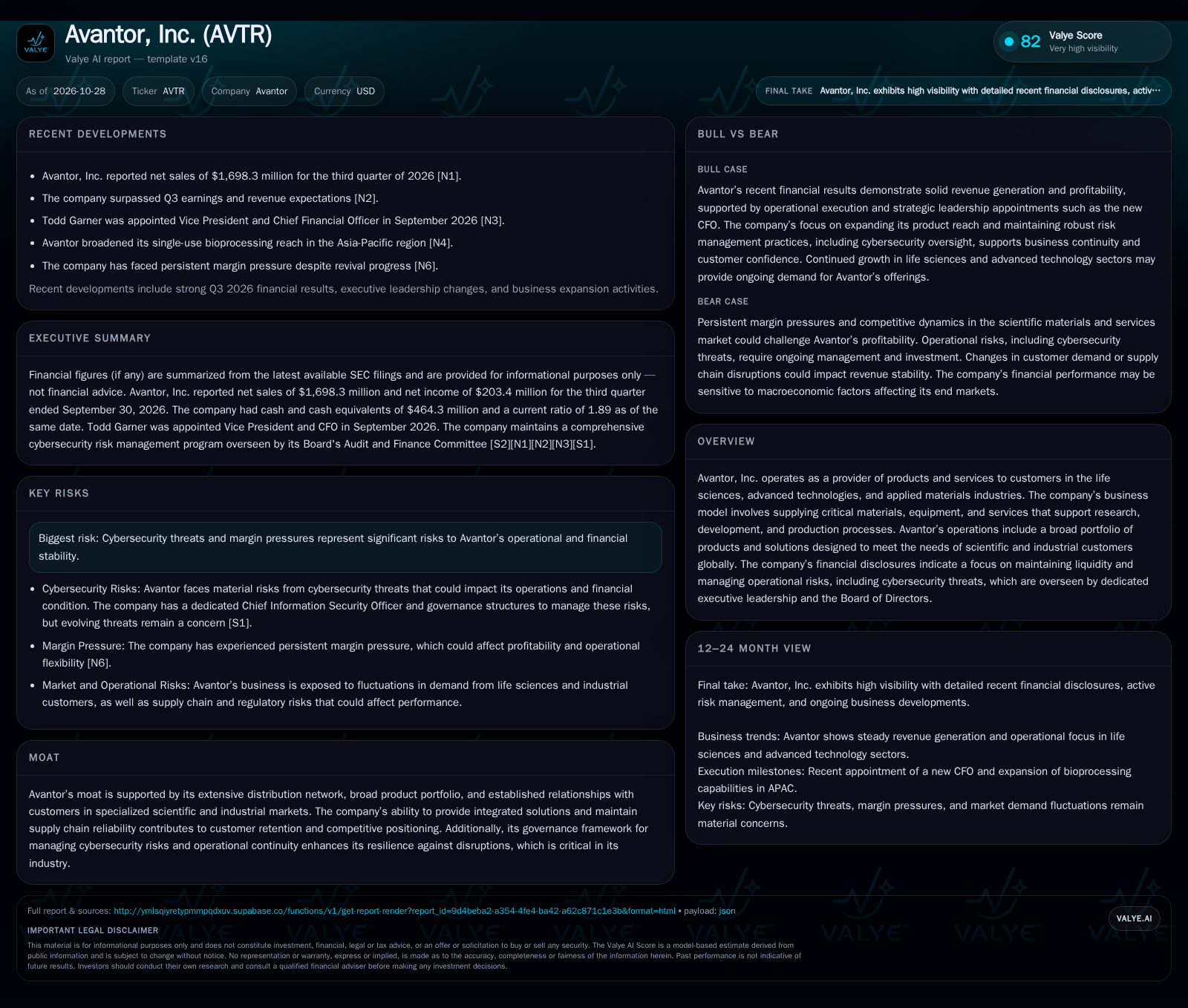
Avantor, Inc. reported strong Q3 2026 net sales and earnings, surpassing expectations, yet continues to contend with margin pressure amid ongoing expansion and operational risk management. The appointment of a new CFO signals potential shifts in financial strategy, while robust governance over cybersecurity and strategic risks aims to protect business continuity. The interplay between margin recovery, customer demand, and operational execution will define Avantor’s performance in the coming quarters. [N1] [N2] [N3] [N6]
Avantor, Inc. enters Q4 2026 on the back of better-than-expected earnings and revenue, reporting $1.7 billion in net sales and a net income of over $200 million for the third quarter. While these results offer a measure of operational strength and market demand, the company continues to face persistent margin pressure—a dynamic that could shape its ability to invest, compete, and grow. With a new CFO now in place and a robust cybersecurity oversight structure, Avantor’s next phase will be defined by its ability to translate topline momentum into sustainable profitability, especially as customer demands and industry competition intensify. [N1] [N2] [N3] [N6]
Earnings Beat and Leadership Changes Signal Strategic Crossroads
Avantor reported net sales of $1,698.3 million and net income of $203.4 million for Q3 2026, with EPS of $0.30, both above reported expectations. This outperformance provides evidence of resilient demand and effective operational execution in a challenging macro environment. [N1] [N2]
Despite topline strength, the company continues to grapple with persistent margin pressure—a key concern highlighted in recent coverage and material to the company’s future flexibility. [N6]
The appointment of Todd Garner as Vice President and CFO in September 2026 introduces new financial stewardship at a pivotal moment, potentially affecting future capital allocation and risk management. [N3]
Avantor’s structured approach to cybersecurity, with board-level oversight, reflects growing operational risk management sophistication, especially critical given its role in sensitive life sciences and technology supply chains. [S2]
Revenue Mix and the Margin Equation in Scientific Supply
Avantor’s business model centers on supplying critical materials, consumables, and services to the life sciences, advanced technologies, and applied materials sectors. Revenue is primarily generated through the sale of a broad portfolio of products, ranging from chemicals and reagents to laboratory equipment and integrated solutions.
The company’s economics are driven by volume and mix: recurring demand from research, production, and development customers tends to be stable, but pricing power is often constrained by competitive dynamics and procurement-driven cost sensitivity. Margins are influenced by product mix (higher-margin proprietary or specialty products vs. lower-margin commoditized supplies), scale efficiencies in distribution, and operational leverage from fixed infrastructure.
Recent margin pressure suggests either input cost inflation, pricing competition, or a shift toward lower-margin offerings—though the specific drivers are not disclosed. If Avantor can shift its mix toward value-added or proprietary solutions, or achieve cost efficiencies through scale and supply chain optimization, margin recovery could follow. Conversely, margin compression may persist if competitive intensity increases or customer procurement consolidates.
Capital requirements are moderate, with working capital tied to inventory and receivables, and capital expenditures likely focused on distribution/logistics, IT systems, and regulatory compliance. Operating leverage is present but may be limited by the need to continuously invest in supply chain reliability and risk management.
Distribution Depth, Product Breadth, and the Battle for Customer Loyalty
Avantor’s competitive position is anchored by its extensive distribution network, broad product portfolio, and deep relationships with scientific and industrial customers. These attributes support customer retention, particularly in regulated or mission-critical environments where supply reliability and integrated service matter.
However, the company faces competition from both global scientific supply giants and specialized niche providers. Price competition is intense for commoditized products, while differentiation relies on proprietary offerings, bundled services, and the ability to serve as a one-stop solution for complex customer needs.
Switching frictions exist, especially for customers reliant on validated supply chains or integrated service contracts, but may not be insurmountable if competitors offer better pricing, innovation, or supply assurance. Technology substitution risk is limited in core consumables but may emerge in digital procurement platforms or direct-from-manufacturer models, which could erode distributor margins.
Avantor’s governance focus on cybersecurity and operational continuity also enhances its value proposition in sensitive end-markets, providing a potential reputational edge over less risk-aware rivals.
What Margin Recovery Would Require: Mix Shift, Innovation, and Customer Value
A favorable scenario for Avantor would see margin pressure easing as the company successfully pivots toward higher-value proprietary products and integrated solutions, leveraging its distribution scale and customer intimacy. If the new CFO implements more disciplined cost controls or strategic pricing initiatives, incremental margin gains could result.
Upside would be further supported by continued growth in life sciences R&D, bioprocessing, and advanced technology manufacturing, which tend to require higher-value, specialized materials and services. Expansion in APAC or other high-growth regions could provide additional volume leverage.
Confirmation of this scenario would include improvement in reported gross and operating margins, a shift in revenue mix toward proprietary or differentiated offerings (if disclosed), and evidence of increased customer retention or contract wins in high-value segments.
A falsification would be continued stagnation or decline in margins, or evidence that competitive pricing pressure and input cost inflation overwhelm any mix or scale benefits.
Volume Growth Offsets Margin Pressure, but Profitability Remains Capped
The most plausible near-term outlook is that Avantor maintains steady revenue growth due to resilient demand for scientific supplies, but ongoing margin pressure caps operating leverage and net income expansion. The company’s broad product set and customer relationships provide a buffer against abrupt revenue declines, but pricing competition and cost inflation may continue to weigh on profitability.
Incremental improvements in cost management or efficiency could partially offset these headwinds, but a full margin recovery likely requires more substantial business mix or structural change. The new CFO may focus on operational discipline, but material shifts in financial trajectory would require evidence of either sustainable cost reduction or successful cross-selling of higher-margin solutions.
This scenario would be confirmed by continued revenue growth in line with or slightly above market, stable but pressured margins, and incremental operational improvements. A break from this pattern—either positive or negative—would likely hinge on external shocks or internal strategic execution.
Margin Compression and Operational Risks Erode Strategic Flexibility
A negative trajectory could emerge if margin pressure intensifies due to persistent cost inflation, further pricing concessions, or a shift in customer demand toward lower-margin products. If competitors accelerate innovation, undercut pricing, or capture key accounts, Avantor could lose share or face deeper margin erosion.
Operational risks—such as supply chain disruptions, regulatory changes, or a major cybersecurity incident—could further compromise profitability and customer trust. The company’s reliance on operational reliability means that any large-scale service failure could have outsized reputational and financial impacts.
This scenario would be confirmed by declining gross and operating margins, revenue stagnation or contraction, or disclosure of operational setbacks (e.g., supply chain interruptions, cyber breaches). A rapid deterioration in liquidity or working capital metrics could also signal emerging stress.
Tracking Avantor’s Margin Prospects and Risk Discipline: What Will Test the Thesis
Sequential and year-over-year trends in gross and operating margins—any improvement or continued compression will be highly informative.
Revenue mix by product type or service category, if disclosed, to assess progress on shifting toward higher-margin offerings.
New customer wins or contract renewals in strategic growth segments (bioprocessing, advanced technologies) as evidence of execution.
Disclosures or signals regarding cost management initiatives and their impact on SG&A or COGS.
Performance and continuity of supply chain operations, including any disruptions or inventory write-downs.
Updates on cybersecurity incidents or risk management enhancements, as operational reliability is increasingly material.
Early indications of strategic direction or capital allocation priorities from the new CFO, especially regarding margin recovery or investment focus.
Disclaimer: This is research-only, informational analysis and not investment advice. It may include AI-generated interpretation and general industry context. Always verify important details using primary sources.

Comments