
Hubbell’s Updated Guidance: Margin Management, Supply Chain Complexity, and the Next Phase of Industrial Growth
Hubbell’s raised full-year EPS guidance and strong third-quarter profit highlight resilient execution, but supply chain volatility, integration risk, and competitive pricing pressure remain central to the company’s long-term economic model and market position.
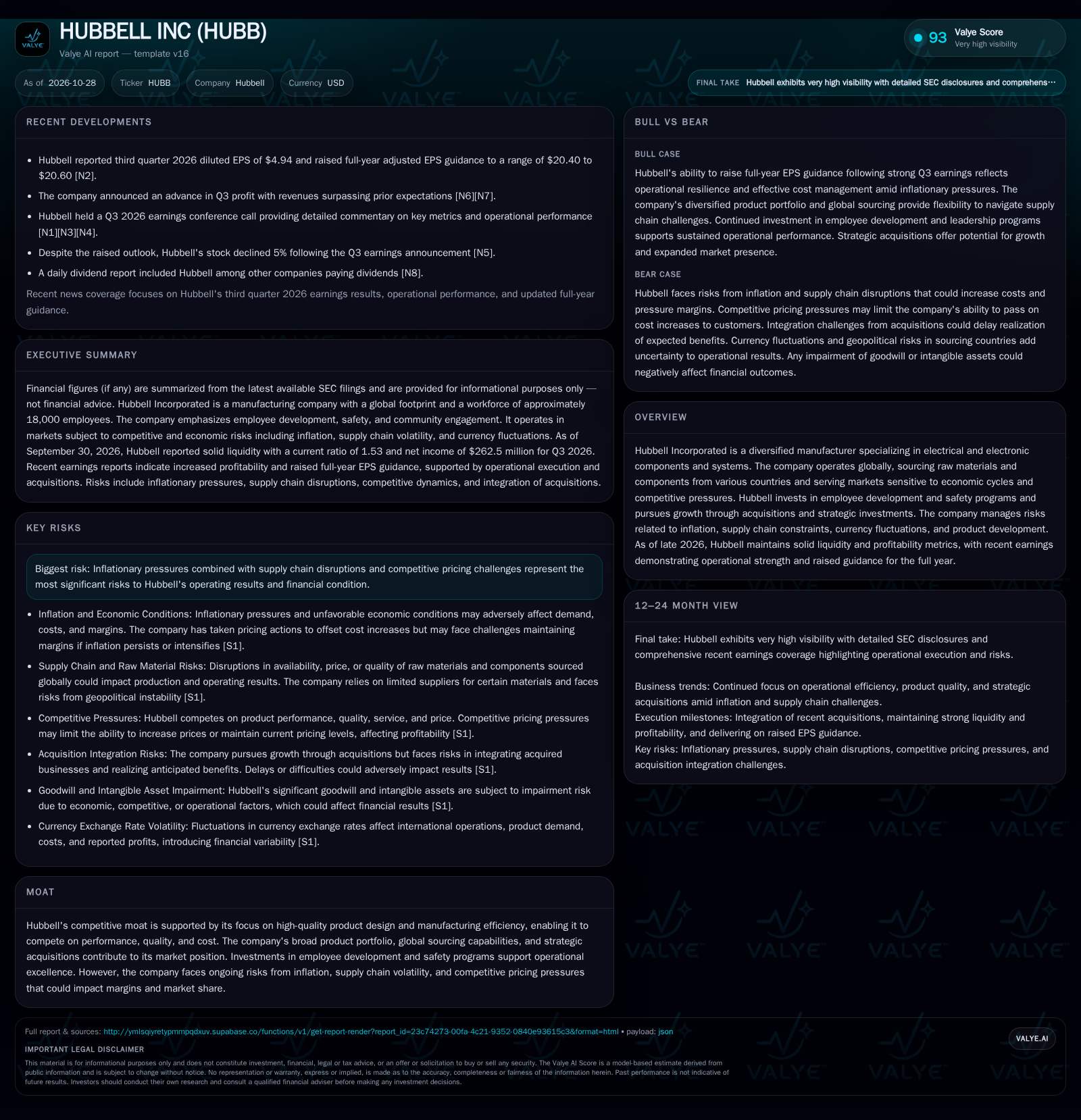
Hubbell Incorporated delivered strong Q3 2026 results, with profit and revenue outpacing expectations and prompting a raised EPS outlook for the year. While recent performance underscores operational discipline, the company continues to navigate inflation, supply chain risks, and the challenge of integrating acquisitions. The underlying business model is tested by input volatility and intense competition, and future performance will depend on margin protection, successful integration, and sustained demand.
Hubbell Incorporated’s third quarter 2026 results delivered a clear message: disciplined execution and strategic pricing have enabled the company to outperform expectations and raise its full-year EPS outlook, even as the industrial sector contends with inflation and global supply chain turbulence. Yet, the muted stock reaction and ongoing exposure to input and integration risks reveal a business whose resilience will be tested by structural industry pressures. This analysis explores how Hubbell’s diversified product portfolio, acquisition strategy, and operational controls interact with the realities of margin compression, capital allocation, and competitive intensity as the company enters its next growth phase.
Earnings Outperformance and Guidance Raise: What Has Changed for Hubbell?
Hubbell reported net income of $262.5 million for Q3 2026, with diluted EPS of $4.94. Revenues and profits both exceeded expectations, leading management to raise full-year adjusted EPS guidance to $20.40–$20.60. This signals operational strength and pricing discipline during a period of broad-based industrial inflation [S2] [N2] [N6] [N7].
Despite these positive surprises, the stock declined 5% after earnings. This reaction suggests that the market is weighing the sustainability of margin gains and the risks embedded in Hubbell’s supply chain, acquisition integration, and cost structure [N5].
On the balance sheet, Hubbell ended Q3 with $334.5 million in cash, $20.5 million in short-term investments, and a current ratio of 1.53. Goodwill and intangibles totaled $4.455 billion, underscoring the company’s reliance on acquisition-driven growth and the potential for future impairment charges if acquired businesses underperform [S1] [S2].
Dissecting Hubbell’s Profit Model: Margin Levers, Cost Headwinds, and Capital Allocation
Hubbell’s economics are fundamentally driven by its ability to price for value in electrical and electronic components—markets characterized by cyclical demand and sensitivity to cost inflation. The company’s revenue mix spans industrial and infrastructure end-markets, which can provide some volume stability but also expose the business to swings in capital spending.
Gross margin resilience depends on offsetting raw material and labor cost inflation through pricing actions, product mix enhancement, and operational efficiency. Fixed costs—particularly in manufacturing and R&D—create operating leverage, so incremental revenue growth can expand margins if volume outpaces cost escalation. However, persistent inflation or inability to pass on price increases would compress margins and potentially erode profitability.
Hubbell’s acquisition-led strategy adds complexity: integration costs, potential synergies, and future impairment risk. The $4.455 billion in goodwill and intangibles represents both growth ambition and a latent drag on future returns if acquired assets do not deliver sustained cash flows. The company reported cash and liquidity metrics for the period; these figures do not by themselves establish operating runway, investment capacity, financial flexibility, or financing capacity. [S1] [S2]
Beyond the immediate cost and pricing dynamics, Hubbell’s capital allocation strategy plays a pivotal role in shaping long-term profitability and growth. The balance between reinvesting in organic R&D, pursuing bolt-on acquisitions, and returning capital to shareholders must be carefully calibrated to avoid overextension. If acquisitions are pursued aggressively without commensurate operational improvements, goodwill impairment risk rises, potentially eroding shareholder value. Conversely, disciplined capital deployment that prioritizes high-return projects and efficient integration can create a virtuous cycle of margin expansion and competitive differentiation. Monitoring the return on invested capital (ROIC) relative to the company’s weighted average cost of capital (WACC) would help assess whether capital allocation decisions are accretive or dilutive over time.
Competitive Dynamics: Quality, Scale, and the Limits of Differentiation
Hubbell operates in intensely competitive segments where product performance, quality, service, and price are core differentiators. While the company’s broad portfolio and global sourcing provide some scale advantage, barriers to entry are moderate and switching costs for customers are generally low—especially in commoditized product lines.
Competition comes from both diversified industrial conglomerates and focused niche players. Price-based competition is acute, particularly during periods of weak demand or excess industry capacity. Product innovation and reliability can foster customer loyalty in certain segments, but pricing power is often limited unless Hubbell can demonstrate clear performance or integration benefits.
Acquisitions can provide access to adjacent markets or proprietary technologies, but also heighten integration risk and dilute returns if synergies do not materialize. Over time, the company’s ability to sustain above-average margins and defend share will depend on execution in operational excellence, supply chain resilience, and selective portfolio enhancement.
The competitive landscape also imposes constraints on Hubbell’s pricing power and margin sustainability. In markets where product commoditization intensifies, the company may face accelerating price erosion unless it can differentiate through service, customization, or technological innovation. This dynamic is particularly relevant in segments with low switching costs, where customers can easily shift to lower-cost alternatives. Additionally, global supply chain disruptions can temporarily advantage competitors with more localized production or diversified sourcing, challenging Hubbell’s scale benefits. Strategic investments in digital supply chain management and advanced analytics could enhance responsiveness and cost efficiency, but these require upfront investment and execution discipline to yield measurable competitive advantage.
Margin Expansion Through Operational Discipline and Strategic Pricing
If Hubbell continues to execute effectively on pricing, cost controls, and supply chain management, it could further expand margins and deliver EPS above the raised guidance. This scenario would be supported by continued strong demand in core end-markets, successful integration of recent acquisitions, and the ability to offset input cost inflation with price increases or mix improvements.
Evidence that would confirm this upside includes sequential gross and operating margin improvement, positive commentary on acquisition synergies and integration progress, and sustained revenue growth outpacing cost escalation. Additional confirmation could come from upward revisions to earnings guidance and market share gains in targeted segments.
Operational discipline in sourcing and manufacturing efficiency could also create opportunities for margin expansion beyond pricing alone. For example, implementing lean manufacturing principles or adopting automation technologies may reduce variable and fixed costs, thereby improving operating leverage. If Hubbell successfully leverages data-driven demand forecasting and inventory optimization, supply chain volatility could be mitigated, reducing working capital requirements and enhancing cash flow. Such operational improvements would not only protect margins during inflationary periods but also build resilience against cyclical downturns. Sustained investment in talent and process innovation would be critical to realize these benefits, highlighting the interplay between human capital and technological advancement in driving margin expansion.
Sustained Profitability Amid Cost and Integration Pressures
The most plausible path is one of continued profitability with moderate growth, as Hubbell manages inflation and supply chain volatility through incremental pricing and operational improvements. Acquisitions contribute to top-line growth, but integration costs and occasional margin pressure persist.
This scenario would be confirmed by quarterly results that track closely to the updated EPS guidance, stable to slightly improving margins, and management commentary that acknowledges but contains supply chain and integration challenges. Falsification would occur if inflation sharply accelerates, pricing lags cost increases, or integration issues trigger meaningful earnings or goodwill impairments.
Cost Inflation and Supply Chain Shocks Erode Earnings Power
In a negative scenario, persistent or worsening input cost inflation, coupled with supply chain disruptions, outpaces Hubbell’s ability to raise prices or adjust product mix. This could lead to margin compression, earnings misses, and potential impairment of goodwill or intangibles associated with underperforming acquisitions.
Evidence for this scenario would include declining gross or operating margins despite revenue growth, downward revisions to earnings guidance, and management disclosures of supply chain or integration setbacks. Additional red flags would be asset write-downs or increased working capital needs straining liquidity.
Benchmarks to Assess Hubbell’s Execution and Resilience
Sequential changes in gross and operating margins, particularly relative to industry peers.
Quarterly progress on integration of recent acquisitions, if disclosed, including cost synergies and retention of key customers or personnel.
Trends in pricing realization versus reported input cost inflation, as discussed in earnings calls or filings.
Revisions (up or down) to full-year EPS guidance and management’s rationale.
Working capital trends, including inventory turns and receivables collection, as potential indicators of supply chain health.
Any goodwill or intangible asset impairments disclosed in quarterly or annual filings.
Volume growth or contraction in key end-markets—industrial, infrastructure, utilities—as a proxy for cyclical demand sensitivity.
Market share commentary or customer wins/losses, if disclosed, to gauge competitive positioning.
Disclaimer: This is research-only, informational analysis and not investment advice. It may include AI-generated interpretation and general industry context. Always verify important details using primary sources.

Comments