
Shentel’s Fiber Ambitions: Expansion Payoff or Margin Squeeze?
Shenandoah Telecommunications (Shentel) is executing a high-stakes transition from legacy broadband and RLEC operations toward a fiber-first growth model centered on its Glo Fiber FTTH platform. Recent asset expansion, revenue growth in new markets, and operational pivots demonstrate strategic momentum—but intensifying competition, thin short-term liquidity, and elevated costs raise questions about sustainable profitability as the fiber build winds down.
Shentel is deep into a costly but high-potential fiber expansion, with Glo Fiber’s growth fueling revenue gains even as legacy operations and video decline. Recent asset additions and operational shifts signal a pivot to post-build economics, but persistent net losses, low liquidity ratios, and the threat of competitive overbuilds cast doubt on the speed and scale of margin recovery. The company’s fate now hinges on converting fiber passings into profitable, sticky customers and managing capital intensity as the nature of its cost base shifts.
Shenandoah Telecommunications is at an inflection point shaped by the scale and economics of its Glo Fiber expansion. The company’s network now reaches over 750,000 homes and businesses, but its financials reveal the strains of rapid growth: revenue is up, but net losses persist, short-term liquidity is tight, and the competitive landscape is crowded. With construction winding down and operational focus shifting, Shentel must now prove that its fiber investment can deliver sustainable margin improvement and defend against both legacy erosion and new market overbuilds.
Recent Asset Expansion, Revenue Trends, and Liquidity Picture
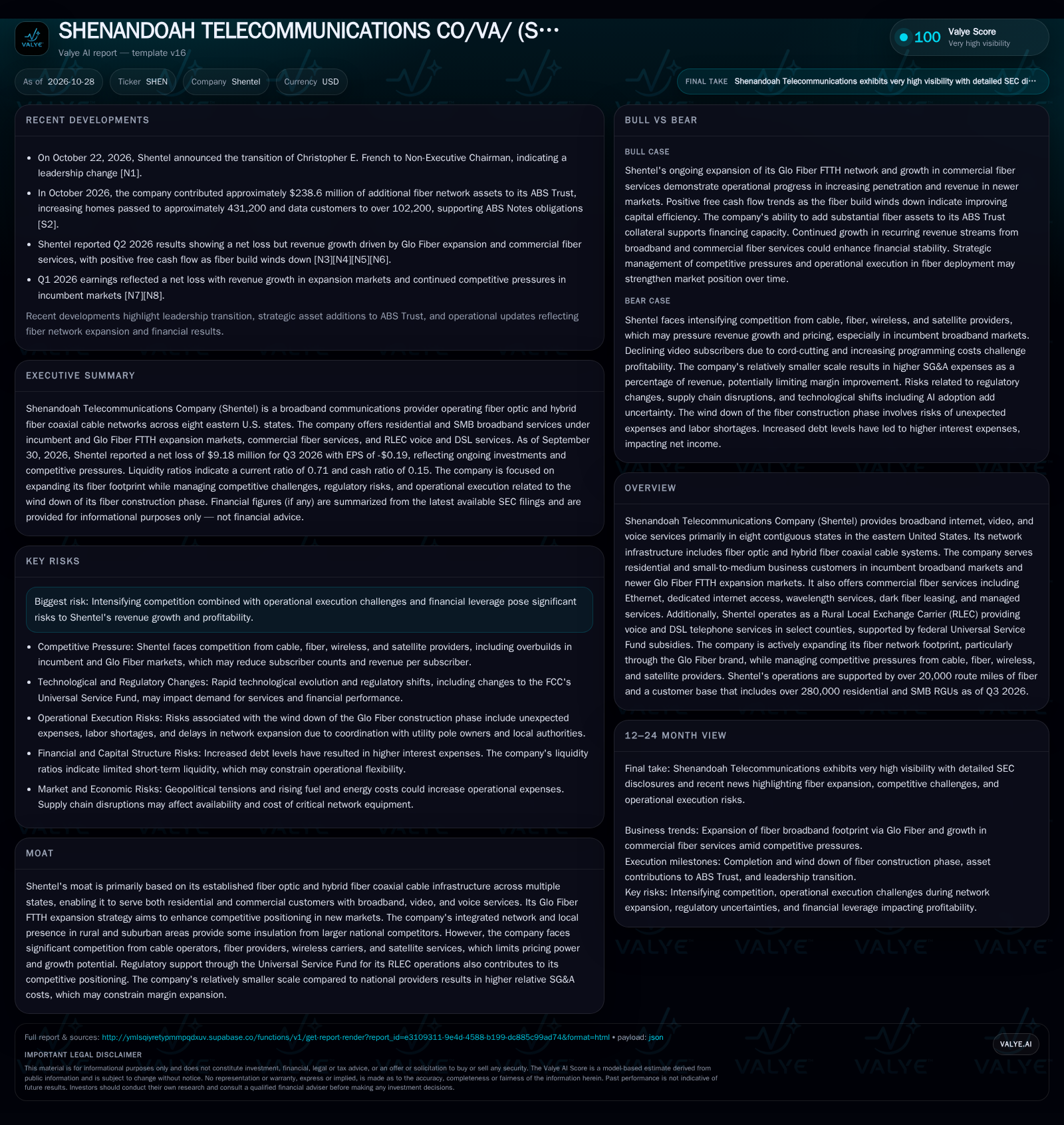
As of September 30, 2026, Shentel’s network passed approximately 754,603 homes and businesses, split between 254,019 in legacy broadband markets and 500,584 in Glo Fiber FTTH expansion territories. Residential and SMB RGUs totaled 280,494, with penetration rates of 43.3% in incumbents and 21.7% in expansion areas—a wide gap that underscores both the company’s near-term challenge and long-term opportunity [S2].
Q3 2026 broadband operating revenue reached $93.9 million, up 4.6% year-over-year, propelled by a 32.2% jump in Glo Fiber expansion revenue and a 5.9% rise in commercial fiber. However, these gains were offset by continued declines in legacy broadband and RLEC segments. Shentel reported a net loss of $9.18 million for the quarter and an EPS of -$0.19 [S2].
The company’s liquidity profile is constrained: $18.6 million in cash and equivalents, a current ratio of 0.71, and a cash ratio of 0.15 as of Q3 2026. These figures reflect the capital-intensive nature of the fiber build and increased debt levels, which have led to higher interest expenses [S2].
In October 2026, Shentel contributed $238.6 million in fiber network assets to its ABS Trust, increasing both homes passed and data customer counts, and supporting its asset-backed notes obligations [S2].
How Glo Fiber and Commercial Services Could Shift Shentel’s Margin Structure
Shentel’s business model is transitioning from a legacy mix of RLEC voice/DSL, hybrid-coax broadband, and video toward a fiber-dominated platform with Glo Fiber as the flagship. The economics of FTTH are fundamentally different: high upfront capital expenditure for network construction (largely fixed), followed by a cost base that becomes more variable as the focus shifts to customer acquisition, service delivery, and network maintenance.
Revenue growth in the near term is being driven by new passings and incremental penetration in expansion markets, but these areas currently operate at lower utilization (21.7% penetration) compared to legacy markets. If Glo Fiber can approach legacy penetration rates, fixed-cost leverage could drive substantial margin expansion. However, this scenario is highly sensitive to competitive intensity and the pace of adoption.
Commercial fiber services—offering Ethernet, dedicated internet, dark fiber leasing, and managed services—provide higher ARPU and steadier contracts, but represent a smaller share of overall revenue. The potential for higher-margin commercial business could be a critical offset to residential price competition, especially as enterprise bandwidth demand grows.
Shentel’s cost structure is in flux. The wind down of the construction phase should, in theory, shift cash flows from capex to opex and free up resources for marketing and customer support, but transition risks (e.g., labor reallocation, unexpected expenses) remain. Increased debt service costs from the ABS Trust and other borrowings will continue to pressure net income until operating leverage from the expanded base is realized.
Competitive Threats and the Limits of Regional Scale
Shentel’s regional fiber and hybrid coax network gives it a local advantage in rural and secondary markets often underserved by national players. However, the competitive landscape is intensifying: approximately 30% of incumbent broadband passings already face direct FTTH or cable competition, and Glo Fiber expansion markets are not immune to overbuilds by larger cable, national fiber, and wireless ISPs [S2].
Switching costs for residential broadband are moderate—installation hassle and bundled services provide some friction, but aggressive promotional pricing by competitors can erode these defenses quickly. The presence of satellite and fixed wireless alternatives, especially in less dense geographies, further limits pricing power.
Shentel’s RLEC operations benefit from Universal Service Fund support, providing some revenue stability, but regulatory risk remains if federal subsidies are reduced. In video, cord-cutting and rising programming costs continue to erode both subscriber counts and margins, making video an increasingly unattractive anchor product.
Relative to national operators, Shentel’s smaller scale means higher SG&A as a percentage of revenue, reducing its ability to absorb competitive pricing or invest at the same rate in customer acquisition and product innovation.
Margin Expansion If Glo Fiber Penetration Accelerates and Churn Remains Low
The most favorable outcome for Shentel is a rapid increase in Glo Fiber penetration rates in expansion markets, narrowing the gap with incumbent areas. If the company can convert a significant portion of the 500,000+ homes passed in these markets into paying customers, fixed network costs would be spread over a much larger base, driving operating leverage and improving margins.
Commercial fiber could provide a second engine of growth if Shentel captures additional enterprise contracts or leverages dark fiber assets in adjacent markets. A shift in the revenue mix toward higher-ARPU, lower-churn business would further stabilize cash flows.
Confirmation of this scenario would include sequential increases in Glo Fiber penetration, rising ARPU, declining customer acquisition costs (as a percentage of revenue), and a return to sustained positive free cash flow as capex moderates [N3].
Falsification would be evident in stagnant penetration rates, rising churn, or continued net losses despite the completion of the construction phase.
Fiber Expansion Delivers Growth but Margin Recovery Is Slow and Uneven
The most plausible path is one where Shentel’s Glo Fiber expansion delivers steady but unspectacular penetration growth, gradually closing the utilization gap but facing persistent pressure from competitive offers and slowing adoption as the most eager early adopters are converted.
In this scenario, the company achieves low- to mid-single-digit annual revenue growth, but margin recovery is delayed by elevated SG&A, ongoing price competition, and the costs of transitioning from construction to operations. Commercial fiber grows incrementally but does not dramatically shift the overall margin mix.
Liquidity remains tight, with debt service absorbing much of the cash flow improvement from reduced capex. Video and RLEC segments continue to decline, offsetting some of the broadband gains. Management is forced to make careful tradeoffs between marketing, network upgrades, and debt repayment.
This scenario is confirmed by steady but slow improvement in penetration and ARPU, persistent net losses or marginal profits, and limited expansion of free cash flow.
Competitive Overbuilds and Execution Missteps Trigger Prolonged Losses
The adverse scenario sees competitive intensity rising sharply—either through cable/fiber overbuilds in Glo Fiber markets or aggressive pricing/bundling by national ISPs—leading to stalled penetration growth, elevated churn, and downward price pressure.
If Shentel struggles to execute the transition from construction to operations—due to labor shortages, unexpected expenses, or coordination failures with utility partners—operating costs could remain elevated while revenue growth disappoints. Regulatory changes, such as cuts to Universal Service Fund support, could further undermine RLEC economics.
Liquidity stress would be visible through deteriorating current and cash ratios, potential covenant breaches, and pressure to seek additional (potentially dilutive) financing. Persistent net losses, negative free cash flow, or a spike in customer acquisition costs would confirm this scenario.
Falsification would require evidence of resilient penetration growth, stable or rising ARPU, and a visible shift toward positive operating margins even as competitive pressure mounts.
Milestones That Will Reveal Whether Shentel’s Fiber Bet Pays Off
Quarterly Glo Fiber penetration rate in expansion markets—sequential improvement would evidence successful customer conversion; stagnation would signal competitive or adoption headwinds.
Average revenue per user (ARPU) for both residential and commercial fiber segments, as changes here reflect pricing power and success in upselling higher-value services.
Churn rate for Glo Fiber and legacy broadband customers—rising churn would indicate competitive leakage; stable or declining churn would support the upside case.
Free cash flow generation post-construction phase, as a sustained positive trend would demonstrate operating leverage and capital discipline.
SG&A and cost of service (per passing or per subscriber), tracking whether the transition from build to operate is delivering expected cost efficiencies.
Debt service coverage ratio and changes in net debt—deterioration here would raise red flags on solvency and potential financial flexibility.
Sequential subscriber counts and video RGU attrition, to gauge whether legacy erosion is accelerating faster than broadband growth.
Incidence of competitive overbuilds or announced network expansions by rival ISPs in core Glo Fiber markets, as these could materially affect penetration and pricing trajectories.
Disclaimer: This is research-only, informational analysis and not investment advice. It may include AI-generated interpretation and general industry context. Always verify important details using primary sources.

Comments