
Masco’s Margin Resilience and Strategic Restructuring: Navigating Demand Shifts and Volatile Inputs
Masco’s Q3 2026 results show margin expansion in Plumbing Products despite flat Decorative Architectural volume, highlighting the company’s pricing power, cost control, and ongoing restructuring. The integration of Liberty Hardware and a new technology leadership role signal a forward-looking operational stance, but risks remain from cyclical housing demand, commodity volatility, and intense competition.
Masco’s Q3 2026 performance demonstrates the company’s ability to offset volume softness in some segments with higher pricing and cost savings, particularly in Plumbing Products. Strategic restructuring and integration moves, alongside a focus on technology, are designed to sharpen operational efficiency. However, the company’s exposure to housing cycles, commodity costs, and competitive threats will remain central to future performance dynamics. [S2] [N4]
Masco’s Q3 2026 results reveal a company actively managing margin pressures and demand imbalances across its diversified building products portfolio. With modest overall sales growth, profitability gains are being driven by pricing actions, cost discipline, and lower tariffs, particularly in the Plumbing Products segment. Meanwhile, strategic restructuring—including the integration of Liberty Hardware and new technology leadership—reflects a focus on operational efficiency and future readiness. Yet, as macroeconomic uncertainty weighs on the housing sector and competitive intensity persists, Masco’s ability to sustain margin gains will depend on its resilience to input cost swings and its success in executing ongoing transformation.
Recent Margin Expansion and Strategic Moves Shape Masco’s Outlook
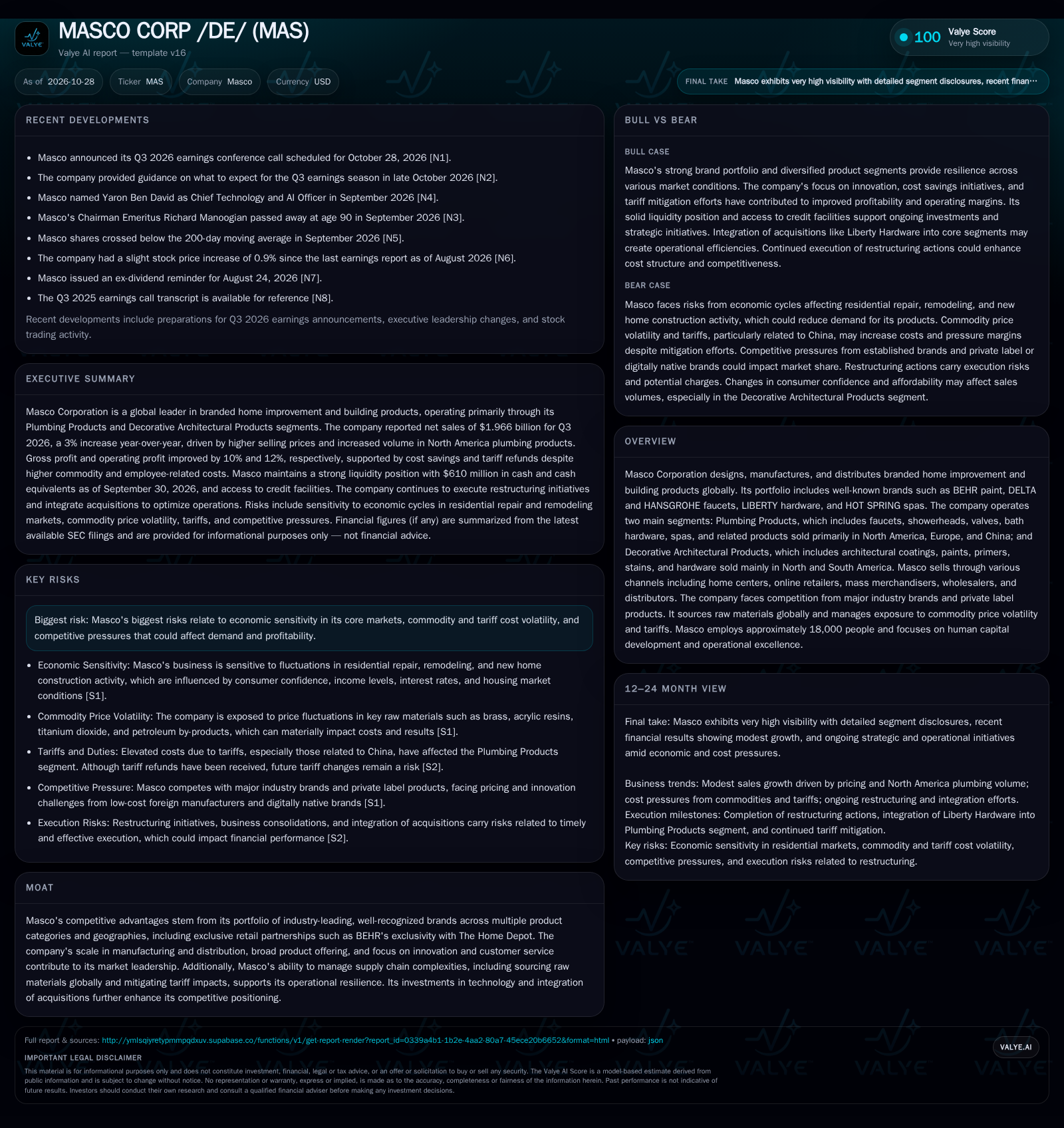
Masco reported Q3 2026 net sales of $1.966 billion, up 3% year-over-year, with the Plumbing Products segment growing 4% in sales and achieving a 24% increase in operating profit. This improvement was attributed to higher net selling prices, increased North America plumbing volume, cost savings, and tariff refunds, partially offset by commodity and labor cost increases. In contrast, the Decorative Architectural Products segment posted flat sales and a slight operating profit decrease, as lower volumes and higher commodity input costs weighed on results [S2].
The company advanced restructuring initiatives in 2026, closing plants, reducing headcount, and consolidating Liberty Hardware into the Delta Faucet business segment. These moves are intended to streamline operations and drive future efficiencies [S2].
Masco reported $610 million in cash and equivalents as of September 30, 2026, and had significant undrawn credit capacity. In September 2026, Masco appointed a Chief Technology and AI Officer, signaling an intent to further leverage digital tools and process automation [S2] [N4].
How Masco’s Brand Power and Cost Initiatives Drive Profitability
Masco’s business model is built on high-volume, branded home improvement products sold through diverse retail and wholesale channels. Revenue is heavily influenced by pricing power and product mix, especially in categories where brand and channel exclusivity (e.g., BEHR’s Home Depot partnership) allow for premium positioning. In Q3 2026, price increases were a key driver of top-line growth, particularly as volume in some segments lagged. This suggests that Masco can at least partially offset volume headwinds with pricing actions in its leading brands [S2].
The company’s gross margin improvement (10% year-over-year gain) signals that cost savings efforts—through restructuring, supply chain optimization, and tariff mitigation—are having a tangible impact. However, the business remains exposed to input cost volatility. Raw materials such as brass, acrylic resins, and petroleum derivatives can swing costs significantly, and tariffs, especially on China-sourced goods, have been a recurring challenge [S1] [S2].
Operating leverage is evident: incremental sales in the Plumbing Products segment translated into disproportionately higher operating profit, while Decorative Architectural Products saw margin compression on flat sales and higher costs. This highlights both the fixed-cost absorption benefits of volume growth and the vulnerability of margins when volumes are stagnant or declining.
Masco’s capital requirements are moderate for its sector, with working capital and capex needs largely tied to inventory and manufacturing footprint. The company reported cash and liquidity metrics for the period; these figures do not by themselves establish operating runway, investment capacity, financial flexibility, or financing capacity. [S2]
Brand Differentiation and Channel Partnerships Versus Intense Rivalry
Masco’s competitive positioning is anchored in its portfolio of well-recognized brands—such as BEHR, DELTA, and HANSGROHE—which enjoy strong retailer relationships and, in some cases, exclusive distribution. The BEHR-Home Depot exclusivity is a notable advantage, supporting stable shelf space and pricing power in the paint category. In plumbing, the company leverages scale and breadth to compete with global peers and local private label offerings [S1].
However, Masco operates in highly contested markets. Major competitors include established brands (e.g., Moen, Kohler, Sherwin-Williams) and a growing array of private label and digitally native entrants. Price competition, retailer bargaining power, and consumer channel shifts (toward e-commerce and direct-to-consumer) all threaten to erode share or compress margins if Masco cannot maintain perceived value and operational efficiency.
The company’s scale in sourcing, manufacturing, and distribution helps buffer some cost and supply chain risks, but it is not immune to input price shocks or retailer-driven margin pressures. Ongoing investments in innovation and technology, as signaled by the recent technology officer hire, may help differentiate products and improve cost structure, but execution and speed-to-market are critical.
If Cost Actions and Innovation Unlock Sustained Margin Expansion
A favorable scenario for Masco would see the company fully realizing cost savings from its ongoing restructuring and integration efforts, particularly the Liberty Hardware consolidation and plant closures. If these initiatives translate into permanent fixed-cost reductions and improved operational agility, Masco could sustain or even expand margins even if revenue growth remains modest.
Further, if the new Chief Technology and AI Officer successfully drives automation, supply chain digitalization, or product innovation, Masco could see incremental efficiency gains and potentially capture share from less nimble competitors. Pricing power in key brands, combined with effective commodity cost pass-through, would reinforce profitability.
Evidence supporting this scenario would include continued gross and operating margin expansion in both core segments, stable or improving market share in North American home centers, and reduced SG&A as a percentage of sales. Announcements of successful digital initiatives or new product launches with measurable market traction would further validate the upside case.
Stable Profitability Amid Mixed Demand and Persistent Input Pressures
The most plausible trajectory for Masco over the next year is one of modest revenue growth, with continued pricing actions offsetting soft or uneven volume trends—particularly as the housing and remodeling cycle remains uncertain. Gross and operating margins are likely to remain above recent lows due to realized cost savings, but further expansion could be capped by ongoing commodity cost inflation and competitive price discounting.
Restructuring and integration benefits will likely continue to accrue but at a slower pace, and the impact of technology and AI initiatives may be incremental rather than transformative in the near term. The Plumbing Products segment should remain the primary profit engine, while Decorative Architectural Products continues to face volume and margin headwinds.
Confirmation of this scenario would be ongoing low-single-digit sales growth, relatively stable margins, and modest improvements in cost structure. Signs of persistent commodity cost volatility or softening consumer demand would support the base case, as would continued flat or declining Decorative Architectural volume.
Margin Compression if Housing Weakness and Cost Inflation Persist
A negative scenario could unfold if U.S. and global housing activity slows further, leading to broad-based volume declines in both new construction and repair/remodeling channels. In such an environment, Masco might struggle to pass through price increases, especially if competitors become more aggressive on pricing or retailers demand concessions.
Simultaneously, if commodity prices for key inputs such as brass or titanium dioxide spike or remain elevated, and tariff relief does not materialize, gross margins could erode rapidly. Restructuring execution risks—such as delays, higher-than-expected charges, or operational disruptions—could further weigh on profitability.
This scenario would be evidenced by declining sales in both major segments, noticeable contraction in gross and operating margins, and rising restructuring or impairment charges. A failure to realize anticipated cost savings or setbacks in technology initiatives would reinforce the downside case.
Milestones That Will Test Masco’s Margin and Efficiency Thesis
Progress on gross and operating margin improvement in both Plumbing Products and Decorative Architectural Products—measured quarterly versus prior year—will indicate whether cost actions are sticking or being offset by new pressures.
Volume trends in North America for both plumbing and paint/coatings, especially as reported by major channel partners such as The Home Depot, will help gauge end-market demand resilience.
Disclosure of realized and projected cost savings from restructuring and Liberty Hardware integration would clarify the permanence of recent margin gains.
Updates on digital transformation initiatives—such as supply chain automation, AI-driven forecasting, or new product launches—would help assess the impact of the new Chief Technology and AI Officer.
Tracking commodity input cost trends, especially for brass, titanium dioxide, and petroleum derivatives, will be critical for forecasting gross margin direction.
Evidence of tariff changes—whether new, repealed, or refunded—will directly impact segment profitability and cost management.
Any material changes in retailer or distributor relationships, particularly exclusivity agreements or private label expansion, could alter Masco’s channel power and pricing dynamics.
If disclosed, customer retention rates, channel mix shifts, or competitive win/loss data would help test the company’s ability to defend share and pricing.
Disclaimer: This is research-only, informational analysis and not investment advice. It may include AI-generated interpretation and general industry context. Always verify important details using primary sources.

Comments