
Biogen’s Strategic Pivot: Rare Disease Expansion, Portfolio Risks, and the Economics of Post-Apellis Integration
With a major acquisition completed and rare disease launches driving growth, Biogen faces a critical inflection point: can new immunology assets and pipeline execution offset the sustained erosion of its legacy MS franchise amid mounting pricing and regulatory pressures?
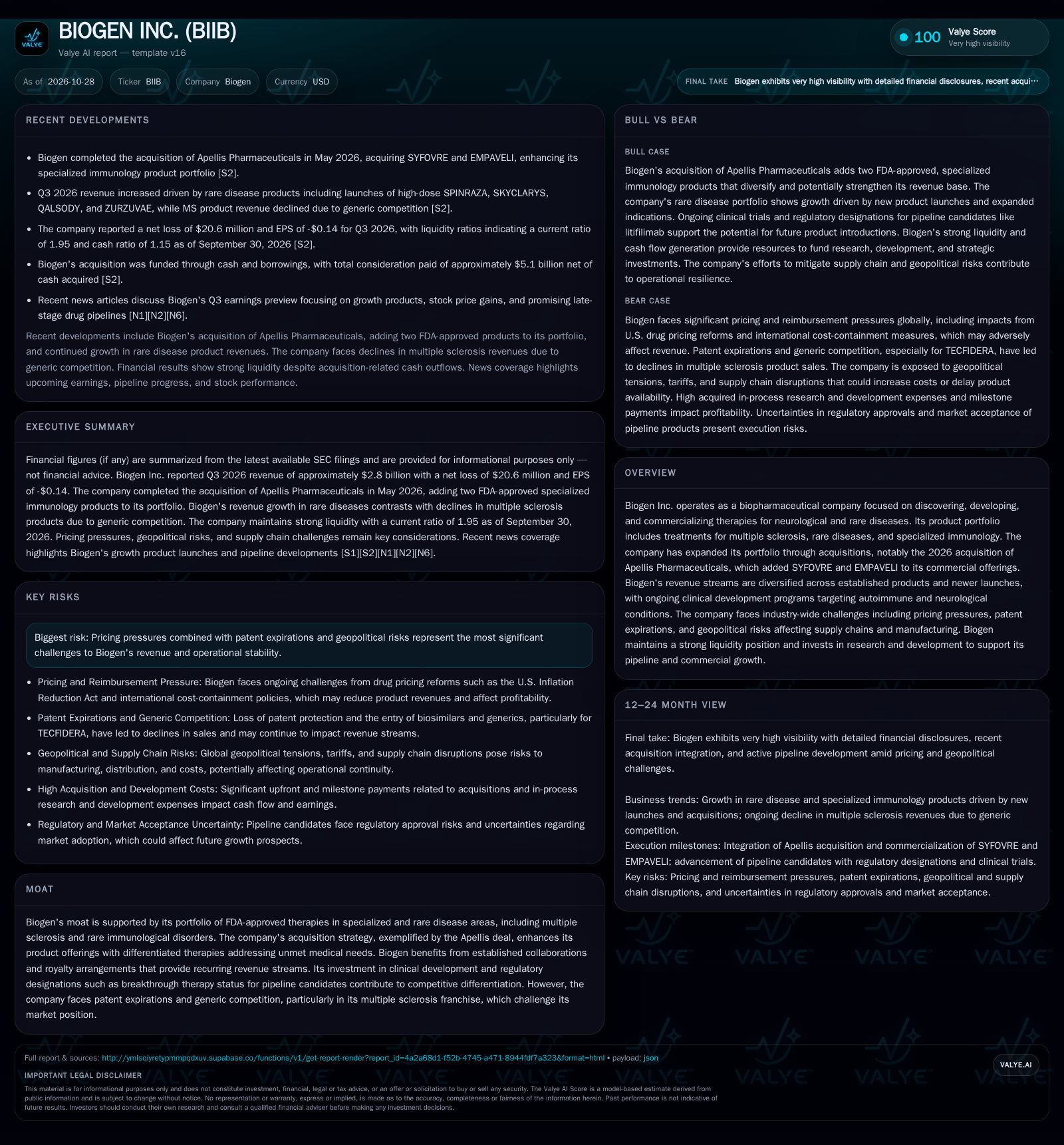
Biogen’s Q3 2026 results show rare disease revenue expansion and the integration of Apellis’s immunology products, but also continued MS franchise declines and a net loss. The company’s economics now hinge on extracting value from new launches, managing high royalty and debt obligations, and navigating intensifying pricing and regulatory headwinds. Success will depend on the commercial trajectory of acquired products and the ability to sustain pipeline momentum while offsetting legacy product erosion and global reimbursement pressures. [S2]
Biogen stands at a strategic crossroads in late 2026, following its $5.1 billion acquisition of Apellis Pharmaceuticals and a quarter marked by both promising rare disease growth and ongoing erosion in its legacy multiple sclerosis (MS) business. The integration of new immunology assets—alongside a slate of recent rare disease launches—offers potential for revenue diversification and margin stabilization. Yet, the company’s path forward is complicated by persistent pricing and reimbursement challenges, high royalty and debt obligations, and an increasingly competitive landscape for neurological therapies. The next phase will test Biogen's ability to generate sustainable growth from its expanded portfolio while offsetting structural headwinds that threaten its historical profit engines. [S2]
Rare Disease Expansion Offsets, but Does Not Fully Counter, MS Franchise Headwinds
Biogen’s Q3 2026 results reflect the early impact of its portfolio pivot: total revenue reached approximately $2.8 billion, but the company recorded a net loss of $20.6 million, with EPS at -$0.14. The major strategic development was the May 2026 acquisition of Apellis Pharmaceuticals, which added two FDA-approved immunology products—SYFOVRE for geographic atrophy and EMPAVELI for rare blood disorders—to Biogen’s commercial platform. Rare disease product revenue jumped 26.8% year-over-year, propelled by launches of high-dose SPINRAZA, SKYCLARYS, QALSODY, and ZURZUVAE. However, these gains were partially offset by a 13.4% decline in MS product revenue as generic competition for TECFIDERA and patient migration to alternative therapies continued to erode the franchise. As of September 30, 2026, Biogen reported $2.9 billion in cash and $1.56 billion in short-term investments, alongside $6.3 billion in long-term debt. [S2]
Portfolio Economics: Royalty Loads, Debt Service, and the Mix Shift Toward Specialty Growth
Biogen’s revenue mix is undergoing a fundamental transition. Historically, the MS franchise delivered high-margin, recurring cash flow, but with patent cliffs and generic entry, this engine is declining. Newer rare disease and specialized immunology products, including those acquired from Apellis, are typically characterized by higher list prices and smaller addressable populations, relying on successful market access negotiations and premium reimbursement. However, these products often carry substantial royalty burdens: Biogen pays royalties (low to mid-single digits or tiered rates) on TYSABRI, SPINRAZA, QALSODY, VUMERITY, and SKYCLARYS, which directly impact gross margins. The Apellis deal also introduced additional amortization and potential milestone payment obligations. Combined with $6.3 billion in debt and $415 million in operating lease commitments, fixed costs are elevated.
Operating leverage is a double-edged sword: incremental revenue from successful rare disease launches could rapidly improve margins due to relatively fixed overhead, but slow uptake or payer resistance would leave Biogen exposed to high fixed charges. Capital needs remain significant, given sustained R&D investment and the necessity to support new product launches and global market expansion. If rare disease and immunology assets can scale, the business could migrate toward higher-mix, defensible niches, but the economics remain sensitive to pricing, payer uptake, and competitive entry.
Defensive Niches vs. Structural Erosion: Biogen’s Position in a Shifting Therapeutics Landscape
Biogen’s competitive moat is anchored in specialized neurology and rare disease markets, where regulatory barriers, clinical differentiation, and specialist prescriber relationships can create stickier demand and higher pricing power than in broader therapeutic categories. The Apellis acquisition aims to reinforce this moat by adding differentiated, FDA-approved assets in immunology, while recent launches (e.g., SKYCLARYS, QALSODY) target underserved or newly addressable patient populations.
However, counterforces are significant. The MS market is increasingly commoditized due to generic and biosimilar competition, undermining Biogen’s legacy stronghold. Globally, payers are aggressively managing specialty drug costs, and U.S. policy changes (such as the Inflation Reduction Act and Medicare Part D redesign) are amplifying reimbursement uncertainty. Competitor categories include large-cap pharma with rare disease ambitions, biotechs with first-in-class neurology assets, and generics/biosimilars targeting Biogen’s legacy blockbusters. The company’s future position depends on sustained innovation, successful integration of acquired products, and the ability to defend price and access for its new portfolio.
A Successful Pipeline-to-Portfolio Transition: What Would Validate a Growth Reacceleration
In a favorable scenario, Biogen’s rare disease and immunology launches achieve rapid market adoption, with SYFOVRE and EMPAVELI gaining strong commercial traction and expanded indications. High-dose SPINRAZA, SKYCLARYS, QALSODY, and ZURZUVAE all exceed initial forecasts, offsetting MS declines and driving a return to top-line and margin growth. If payer negotiations for new products secure broad reimbursement at premium prices, and global regulatory approvals extend the addressable market, operating leverage would improve as fixed costs are absorbed by higher revenue.
This upside would be confirmed by sustained double-digit rare disease revenue growth, expanding gross margins despite royalty payments, and a return to positive net income. Evidence would include strong prescription growth for acquired and launched products, favorable reimbursement decisions, and pipeline readouts supporting further product launches. A reduction in net debt or increased R&D investment without margin compression would further validate the scenario.
Mid-Cycle Dynamics: Portfolio Rebalancing Amid Persistent External Headwinds
The most plausible path sees Biogen gradually shifting its revenue mix toward new rare disease and immunology products, but with only partial offset of MS franchise erosion. New launches generate growth, but payer and regulatory pressures cap pricing and slow uptake in some markets. Royalty and debt service continue to weigh on margins, and R&D investment remains high to support future launches. The company maintains its reported liquidity position, but does not achieve full earnings recovery in the near term.
Confirmation would come from single-digit consolidated revenue growth, stabilization of net losses or return to modest profitability, and continued investment in pipeline advancement. If MS revenue continues to decline at a high single- to low double-digit rate but rare disease and immunology growth remains robust, this would support the scenario. Falsification would require either a sharp acceleration in rare disease revenue (supporting the upside) or a failure of new products to gain traction (pushing toward the downside).
Pricing Compression and Portfolio Stalls: How Biogen Could Lose Strategic Momentum
A negative scenario would see rare disease and immunology launches underperform due to payer pushback, competitive entrants, or safety/efficacy concerns. If new products fail to achieve broad reimbursement or face significant pricing cuts—particularly in the U.S. and key international markets—revenue growth would stall. Persistent MS franchise declines would outpace gains from the new portfolio, resulting in sustained or widening net losses.
Further downside could be driven by regulatory setbacks for pipeline candidates, unexpected safety events, or disruptive supply chain shocks. In this environment, Biogen’s fixed royalty and debt obligations would exacerbate margin pressure, potentially forcing cost cuts or additional financing. Evidence would include declining or flat rare disease revenue, margin contraction despite cost controls, negative pipeline news, or adverse reimbursement decisions.
Milestones and Metrics That Will Define Biogen’s Post-Apellis Trajectory
Prescription and revenue growth for SYFOVRE and EMPAVELI in the first 12–18 months post-acquisition, segmented by geography and indication, if disclosed.
Net revenue and patient uptake trends for recent rare disease launches (high-dose SPINRAZA, SKYCLARYS, QALSODY, ZURZUVAE), and evidence of expanded label indications.
Payer coverage decisions, formulary placements, and realized net pricing for new immunology and rare disease products, especially in the U.S. and Europe.
Year-over-year MS franchise revenue declines and evidence of stabilization or acceleration in patient loss to generics and competing therapies.
Gross margin trends, including the impact of royalty rates and the cost structure for acquired and launched products.
Debt service coverage and net debt trajectory relative to EBITDA or operating cash flow, considering ongoing R&D and milestone payments.
Pipeline development milestones—regulatory submissions, approvals, or pivotal trial results for late-stage candidates.
Operational disruption or cost increases due to geopolitical, supply chain, or inflationary pressures, if disclosed.
Disclaimer: This is research-only, informational analysis and not investment advice. It may include AI-generated interpretation and general industry context. Always verify important details using primary sources.

Comments