
MGP Ingredients: Profitability, Liquidity, and Ingredient Market Dynamics
However, the company’s long-term trajectory will be shaped by its ability to manage input costs, retain customer relationships, and defend margins as the ingredient supply sector faces ongoing shifts in demand and competitive intensity.
However, the company’s long-term trajectory will be shaped by its ability to manage input costs, retain customer relationships, and defend margins as the ingredient supply sector faces ongoing shifts in demand and competitive intensity.
MGP Ingredients enters Q4 2026 on a foundation of profitability and reported liquidity position, reporting $6.9 million in net income and a current ratio near 7. As the sector evolves and peers such as Alto Ingredients chase scale and efficiency, MGP’s strategies for defending margins and fostering recurring demand will be critical levers for value creation—or risk.
Current Profitability and Liquidity Status at MGP Ingredients
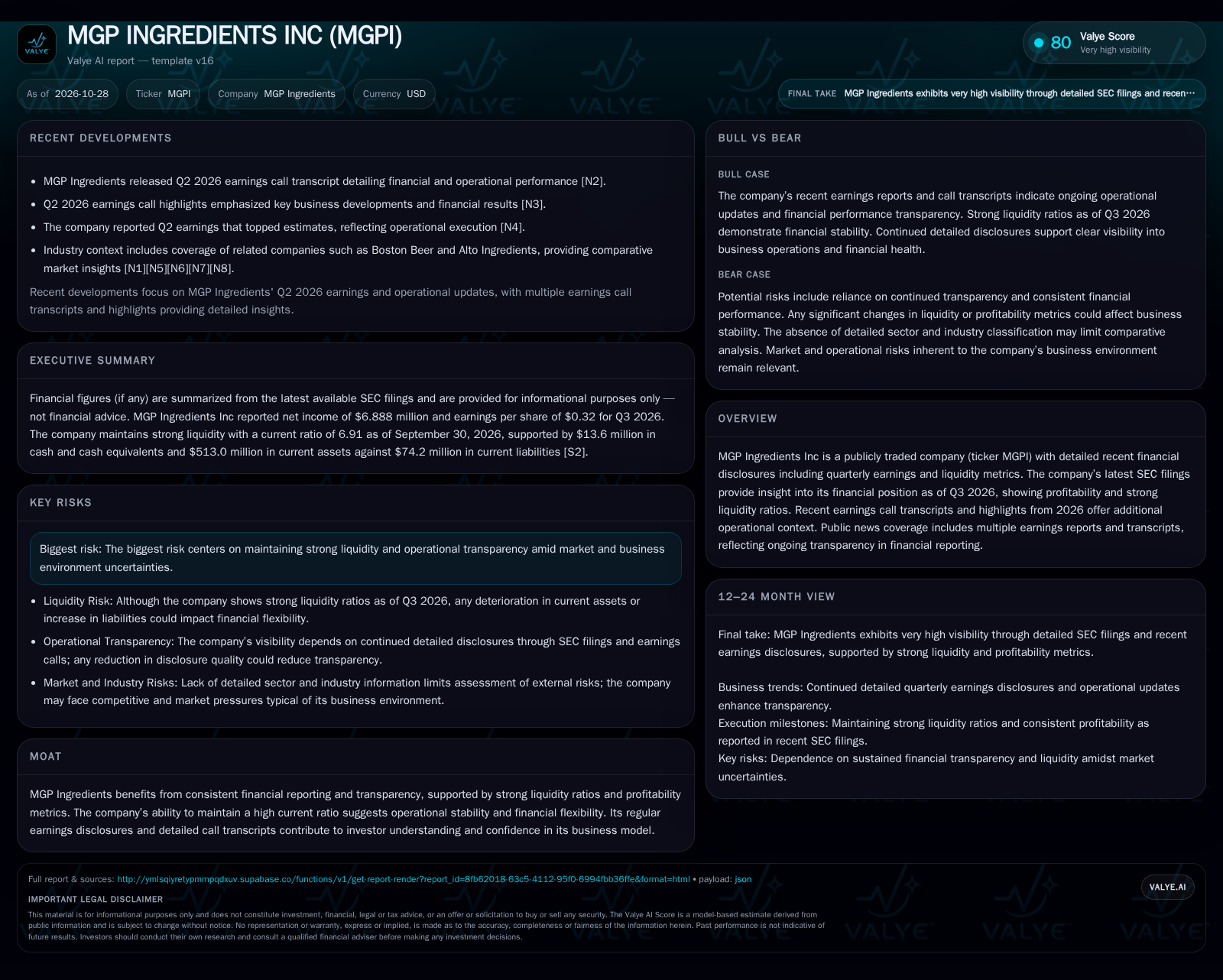
MGP Ingredients reported net income of $6.888 million and earnings per share of $0.32 for the quarter ended September 30, 2026 [S2]. As of the same date, the company held $13.6 million in cash and cash equivalents, with current assets totaling $513.0 million against $74.2 million in current liabilities, yielding a current ratio of 6.91 and a cash ratio of 0.18 [S2]. The company reported cash and liquidity metrics for the period; these figures do not by themselves establish operating runway, investment capacity, financial flexibility, or financing capacity. Recent earnings call transcripts and reports from Q2 and Q3 2026 further highlight ongoing operational execution and transparency [N2] [N3] [N4]. The current financial position offers a stable base, but the company’s forward trajectory will depend on its ability to sustain these metrics amid shifting market and input dynamics.
While the current liquidity ratios suggest a strong short-term financial position, it is important to consider the quality and composition of current assets. Monitoring the turnover rates of these assets would provide deeper insight into the company's true liquidity and operational efficiency.
Economics of Ingredient Supply: Fixed Costs, Margins, and Capital Needs
MGP Ingredients operates in a sector where revenue is typically driven by a mix of contract manufacturing, proprietary branded ingredients, and possibly specialty or value-added product lines. Pricing is influenced by commodity input costs (such as grains or specialty chemicals), customer contract terms, and the ability to differentiate products. The sector generally faces moderate-to-high variable cost structures due to raw material dependence, while fixed costs are associated with plant operations, quality control, and regulatory compliance.
Operating leverage is plausible if the company can increase plant utilization or drive higher volumes through existing infrastructure. However, margin pressure may arise from input cost volatility or if major customers exert pricing pressure. Capital needs are typically moderate, focused on plant maintenance, incremental capacity expansion, or process upgrades rather than major greenfield investments.
The capital intensity of the ingredient supply business also implies that the timing and scale of investments can materially affect profitability. Incremental capacity expansions or process improvements may offer diminishing returns if market demand does not grow commensurately or if competitors simultaneously enhance their capabilities. Furthermore, the company’s ability to pass through input cost increases to customers depends on contract structures and market conditions; fixed-price contracts or highly competitive bidding environments may limit pricing flexibility. Understanding the elasticity of demand for the company’s products and the typical contract durations would help assess how input cost volatility translates into margin variability over time.
Maintaining Market Share in a Competitive Ingredient Landscape
MGP Ingredients competes with a range of ingredient suppliers, from diversified agribusinesses to specialty ingredient peers. The principal sources of competitive pressure include substitute products, customer consolidation, and the commoditization of basic ingredient offerings. Downstream customers—such as food and beverage manufacturers—often have significant bargaining power, especially if MGP’s offerings are not highly differentiated.
Potential advantages for MGP could include proprietary process know-how, long-standing customer relationships, specialty or branded ingredient lines, and supply chain reliability. However, these advantages must be actively defended, as larger competitors may possess scale benefits and smaller, nimble players could undercut on price or innovate in niche segments. The company’s consistent financial reporting and visibility provide some reputational edge with investors, but sustained economic advantage will require either product differentiation or operational efficiency that cannot be easily replicated by peers.
Customer concentration risk is a critical factor influencing pricing power and margin sustainability. If a few large customers represent a significant portion of revenue, their bargaining leverage can intensify, especially if switching costs are low or alternative suppliers offer comparable quality at lower prices. Moreover, competitors with greater scale may achieve cost advantages through economies of scale, vertical integration, or superior supply chain management, further pressuring margins. The company’s ability to innovate in product formulation, packaging, or service delivery could create differentiation that mitigates these risks. However, such innovation requires sustained investment and alignment with evolving customer preferences, which may vary across segments and geographies.
Opportunities for Margin Growth via Differentiation and Increased Volume
A favorable trajectory for MGP Ingredients would see the company leveraging its liquidity and operational stability to invest in higher-margin, specialty ingredients or branded products. If the company can successfully differentiate its offerings—through functional claims, quality assurance, or unique inputs—it could achieve pricing power and reduce vulnerability to commodity cycles.
Upside would be further supported if plant utilization rises, allowing fixed costs to be spread over greater volumes, and if input costs are managed through strategic sourcing or hedging. Evidence confirming this scenario would include rising gross margins, increased revenue from specialty or branded products (if disclosed), and stable or growing volumes despite sector competition. Additional signals might be announcements of new customer contracts in premium segments or successful product innovation launches.
Profitability Outlook Under Competitive and Cost Pressures
The most plausible outlook is that MGP Ingredients maintains modest profitability and liquidity, but faces periodic margin pressure from input cost fluctuations and customer pricing demands. The company may continue to operate profitably, but with limited pricing power unless it can further differentiate its portfolio.
Confirmation of this scenario would include stable net income and EPS, neutral-to-slightly declining gross margins in the face of rising input costs, and continued reliance on operational efficiency to sustain results. If volumes remain steady and the company retains key customer relationships, this would support the base case. Falsification would be signaled by a sharp drop in profitability or major customer losses.
Risks of Margin Declines and Customer Attrition
In an adverse scenario, MGP Ingredients could face a combination of rising input costs—such as grain or energy spikes—and intensified competition, leading to margin compression. If major customers consolidate or switch to alternative suppliers, the company may be forced to lower prices or accept less favorable contract terms, eroding profitability.
Additional risks include supply chain disruptions or regulatory changes that increase compliance costs. Confirmation of this downside would be visible in declining net income, deteriorating liquidity metrics, and potentially negative cash flow from operations. A significant rise in current liabilities or a drop in current assets would also signal emerging stress.
Factors Influencing MGP Ingredients’ Long-Term Value Trajectory
Gross margin trends in upcoming quarters would help clarify whether the company is defending pricing or absorbing input cost pressures.
Volume growth or retention in core ingredient categories—if disclosed—would indicate whether the company is maintaining or expanding share.
Mix shift toward specialty or branded products (if disclosed) would signal progress on margin expansion strategies.
Changes in customer concentration or the addition/loss of major customer relationships (if disclosed) would materially affect revenue stability.
Announcements of plant utilization rates, capacity expansions, or process efficiency initiatives would help test the company’s ability to leverage fixed costs.
Working capital trends, especially movements in current assets and liabilities, would provide early warning of emerging liquidity risks.
Any announced changes in input sourcing or hedging strategies would indicate management’s approach to cost volatility.
Disclosures regarding regulatory changes or compliance costs could impact the economics of the ingredient supply business.
Disclaimer: This is research-only, informational analysis and not investment advice. It may include AI-generated interpretation and general industry context. Always verify important details using primary sources.

Comments