
OGE Energy: Regulated Scale, Renewables Ambition, and the Realities of Utility Economics
The interplay of regulatory frameworks, infrastructure spending, and evolving power demand will shape its risk/reward profile over the next cycle.
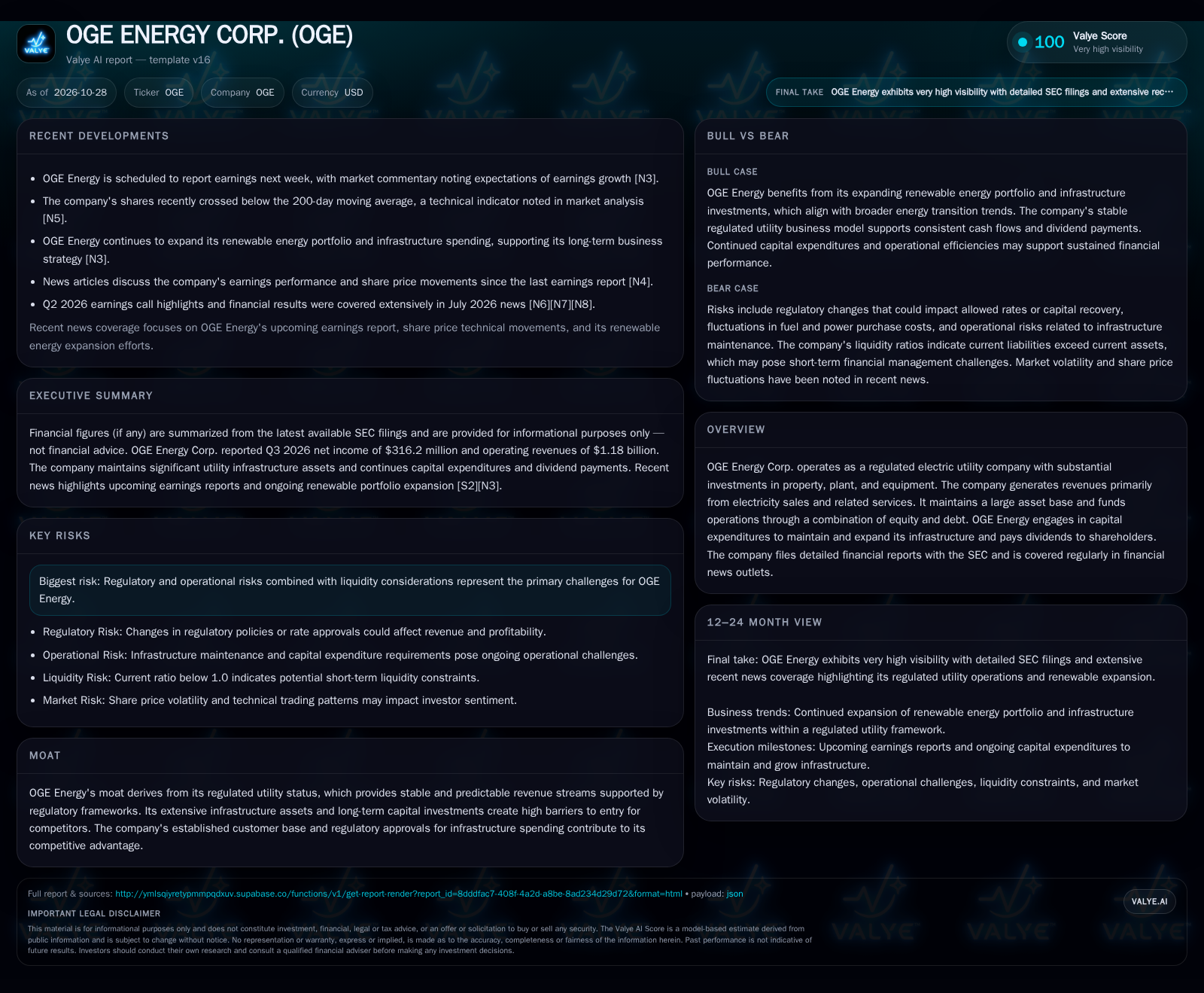
OGE Energy reported $1.18 billion in Q3 2026 revenue and $316 million in net income, reflecting the durable economics of a regulated electric utility with a massive infrastructure base. The company continues to spend heavily on capital projects—including renewables—and pays substantial dividends, but a current ratio of 0.66 highlights short-term balance sheet pressure. Regulatory stability, execution on renewables, and the ability to manage capital intensity are central to its future performance [S2] [N3].
OGE Energy Corp. stands at the intersection of regulated utility stability and the capital-intensive push into renewables. Its third-quarter financials underscore the predictable earnings stream from its core monopoly franchise, but also reveal the persistent tension between high capital expenditures, dividend payments, and short-term balance sheet constraints. As regulatory frameworks evolve and the energy transition accelerates, OGE’s ability to balance infrastructure investment, potential financial flexibility, and ratepayer expectations will determine whether it can sustain both growth and returns through the next cycle.
OGE’s Recent Financials Highlight Utility Stability and Capital Demands
OGE Energy reported operating revenues of $1.18 billion and net income of $316.2 million for Q3 2026, underscoring the stable cash generation typical of regulated electric utilities [S2]. The company’s property, plant, and equipment base reached $18.6 billion gross ($13.2 billion net), reflecting ongoing investment in infrastructure. Capital expenditures were $768 million in the first nine months of 2026, while dividend payments to common shareholders totaled $264.6 million over the same period [S2]. [S2] These facts frame OGE’s core challenge: maintaining strong regulated returns and shareholder payouts while funding heavy, multi-year capital programs.
The interplay between capital expenditures and dividend payments is a critical balancing act for OGE, especially given the capital-intensive nature of utility operations. While dividends provide a steady income stream attractive to investors seeking stability, excessive payouts can constrain the company’s ability to self-fund infrastructure upgrades and renewable projects. The cited source reports dividend-related activity; that disclosure alone does not establish dividend-policy continuity, management confidence, or a material constraint on capital flexibility. Monitoring how OGE manages this balance over time will reveal its financial discipline and strategic prioritization.
How OGE’s Regulated Model and Capital Intensity Shape Earnings Power
The economics of OGE Energy are fundamentally shaped by its status as a regulated utility. Revenues are largely determined by approved rates set by state regulators, with the company’s allowed returns linked to its regulated asset base. However, the capital-intensive nature of the business—evidenced by $768 million in capex YTD—means that large upfront investments are required to maintain and expand infrastructure, particularly as OGE ramps up its renewable energy portfolio.
Operating leverage is structurally limited by regulatory oversight: while scale and efficiency gains can improve margins, cost savings and capital expenditures are often factored into future rate cases, capping upside. Dividend payments compete with capex for free cash flow, and regulatory lag can create timing mismatches between investment and allowed returns. The ability to earn a fair return on invested capital, manage cost inflation, and navigate rate recovery will be central to OGE’s long-term value creation.
The regulatory framework inherently limits OGE’s operational flexibility, as cost recovery and allowed returns depend on periodic rate cases that require regulatory approval. This introduces a timing risk where capital deployed today may not be fully compensated until future rate adjustments, creating potential cash flow mismatches. Additionally, inflationary pressures on labor, materials, and technology costs can compress margins if not adequately addressed in rate proceedings. Effective regulatory engagement and transparent cost forecasting become essential to mitigate these risks. Moreover, the integration of intermittent renewable resources introduces complexity in grid management, potentially increasing operating expenses and requiring new investments in grid modernization and energy storage solutions.
Barriers to Entry, Regulatory Moats, and the Threat of Energy Transition Disruption
OGE’s competitive advantages are anchored in its regulated monopoly status, extensive infrastructure, and established customer relationships. The high cost and complexity of building transmission, distribution, and generation assets—combined with regulatory protections—create formidable barriers to entry for new competitors. Rate base growth through continued infrastructure investment can support earnings growth, provided regulators approve cost recovery.
However, the utility landscape is not static. The push toward renewables, distributed generation, and potential regulatory reform could alter the economics of legacy utilities. While OGE’s expansion of its renewable portfolio aligns with policy and customer preferences, it also exposes the company to execution risk, changing cost structures, and the need to integrate intermittent resources into the grid. Non-utility competitors, such as independent power producers and distributed energy providers, represent potential substitutes at the margin, particularly if technology or regulation accelerates the shift away from centralized utility models. OGE’s ability to secure favorable rate treatment for new investments, maintain reliability, and manage costs will determine the durability of its moat.
While OGE benefits from regulatory protections, the evolving energy landscape introduces strategic challenges that could erode its moat. Distributed energy resources (DERs), such as rooftop solar and home battery systems, empower customers to reduce reliance on centralized utilities, potentially shrinking OGE’s load and revenue base. If regulatory policies increasingly favor DER adoption or introduce performance-based ratemaking, OGE may face pressure to innovate its business model. Additionally, the rise of third-party energy service providers offering demand response or energy efficiency solutions could create competitive pressure on traditional utility revenue streams. OGE’s ability to adapt through grid modernization, customer engagement, and innovative rate designs will be pivotal in sustaining its competitive position.
Regulatory Support and Successful Renewable Execution Fuel Above-Trend Earnings
A constructive scenario for OGE would see state regulators continue to support substantial rate base expansion, approving timely cost recovery for both traditional grid investments and new renewable projects. This would allow OGE to grow earnings and dividends at or above the industry average, leveraging its existing infrastructure and customer base. If renewable integration is managed efficiently—delivering cost savings or enhanced reliability—OGE could also realize incremental margin improvement.
Confirmation of this scenario would include evidence of consistent regulatory approvals for major projects, stable or improving allowed returns on equity, and above-peer growth in rate base and earnings. The scenario would be challenged if regulatory pushback delays cost recovery, renewable projects face material overruns, or if large-scale customer defection to non-utility alternatives accelerates.
Steady-State Utility Performance with Managed Capital Constraints
The most plausible outcome is that OGE continues to deliver reliable, if unspectacular, earnings growth in line with its regulated utility peers. Rate base grows at a measured pace as regulators balance infrastructure needs with bill impacts to customers. Operating margins and returns on equity remain stable, reflecting industry norms.
This scenario will be confirmed if future SEC filings and earnings reports show stable net income growth, manageable debt and equity issuance to fund capex, and no material increase in regulatory disallowances or project delays. Evidence that would challenge this baseline includes escalating cost pressures (particularly for renewables), regulatory delays in rate approvals, or a need to cut dividends to preserve balance sheet health.
Liquidity Pressures and Regulatory Headwinds Erode Utility Economics
A more adverse scenario could develop if OGE faces a combination of regulatory resistance to rate increases, rising cost inflation (especially for renewables and grid upgrades), or unexpected operational issues.
This scenario would be confirmed by evidence such as increasing short-term borrowings, dividend cuts or suspensions, negative credit rating actions, or regulatory disallowances of major capital projects. Project delays, cost overruns, or declining customer demand could further stress the business model. The scenario would be less likely if OGE demonstrates consistent access to low-cost capital, maintains regulatory support, and keeps project execution on track.
Testing OGE’s Resilience: Metrics That Will Shape the Investment Thesis
Net income and earnings per share trends relative to regulatory allowed returns, especially in the context of rising capital expenditures [S2].
Regulatory outcomes: frequency and size of approved rate increases, rate base growth, and allowed returns on equity, as disclosed in future filings or rate case outcomes.
Capital expenditure execution: pace of renewable project completions, budget adherence, and any disclosed cost overruns or delays.
Current ratio and liquidity metrics: changes over time, new credit facilities, or debt/equity issuance to fund working capital and capex.
Customer and load trends: reported changes in customer base, electricity demand, or distributed generation adoption, if disclosed.
Any material regulatory or policy changes at the state or federal level that could impact cost recovery, allowed returns, or investment planning.
Disclaimer: This is research-only, informational analysis and not investment advice. It may include AI-generated interpretation and general industry context. Always verify important details using primary sources.

Comments