
Associated Banc-Corp: Profitability, Visibility Gaps, and the Structural Realities of Regional Banking
Associated Banc-Corp delivered solid Q3 2026 net income and met earnings expectations, yet persistent gaps in disclosure limit full risk assessment. The company’s performance must be weighed against the structural economics of regional banking, evolving credit and regulatory cycles, and the challenges of managing through incomplete financial transparency.
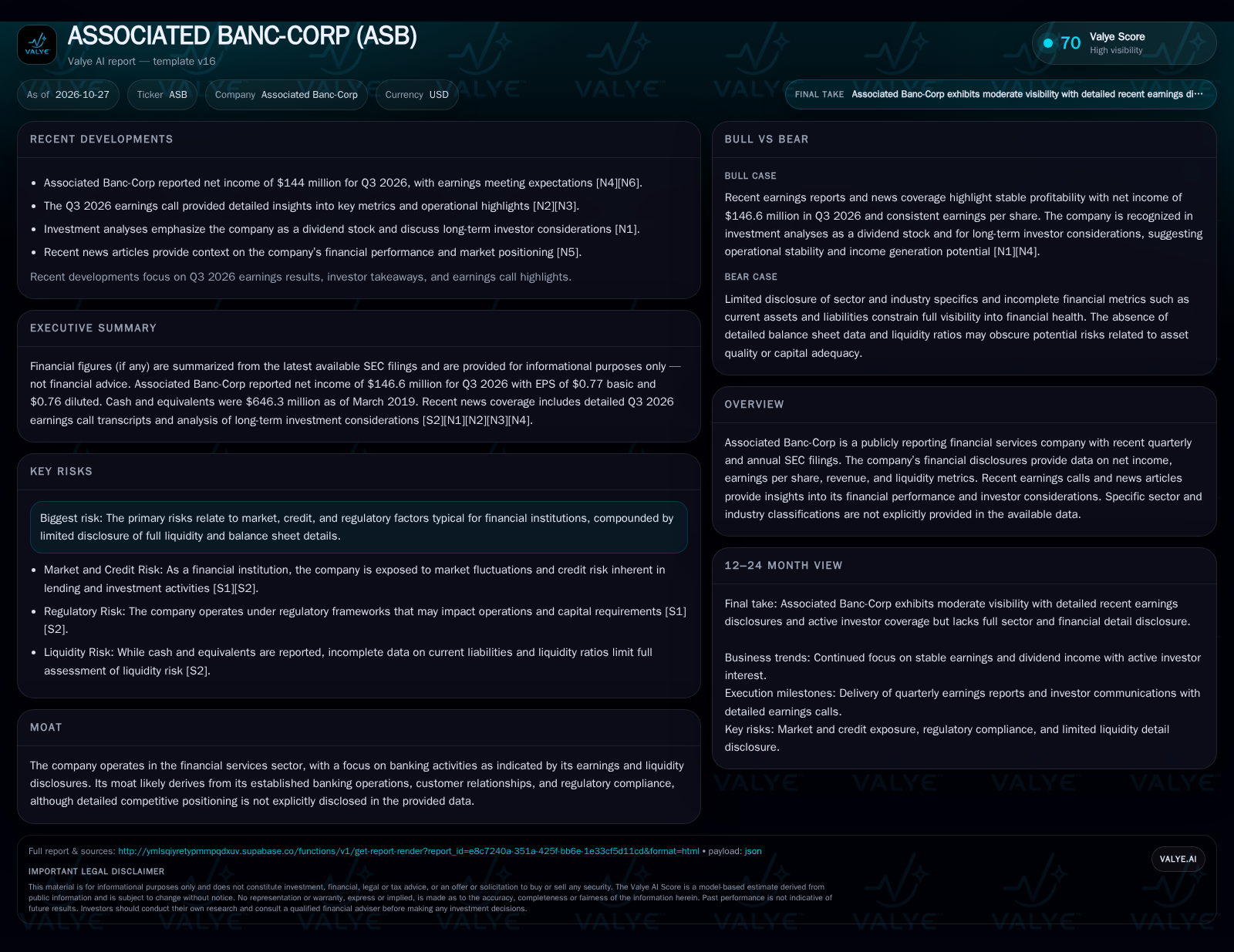
Associated Banc-Corp reported $146.6 million in Q3 2026 net income, with EPS of $0.77 (basic). Earnings met expectations, but limited disclosure of sector specifics and balance sheet metrics leaves investors with only a partial view of risk and capital strength. As a regional bank, ASB’s economics hinge on net interest margin, credit quality, and operating leverage, all of which are sensitive to market and regulatory cycles.
Associated Banc-Corp’s most recent quarter underscores the steady, if unspectacular, profitability that characterizes many regional banks: $146.6 million in net income for Q3 2026, with earnings per share in line with consensus. Yet, beneath this headline stability, the company’s disclosures leave key questions open—especially around asset quality, capital strength, and exposure to credit cycles. For investors, the thesis now pivots not just on reported earnings, but on the ability to gauge the underlying mechanics and resilience of the business in an environment where full financial transparency is lacking.
Earnings Visibility Versus Disclosure Gaps: The Present Snapshot
Associated Banc-Corp reported net income of $146.6 million for Q3 2026, with basic EPS of $0.77 and diluted EPS of $0.76. These results align with consensus expectations, suggesting operational stability but not signaling breakout growth or material underperformance [S2] [N4] [N6]. Revenue for the quarter was $329.7 million as of Q3 2024, though more recent top-line figures are not supplied [S2].
Despite the clear reporting of earnings, there is limited disclosure regarding current sector classification, detailed balance sheet metrics, and liquidity ratios. The last reported cash and cash equivalents figure dates to March 2019, at $646.3 million, offering little insight into present-day liquidity or capital adequacy [S2].
This mix of headline profitability and visibility gaps matters because, for a regional bank, asset quality, funding costs, and capital strength are critical to long-term value creation and resilience through market cycles. The absence of detailed disclosures elevates the importance of monitoring for adverse credit or market events that could stress the core business.
How Regional Banks Like ASB Generate—and Lose—Economic Value
The fundamental economics of a regional bank such as Associated Banc-Corp are shaped by its net interest margin (NIM)—the spread between interest earned on loans and paid on deposits. In normal conditions, the majority of revenue stems from this spread, supplemented by fee-based income from services such as payments, mortgage origination, and wealth management.
Operating leverage is moderate: branch networks and compliance functions create a largely fixed cost base, but digitalization may allow for incremental margin expansion if customer acquisition and servicing shift online. Conversely, credit losses—especially in consumer, commercial real estate, or small business portfolios—can quickly erode profitability, making loan underwriting and risk management central to the business model.
Capital needs are persistent. Regulatory requirements force banks to hold minimum levels of Tier 1 capital and maintain liquidity coverage ratios, often constraining the pace of loan growth or shareholder returns. Absent evidence of extraordinary capital deployment or restructuring, ASB’s potential financial flexibility is most likely determined by retained earnings and regulatory capital buffers.
In the absence of full disclosure, it is plausible that ASB’s revenue mix, cost structure, and risk appetite resemble other mid-sized regional banks, with profitability tightly linked to macroeconomic interest rate trends, local credit demand, and the competitive intensity of deposit markets.
Structural Advantages and Vulnerabilities in the Regional Banking Arena
Associated Banc-Corp operates in a competitive landscape defined by other regional banks, community lenders, national financial institutions, and increasingly, fintech platforms. Its potential advantages likely stem from established customer relationships, a physical branch footprint, and regulatory compliance history—factors that can build switching frictions and local trust.
However, these same incumbency advantages are being eroded by digital-first competitors, rising customer expectations for seamless online banking, and the commoditization of core lending and deposit products. In a low-rate or high-credit-loss environment, smaller regional banks can be at a disadvantage relative to larger, more diversified peers with scale-driven cost advantages and broader funding access.
Fintech substitution is a growing threat, particularly if digital lenders can cherry-pick prime customers or undercut fee structures. Conversely, regulatory burdens and the complexity of compliance may discourage new entrants, preserving some degree of moat for incumbent banks like ASB—especially in less densely served regions.
Without more granular disclosure, it is difficult to assess whether ASB enjoys superior deposit franchise quality, above-peer NIM, or differentiated fee income. However, the company’s operational stability and ability to meet earnings expectations suggest it is at least maintaining parity with its peer set.
What Could Drive Positive Re-Rating: Margin Expansion and Credit Outperformance
A favorable scenario for Associated Banc-Corp would involve a combination of stable or rising net interest margins, benign credit conditions, and above-peer growth in fee-based revenue. If the company can demonstrate loan growth without a corresponding deterioration in asset quality—especially in commercial and consumer portfolios—it could support both earnings momentum and capital accumulation.
Evidence that would confirm this scenario includes: consistent quarterly increases in net interest income (if disclosed), low nonperforming asset ratios, and declining charge-offs. Additional upside could come from cost discipline and operational leverage, such as branch consolidation or digital migration, which would allow for margin expansion even in a flat revenue environment.
If management were to provide more granular disclosure around capital ratios, liquidity buffers, and loan book composition, and these metrics compared favorably to regional peers, the market could reward ASB with a higher valuation multiple and lower perceived risk premium.
Sustaining Earnings in a Moderately Competitive and Uncertain Environment
The most plausible trajectory for Associated Banc-Corp is continued delivery of steady, consensus-level earnings, with profitability anchored by stable net interest margins and manageable credit costs. The company is likely to track broader regional banking trends, with neither outsized growth nor material deterioration in core metrics.
Confirmation of this scenario would include: ongoing delivery of earnings in line with guidance and analyst expectations (as seen in Q3 2026), absence of negative credit surprises, and incremental improvements in operational efficiency. The lack of disclosure on sector specifics, capital ratios, or liquidity will keep some risk premium embedded in the stock, but unless adverse events materialize, the company should be able to sustain current performance.
Falsification would come from unexpected credit losses, significant margin compression due to funding cost pressures, or regulatory actions that force capital raises or constrain growth.
Visibility Gaps and Market Stress: How Weakness Could Materialize
The key risk for Associated Banc-Corp is that limited disclosure masks latent vulnerabilities in asset quality, funding costs, or capital strength. If macroeconomic conditions deteriorate—through rising unemployment, commercial real estate stress, or interest rate volatility—credit losses could rise sharply, compressing earnings and eroding capital.
A negative outcome could be triggered if undisclosed concentrations in riskier loan categories or outsize exposure to rate-sensitive funding sources are revealed during a downturn. In this scenario, the company might be forced to raise capital, curtail lending, or absorb balance sheet losses, leading to a material decline in shareholder value.
Evidence for this scenario would include: sudden spikes in provision for loan losses (if disclosed), missed earnings targets, regulatory interventions, or negative revisions to credit or liquidity outlooks by management or external analysts.
Testing the Thesis: What Would Confirm or Challenge ASB’s Resilience
Quarterly disclosure of net interest margin and its trajectory—if disclosed—would help clarify whether ASB is managing funding costs and loan yields effectively.
Nonperforming loan and charge-off rates, especially in commercial and consumer portfolios, would provide direct insight into asset quality and credit risk.
Regulatory capital ratios (CET1, Tier 1, total capital)—if disclosed—are critical for assessing capital adequacy and the ability to absorb losses.
Deposit growth or runoff trends, especially in the context of changing rate environments, would signal franchise strength and funding stability.
Expense ratio and efficiency improvements from digitalization or branch optimization would indicate progress on operating leverage and margin enhancement.
Management commentary or external analysis on exposure to commercial real estate or other cyclical sectors would help evaluate downside risk.
Disclaimer: This is research-only, informational analysis and not investment advice. It may include AI-generated interpretation and general industry context. Always verify important details using primary sources.

Comments