
InvenTrust Properties: Retail Real Estate Economics in a High-Visibility, Inflation-Linked Lease Model
InvenTrust Properties Corp. has delivered above-estimate Q3 2026 results while maintaining a disciplined approach to retail property management, interest rate hedging, and inflation mitigation. The company’s current position highlights the durability of its lease structures and debt management, but the next phase will hinge on tenant performance, re-leasing dynamics, and the ability to offset macroeconomic volatility through contractual protections.
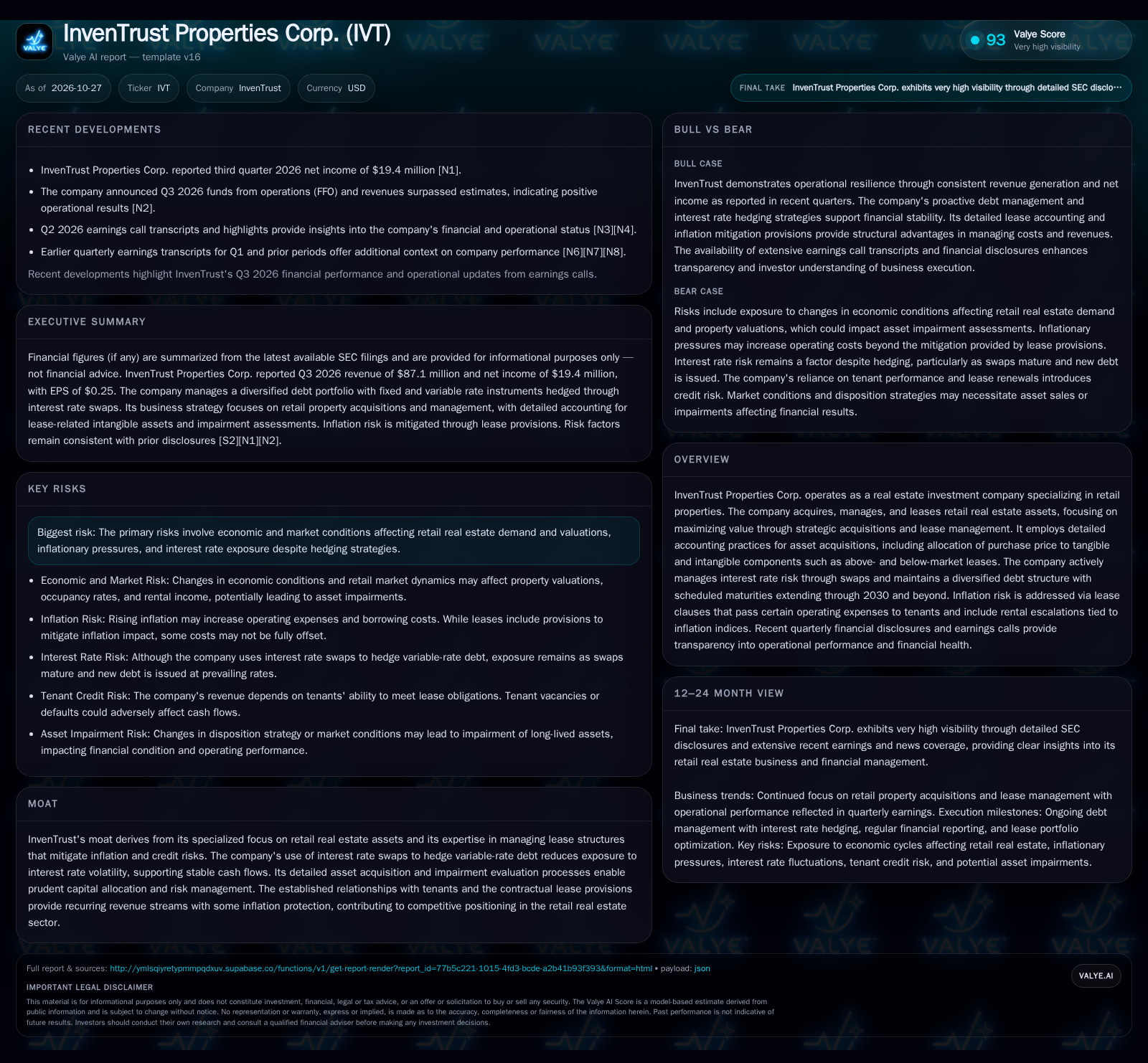
InvenTrust Properties reported Q3 2026 revenue of $87.1 million and net income of $19.4 million, exceeding FFO and revenue estimates. Its operational model relies on lease structures that pass through operating costs and include inflation-linked escalations, while debt is actively managed with swaps. The company’s financial visibility is high, but future performance will depend on tenant credit, re-leasing spreads, and macroeconomic resilience. [S2] [N1] [N2]
InvenTrust Properties Corp. stands out for its transparency and disciplined financial management, as evidenced by above-estimate Q3 2026 results and detailed operating disclosures. The company’s focus on retail real estate, supported by inflation-linked lease structures and active interest rate risk management, has underpinned recent outperformance. However, as the retail landscape evolves and macroeconomic headwinds persist, the company’s ability to maintain occupancy, renew leases on favorable terms, and manage refinancing risk will be central to its ongoing stability and value creation.
Recent Financial Outperformance and Structural Positioning
In Q3 2026, InvenTrust Properties reported revenue of $87.1 million and net income of $19.4 million, translating to EPS of $0.25. These results surpassed both funds from operations (FFO) and revenue estimates, signaling operational strength and potential resilience in a competitive retail real estate environment. The company continues to deploy a structured debt portfolio, actively using interest rate swaps to manage exposure, with $400 million notional in swaps outstanding as of year-end 2025. Leases are designed to pass operating expenses to tenants and include escalation clauses linked to inflation indices, aiming to buffer against rising costs. These factors highlight both recent execution and the mechanisms InvenTrust relies on to maintain financial stability. [S1] [S2] [N1] [N2]
How Lease Structures and Debt Management Shape Cash Flows
InvenTrust generates revenue primarily through rental income from retail properties. The company’s lease agreements typically require tenants to cover operating expenses—such as property taxes, insurance, and maintenance—reducing the landlord’s direct exposure to inflationary pressures. Additionally, many leases feature rental escalation clauses indexed to inflation, providing a structural mechanism for revenue growth in rising price environments. This model can partially decouple net operating income from shifts in utility or maintenance costs, but ultimate protection depends on tenants’ ability to absorb and pay higher rents.
On the cost side, InvenTrust manages a blend of fixed and variable-rate debt, using interest rate swaps to fix rates for a portion of its borrowings. This hedging strategy smooths interest expense volatility, but as swaps mature, the company may face higher refinancing costs if rates remain elevated. Capital needs are driven by acquisition activity, property improvements, and debt maturities; prudent capital allocation and refinancing discipline are critical, especially as retail property values and financing conditions fluctuate.
Operating leverage in this model is moderate: while certain costs are passed through, occupancy rates, rental spreads, and tenant creditworthiness drive profitability. The amortization of intangible lease assets (such as above/below-market leases acquired) affects reported income but is non-cash, emphasizing the importance of cash flow measures (like FFO) for understanding true earning power.
Specialization in Retail Real Estate: Advantages and Exposures
InvenTrust’s competitive positioning is anchored in its focus on retail properties and expertise in managing complex lease structures. This specialization allows the company to optimize tenant mix, negotiate inflation-protected leases, and maintain relationships that support stable occupancy. The ability to pass through operating expenses and utilize escalation clauses offers some insulation from cost shocks—a potential advantage over landlords with less flexible lease models.
However, the retail real estate sector faces ongoing challenges from e-commerce, shifting consumer behavior, and retail tenant consolidation. Competitors include other retail-focused REITs, diversified property owners, and private equity investors targeting distressed or value-add retail assets. Substitution risk arises from alternative property types (industrial, mixed-use), while tenant bankruptcies or anchor tenant departures can have outsized impact on smaller portfolios.
The company’s rigorous approach to asset acquisition and impairment assessment may enable more disciplined capital deployment than less specialized peers, but sector cyclicality and local market dynamics remain persistent counterforces.
When Lease Protections and Retail Recovery Reinforce Earnings
A favorable scenario unfolds if InvenTrust’s inflation-linked lease escalations and expense pass-throughs continue to outpace operating cost growth, while retail sector demand stabilizes or recovers. Strong tenant retention and the ability to re-lease space at higher rents would provide organic NOI growth. If refinancing activity coincides with stable or declining interest rates, hedging costs could remain manageable, supporting FFO margins.
Evidence confirming this scenario would include sustained or rising occupancy rates, positive leasing spreads on renewals, continued outperformance versus FFO/revenue estimates, and stable or improving tenant credit profiles. Additional confirmation would come from management commentary indicating robust leasing pipelines and limited exposure to distressed tenants. If disclosed, sequential improvement in same-store NOI and positive re-leasing spreads would further support the upside case.
Steady Performance Amid Mixed Retail and Rate Environments
The most plausible near-term outcome is a continuation of current trends: InvenTrust maintains solid occupancy and delivers consistent cash flows, but headwinds from selective tenant weakness, modestly rising operating costs, and refinancing at higher rates offset some lease-driven revenue growth. The company’s inflation-mitigation lease provisions and hedging strategies allow it to navigate macro volatility, while disciplined asset management limits impairment risk.
This scenario is supported if InvenTrust’s FFO and revenue remain in line with recent quarters, occupancy holds steady, and there are no material asset sales or impairments. Confirmation would come from stable credit metrics, no significant increase in tenant default rates, and refinancing activity that does not materially erode interest coverage. A useful metric would be the trend in weighted average lease term (WALT) and the proportion of leases subject to near-term renewal.
Macroeconomic Stress and Tenant Defaults Pressure the Model
A negative scenario could develop if a macroeconomic downturn or retail sector disruption leads to increased tenant defaults or widespread lease non-renewals. Rising vacancies would erode occupancy and reduce rental income, while asset values could fall, triggering impairments. If inflation accelerates faster than lease escalations or if tenants resist rent increases, net operating income margins could compress. Interest rate hedges rolling off in a high-rate environment would further increase interest expense, straining cash flow.
This scenario would be confirmed by sequential declines in occupancy, negative leasing spreads, management commentary highlighting tenant distress, or a spike in property impairments. Watch for a rising trend in bad debt expense, pressure on FFO, and any need to dispose of assets at a loss to preserve liquidity.
Testing the Thesis: Lease Economics, Tenant Health, and Rate Dynamics
Occupancy rate trends and changes in same-store NOI—if disclosed—will reveal whether leasing strategies are translating into sustained cash flow.
Re-leasing spreads (the difference between new and expiring rents) would clarify whether the company is capturing inflationary gains or facing rent pressure.
Weighted average lease term (WALT) and the schedule of lease expirations will indicate renewal risk and near-term cash flow visibility.
Tenant concentration and credit quality metrics—if disclosed—would help assess exposure to individual tenant failures.
The proportion of debt maturing within the next 24 months and the weighted average interest rate on new financings will show refinancing risk.
Trends in bad debt expense or write-offs could signal emerging tenant distress.
Management’s commentary on retail demand, acquisition pipeline, and disposition strategy will provide qualitative insight into forward-looking risk and opportunity.
Evidence of asset impairments or forced asset sales would suggest pressure on property valuations and capital structure.
Disclaimer: This is research-only, informational analysis and not investment advice. It may include AI-generated interpretation and general industry context. Always verify important details using primary sources.

Comments