
Caesars Entertainment: Digital Momentum, Physical Headwinds, and the Uncertainty of a Transformative Merger
Caesars Entertainment’s recent financials reveal a business at a crossroads: digital gaming is expanding rapidly, but legacy casino operations—especially in Las Vegas—face declining visitation and mounting costs.
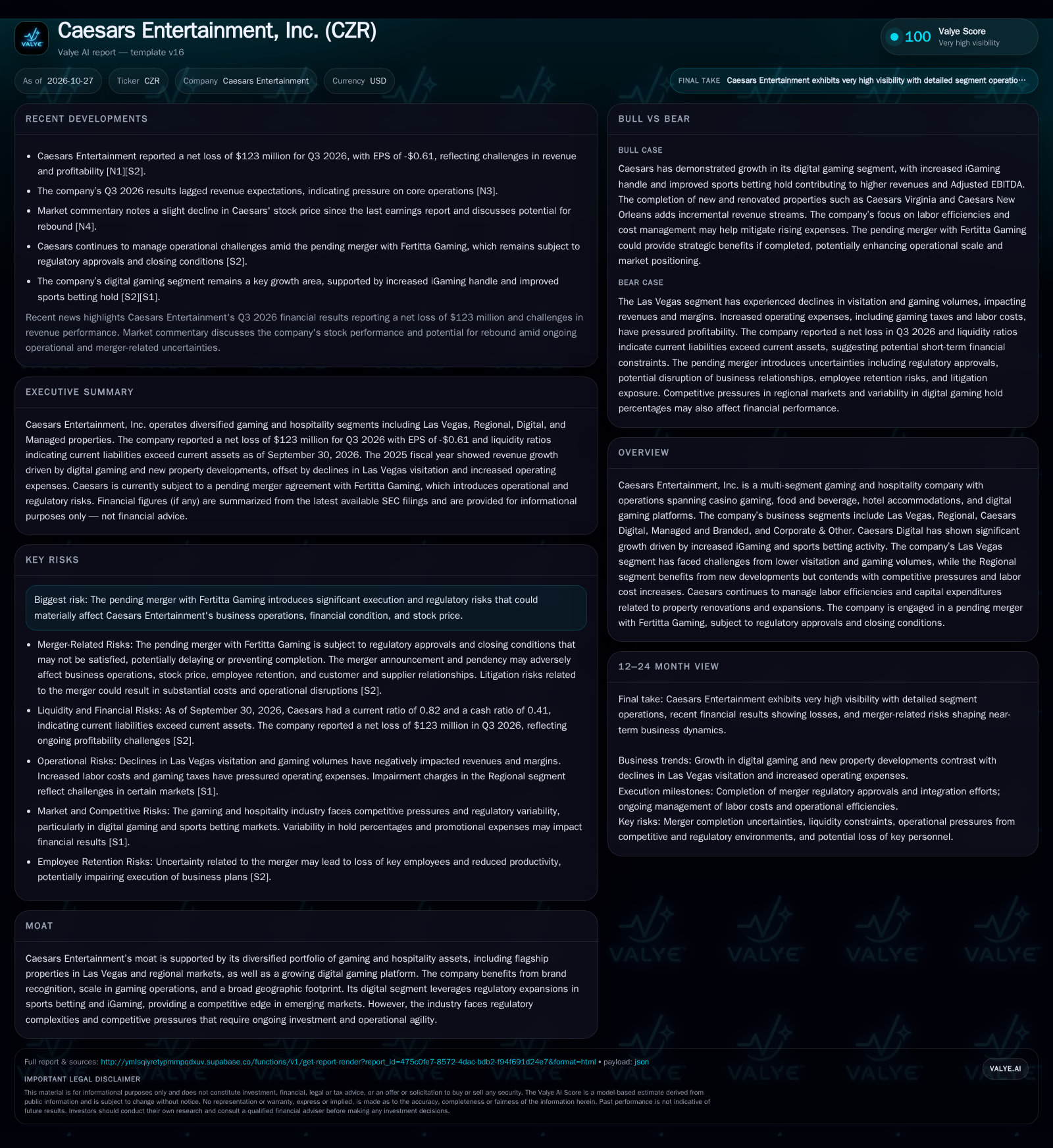
Caesars Entertainment saw strong growth in its digital segment and new regional properties, but these positives were offset by struggles in Las Vegas, higher operating expenses, and a net loss in Q3 2026. Liquidity is tight relative to current liabilities. The outcome of the pending Fertitta Gaming merger will likely determine Caesars’ near-term trajectory, with regulatory and integration risks looming large. [S1] [S2] [N1] [N3]
Caesars Entertainment stands at a pivotal moment: its digital operations are gaining traction as state-level legalization of iGaming and sports betting expands, but its traditional casino and hospitality businesses—especially in Las Vegas—are struggling with declining visitation and rising costs. Investors face a complex picture shaped by digital growth, physical asset headwinds, and the uncertain impact of a major M&A transaction. [S1] [S2] [N1] [N3]
Recent Performance: Digital Gains Offset by Physical Weakness and Merger Overhang
For the year ended December 31, 2025, Caesars reported $11.486 billion in consolidated net revenues, with growth largely attributable to the Caesars Digital segment and incremental contributions from newly developed or renovated properties such as Caesars Virginia and Caesars New Orleans. [S1] [S2] [N1]
Las Vegas operations declined in both net revenues and Adjusted EBITDA during 2025 due to lower city-wide visitation and less favorable table games hold, while the Regional segment saw higher revenues from new developments but faced margin pressure from rising labor costs and competitive reinvestment. [S1]
The digital segment, meanwhile, produced notable gains in revenue and Adjusted EBITDA, benefiting from increased iGaming handle and improved sports betting hold percentages. [S1] [S2]
Overlaying these results is the pending merger with Fertitta Gaming, which remains subject to regulatory approvals and introduces operational, legal, and employee retention risks that could materially impact future performance. [S2]
How Caesars’ Multi-Segment Model Balances Digital Scale and Physical Asset Complexity
Caesars’ economic engine is fundamentally a multi-segment blend: traditional casino gaming, hospitality (hotels, food & beverage), and a fast-growing digital platform. Gaming operations—both physical and digital—are the primary revenue driver, with digital now representing the fastest-growing component. Digital’s appeal lies in its scalability and comparatively higher incremental margins: once a digital platform is built and regulatory compliance is achieved, additional customer volume can be added with limited incremental costs, offering potential operating leverage if promotional expenses and platform costs are managed.
Physical casinos, by contrast, are capital-intensive and exposed to both fixed costs (real estate, staffing, maintenance, taxes) and cyclical demand swings. Renovations and new developments (e.g., Caesars Virginia) can temporarily boost revenues but require significant upfront investment and ongoing competitive reinvestment, especially in markets where local competition is fierce or labor costs are rising.
If digital growth continues and margin expansion is realized, Caesars could see improved overall economics; however, persistent losses, impairment charges (such as the $182 million in the Regional segment in 2025), and elevated operating expenses threaten to offset these gains. The economics of the merger with Fertitta Gaming are not yet visible, but the deal could bring both integration costs and potential synergies if executed well.
Brand Scale and Digital Reach: Moat Strengths Meet Intensifying Rivalry
Caesars’ primary competitive advantages are its brand recognition, loyalty program (Caesars Rewards), and geographic footprint that spans both flagship Las Vegas properties and regional markets. The development of Caesars Digital has allowed the company to tap into the rapid expansion of legalized sports betting and iGaming, leveraging its brand and customer database to acquire digital users at potentially lower cost than pure-play digital competitors.
However, these strengths are counterbalanced by intense competition: in Las Vegas, rival integrated resorts and entertainment alternatives are competing for a potentially shrinking visitor pool, while in regional markets, new entrants and local operators are driving up labor and promotional costs. In digital gaming, Caesars faces aggressive competitors with deep pockets and product innovation, including both legacy casino operators and pure online platforms.
Switching frictions in digital gaming are limited, as customers can easily move between platforms based on promotional offers and user experience. In physical casinos, switching costs are higher, but market share is vulnerable to new property openings, changes in local economic conditions, and regulatory shifts.
The pending Fertitta merger could enhance scale, diversify the property portfolio, or introduce new management expertise, but it also risks disruption, culture clash, or dilution of brand focus if not carefully managed. [S2]
A Digital-First Caesars Emerges: What Would Confirm a Sustainable Turnaround?
The most favorable outcome is one in which digital gaming continues its rapid expansion, driven by further state-level legalization, rising iGaming handle, and stable or improving hold percentages. If Caesars can leverage its loyalty ecosystem to cross-sell digital and physical offerings, customer lifetime value could increase, while marketing and promotional spend is kept in check through disciplined cost management.
Successful completion and integration of the Fertitta merger—without major customer or talent attrition—could unlock scale-driven synergies (such as shared technology, purchasing, and marketing platforms) and potentially broaden the company’s geographic and demographic reach.
Confirmation of this scenario would require sequential growth in digital revenues and Adjusted EBITDA, stable or improving margins in the Regional and Las Vegas segments, and evidence of synergy realization post-merger (e.g., reduced per-unit costs, expanded digital/physical cross-promotion). An improved liquidity profile (higher current ratio, growing operating cash flow) would further validate a sustainable turnaround.
Conversely, evidence that would falsify this scenario includes stalled digital revenue growth, ongoing or worsening margin compression, or post-merger operational disruption leading to further losses or customer churn.
Caesars’ Next Phase: Incremental Digital Gains, Physical Stabilization, and Merger Execution Risk
The most plausible middle path is one of gradual digital growth offset by persistent headwinds in legacy operations. Caesars Digital is likely to continue expanding as more states legalize iGaming and sports betting, but growth rates may moderate and promotional intensity could keep margins in check. The physical casino and hospitality segments may stabilize but are unlikely to deliver significant growth absent a broader recovery in Las Vegas visitation or a step-change in regional economic conditions.
The pending Fertitta Gaming merger could eventually bring scale benefits, but near-term execution risk—regulatory delays, integration complexity, and employee retention challenges—may weigh on results and distract management.
Confirmation would come from steady digital revenue growth, stabilization of Las Vegas and Regional segment margins, and successful navigation of the merger process without major disruption. Falsification would be indicated by persistent losses, further liquidity deterioration, failed merger closing, or significant market share loss in either digital or physical channels.
How Liquidity Constraints and Merger Disruption Could Compound Core Business Risk
In a negative scenario, Caesars faces a confluence of pressures: digital growth slows due to regulatory setbacks or higher-than-expected promotional costs, while legacy casino and hospitality operations continue to deteriorate amid weak visitation, cost inflation, and competitive reinvestment needs. The company’s liquidity position becomes increasingly precarious, forcing asset sales, capital raises under unfavorable terms, or reductions in capex and marketing that further erode competitiveness.
If the Fertitta merger is delayed or fails to close, Caesars could incur substantial transaction costs without realizing any offsetting strategic benefits, while the uncertainty may accelerate employee departures and customer attrition. Even if the merger closes, poor integration or culture clash could trigger operational disruptions, litigation, or impairments.
Confirmation of this scenario would include continued net losses, declining cash balances, inability to fund growth or maintain properties, and negative trends in both customer retention and employee turnover. Additional impairment charges, legal expenses, or asset divestitures would further reinforce the downside case.
Milestones and Metrics That Will Determine Caesars’ Post-Merger Trajectory
Quarterly digital revenue growth and Adjusted EBITDA trends—especially sequential changes relative to promotional spend—will be critical to assessing the sustainability of the digital segment’s momentum.
Las Vegas segment metrics: visitation rates, gaming volume, and table hold percentages remain core indicators of whether physical operations are stabilizing or declining.
Regional segment margins and labor cost trends will test the company’s ability to offset inflation and competitive reinvestment pressures.
Progress on Fertitta merger milestones—including regulatory approvals, closing date, and announced integration or synergy targets—will shape near-term risk and opportunity. [S2]
Employee turnover and retention rates, particularly in key management roles, will signal whether merger-related uncertainty is impairing execution.
Post-merger litigation or contractual disruptions (e.g., customer/supplier contract terminations) could indicate unanticipated costs or business erosion. [S2]
Impairment charges or asset divestitures in regional or legacy segments would confirm ongoing operational stress. [S1]
Disclaimer: This is research-only, informational analysis and not investment advice. It may include AI-generated interpretation and general industry context. Always verify important details using primary sources.

Comments