
Applied Industrial Technologies: Leveraging Technical Expertise and Automation Expansion in a Shifting Industrial Landscape
Applied Industrial Technologies continues to outperform earnings expectations and raise its outlook, propelled by a deep technical bench, broad inventory reach, and targeted automation growth. As secular trends reshape industrial demand, the company’s ability to cross-sell engineered solutions and adapt to new verticals will determine the durability of its moat and the upside potential for shareholders.
Applied Industrial Technologies’ recent profit growth and increased EPS outlook reflect its strong positioning at the intersection of MRO distribution and engineered automation solutions. A broad facility network, deep customer relationships, and expansion into automation provide resilience and upside. However, risks remain from industrial cycles, supply chain volatility, and execution on integration and digital initiatives.
Applied Industrial Technologies stands at a pivotal point in its evolution as a value-added distributor and technical solutions provider. Surpassing Q1 FY2027 earnings estimates and boosting its EPS outlook, the company is capturing the benefits of secular industrial shifts—such as supply chain reshoring and automation adoption—while leveraging its broad product portfolio and technical expertise. As it expands into automation and engineered solutions to serve higher-growth end markets, the key questions are whether Applied can sustain its competitive advantages, manage integration risks, and translate operational investments into durable margin expansion. The company’s recent financial performance and strategic moves offer insight into both its resilience and the challenges ahead.
Profit Growth and EPS Outlook Signal Strategic Momentum
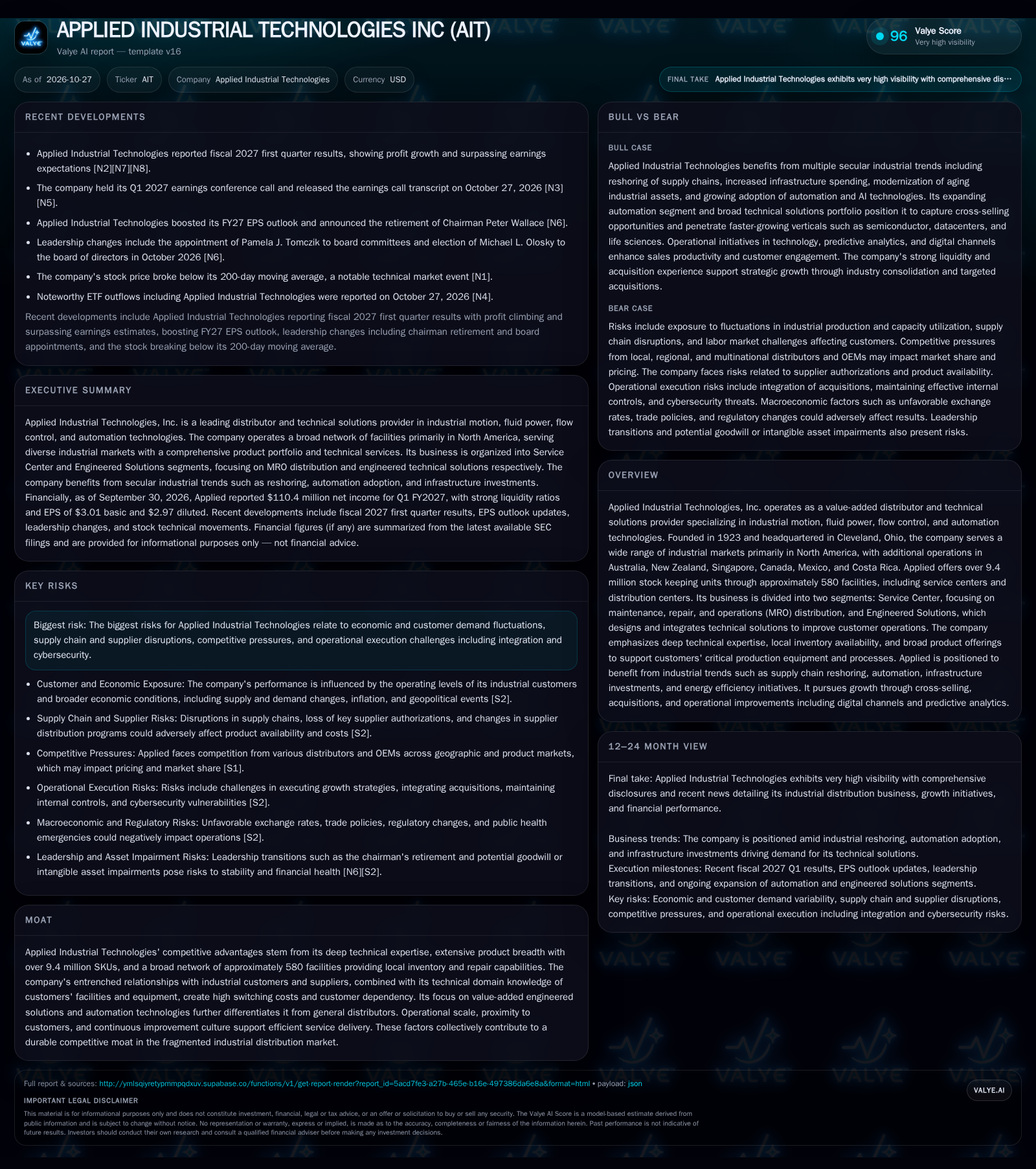
Applied Industrial Technologies reported fiscal Q1 2027 profit growth, surpassing earnings expectations and raising its full-year EPS outlook [N2] [N6] [N7] [N8]. This positive surprise reflects both operational execution and underlying demand strength in core industrial markets. The company’s financial snapshot as of September 30, 2026, shows net income of $110.4 million and a current ratio of 2.89, indicating a strong balance-sheet position [S2]. Leadership transitions are also underway, with the retirement of the chairman and new board appointments announced in October 2026 [N6]. These developments matter as they set the tone for strategic priorities, capital allocation, and the pace of ongoing transformation in automation and engineered solutions.
How Scale, Technical Know-How, and Automation Expansion Drive Earnings Power
Applied’s business model blends high-volume, lower-margin MRO distribution (Service Center segment, 64% of sales) with higher-value, solution-oriented Engineered Solutions (36% of sales) [S1]. The Service Center segment generates stable revenue through recurring MRO needs, but faces pricing pressure and high competition. In contrast, Engineered Solutions—encompassing custom automation, integration, and technical consulting—commands higher gross margins and creates opportunities for differentiated value capture.
The economics hinge on scale, inventory breadth (over 9.4 million SKUs), and deep embeddedness in customer workflows. Local inventory and repair capabilities reduce downtime for industrial clients, supporting premium pricing and repeat business. As automation and digital services expand, Applied’s ability to cross-sell complex solutions into its large installed base may improve revenue mix and operating leverage. However, integration of acquired automation assets and the shift towards more technical offerings may increase fixed costs and require continued investment in talent, technology, and digital infrastructure.
Capital needs are moderate for a distributor but rise with the push into engineered systems—requiring investments in engineering talent, digital platforms, and inventory management. The company reported cash and liquidity metrics for the period; these figures do not by themselves establish operating runway, investment capacity, financial flexibility, or financing capacity.
Moat Dynamics: Technical Depth, Local Presence, and the Race to Automate
Applied’s moat rests on technical expertise, product breadth, and an extensive network of 580 facilities, which together enable fast response, on-site support, and deep customer relationships [S1]. This creates high switching costs for clients whose operations depend on timely MRO and technical support. The company’s ability to integrate new automation technologies—such as robotics, machine vision, and digital networking—differentiates it from commodity distributors.
However, these advantages are not unassailable. Large national distributors, regional specialists, and OEM direct channels all vie for share, especially as digital platforms lower the friction for price-based competition. The shift toward automation and engineered solutions brings Applied into closer competition with specialized automation integrators and technology vendors, who may have deeper domain expertise in certain verticals. Supplier relationships are generally non-exclusive, which limits proprietary advantage and exposes Applied to changes in supplier distribution strategies [S1].
The question is whether Applied can maintain its local service edge and technical credibility as it scales up its solutions business, without diluting its core strengths in MRO distribution.
Automation Cross-Selling and Vertical Expansion Unlock New Growth Vectors
A favorable scenario sees Applied leveraging its installed base and technical sales force to drive adoption of engineered automation solutions across high-growth verticals—such as semiconductors, data centers, life sciences, and alternative energy [S1]. The company’s investments in digital channels, predictive analytics, and consultative selling could deepen customer relationships and generate higher-margin, multi-year project work. Successful integration of acquisitions in automation and digital domains may accelerate share gains versus traditional distributors.
Upside would be confirmed by sustained above-market revenue growth in Engineered Solutions, rising gross margins, and new customer wins in strategic verticals. Evidence of expanded multi-product contracts, increasing project backlog (if disclosed), and higher cross-sell rates would further validate the case. If disclosed, a material increase in automation-driven revenue as a proportion of sales would be a strong indicator.
MRO Resilience Meets Measured Automation Gains in a Mixed Macro Environment
The most plausible outcome is that Applied continues to deliver steady growth, with MRO distribution providing a stable revenue floor and incremental gains from automation and engineered solutions. The company benefits from secular tailwinds—reshoring, infrastructure spending, and energy efficiency—but also faces periodic headwinds from industrial production cycles and customer capex variability.
In this scenario, operating margins improve modestly as automation scales and operational initiatives (such as supply chain optimization and e-commerce adoption) yield efficiency gains. However, competitive pricing, supplier churn, and integration costs limit the pace of margin expansion. Confirmation would come from continued earnings beats, modest gross margin improvement, stable customer retention rates (if disclosed), and disciplined capital deployment. Falsification would be signaled by margin stagnation, rising SG&A as a share of sales, or slower-than-expected growth in engineered solutions.
Industrial Cyclicality, Integration Stumbles, and Supply Chain Disruptions Derail Progress
A negative scenario centers on a downturn in industrial activity—whether from macroeconomic contraction, customer destocking, or project delays—which compresses both MRO and solutions revenues. Simultaneously, integration challenges or talent shortages in the automation segment could erode service quality and increase costs. Supply chain disruptions or loss of key supplier authorizations would further pressure gross margins and inventory availability [S2].
Downside would be confirmed by declining sales in both segments, margin compression, and negative operating leverage. Evidence would include a marked increase in inventory write-downs, customer attrition, or project cancellations (if disclosed), as well as missed earnings guidance or downward EPS revisions. Leadership instability following recent board changes could magnify execution risks if strategic alignment falters.
What Will Determine Applied’s Ability to Sustain Its Moat and Drive Margin Expansion?
The growth rate and margin trajectory of the Engineered Solutions segment, especially as automation and digital solutions scale relative to traditional MRO distribution.
Any disclosures or evidence of cross-selling success—such as increased multi-product contracts, project backlog growth, or higher average account revenue per customer.
Trends in supplier relationships: new authorizations, loss of key suppliers, or changes in distribution agreements that could affect product availability or margin.
Operational KPIs tied to digital transformation—such as e-commerce penetration, predictive analytics adoption, or reduction in service center operating costs (if disclosed).
Impact of leadership changes on strategic direction, talent retention, and execution of acquisition integration plans.
SG&A as a share of sales and trends in operating leverage, particularly as automation and engineered solutions become a larger share of the mix.
Customer retention or churn rates, especially among strategic accounts and in newly targeted high-growth verticals (if disclosed).
Disclaimer: This is research-only, informational analysis and not investment advice. It may include AI-generated interpretation and general industry context. Always verify important details using primary sources.

Comments