
Huntington Bancshares: Scale, Expansion, and the Realities of Regional Banking Economics
Huntington Bancshares has leveraged acquisitions and organic growth to expand its asset and funding base, driving double-digit loan and deposit increases. Yet, credit costs, integration risk, and margin sensitivity to rates remain central to the long-term investment case.
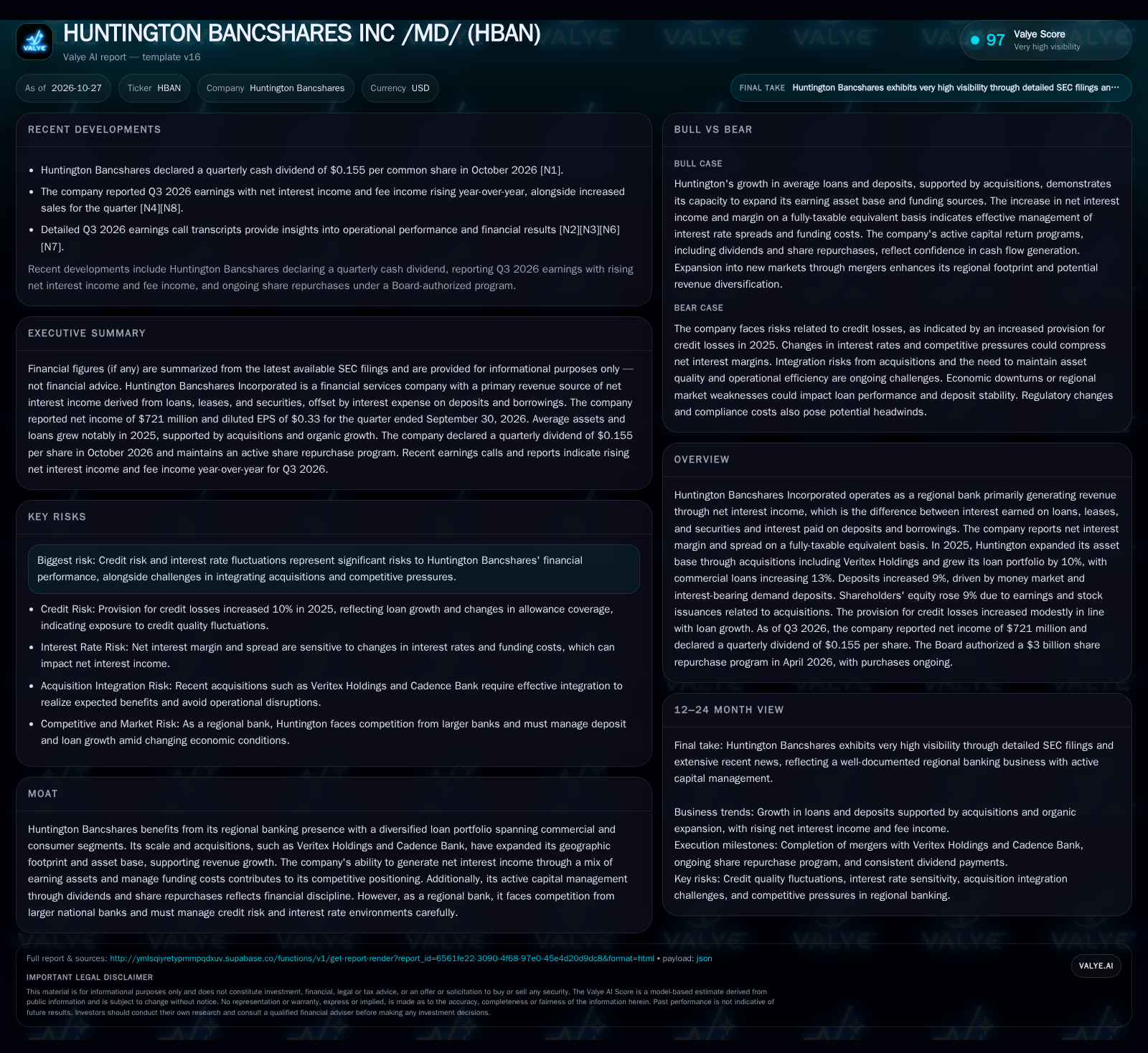
Huntington Bancshares reported strong asset, loan, and deposit growth in 2025-2026, supported by acquisitions and ongoing capital return programs. While net interest income and fee revenue have risen, the bank faces increased provision for credit losses and the challenge of integrating recent mergers. The sustainability of margin expansion and asset quality—amid a competitive, rate-sensitive landscape—will determine whether Huntington can translate scale into durable shareholder returns. [S1] [S2] [N4] [N8]
Huntington Bancshares is executing a classic regional banking scale-up: leveraging acquisitions and core loan growth to build a larger, more diversified balance sheet. The company’s double-digit expansion in both assets and deposits, paired with rising net interest and fee income, signals effective spread management and market-share gains. However, the realities of credit risk, integration complexity, and net interest margin vulnerability—especially in a shifting rate environment—underscore that scale alone does not guarantee superior returns. The next phase will test whether Huntington can translate its expanded footprint into sustainable profitability and defend its competitive position against both national banks and fintech disruptors.
Recent Growth and Capital Actions Set the Stage
Huntington Bancshares reported a 12% year-over-year increase in net interest income for 2025, reaching $6.056 billion, with a net interest margin (NIM) of 3.13% on a fully-taxable equivalent basis [S1]. Average assets rose 7% to $210.8 billion, reflecting both the acquisition of Veritex Holdings and underlying loan growth. Commercial loans led the way, up 13%, while consumer loans grew 6%. Deposits increased 9%, primarily through money market and interest-bearing demand accounts, offset by a decrease in time deposits [S1].
The bank’s provision for credit losses rose 10% to $463 million in 2025, mirroring loan growth and a modest reduction in allowance coverage ratios [S1]. The cited source reports dividend-related activity; that disclosure alone does not establish dividend-policy continuity, management confidence, or a material constraint on capital flexibility. [S2] [N1] These developments highlight a focus on capital return and balance-sheet expansion, but also a rising cost of credit.
How Huntington Converts Scale into Earnings Power
Huntington’s business model is anchored in net interest income, the spread between yield on earning assets (loans, leases, securities) and the cost of funding (deposits, borrowings). The reported NIM of 3.13% (FTE) in 2025 suggests effective pricing and funding cost management, but the absolute level and direction of NIM remain highly sensitive to the interest rate environment and deposit mix [S1].
Loan growth—particularly in commercial lending—has the potential to drive operating leverage if credit quality holds and incremental funding costs are managed. However, the 10% increase in provision for credit losses signals that credit expansion is not frictionless; risk-adjusted returns depend on both underwriting discipline and macroeconomic stability.
Fee income provides some diversification, but for a bank of Huntington’s size, the bulk of earnings still trace to spread income. The company’s capital return strategy (dividends and buybacks) absorbs a portion of retained earnings but is not a substitute for organic profitability. Recent acquisitions have increased fixed costs (integration, systems, personnel) in the near term, raising the bar for future efficiency gains and requiring careful management to avoid margin dilution.
Acquisitions Expand the Footprint, but Competition Remains Fierce
Huntington’s recent acquisitions—including Veritex Holdings and Cadence Bank—have extended its reach across the Midwest and into Texas and the southern U.S. This larger footprint diversifies geographic risk and opens access to new commercial and retail banking markets [S1] [S2]. In theory, this scale could yield network effects in deposit gathering and cross-selling opportunities, but regional banks face intense competition from national banks, credit unions, and digital-first fintechs that can erode pricing power and customer loyalty.
Switching costs for most retail and small business customers remain modest, making service quality, product breadth, and digital convenience critical differentiators. Huntington’s ability to defend and grow its share will depend not just on legacy branch presence, but on its capacity to invest in technology, maintain asset quality, and integrate new operations without disruption.
Moreover, as a regional player, Huntington is exposed to local economic cycles, and its recent growth in commercial lending increases sensitivity to business credit risk in new geographies.
If Integration Succeeds and Credit Quality Holds, Earnings Could Outpace Peers
The most favorable scenario for Huntington involves successful integration of Veritex Holdings and Cadence Bank, enabling the company to extract cost synergies and expand revenue through cross-selling and deeper market penetration. If the bank maintains or expands its net interest margin—perhaps by leveraging its larger deposit base to reduce funding costs—and keeps credit costs contained despite rapid loan growth, it could deliver above-peer earnings growth and return on equity.
Confirmation would come from sustained NIM stability or expansion, positive operating leverage (revenue growing faster than expenses), and stable or improving credit metrics (low net charge-offs, steady delinquency rates). Evidence of fee income expansion, particularly from treasury management or wealth products in new markets, would also support the upside thesis.
Falsification would occur if integration stumbles generate outsized costs, if net interest margin compresses due to competitive pricing or higher funding costs, or if credit quality weakens in new or cyclical markets.
Scale Offsets Margin Pressure, but Returns Remain in Line with Regional Bank Norms
The most plausible outcome is that Huntington’s expanded balance sheet offsets some of the margin pressure from a competitive, rate-sensitive environment, but that returns remain broadly similar to those of peer regional banks. Loan and deposit growth moderate as acquisition benefits are digested and integration costs persist through 2026.
Net interest margin stabilizes or compresses modestly as deposit pricing competition and funding mix changes offset asset yield gains. Credit costs remain manageable but elevated relative to pre-expansion periods, reflecting both new market exposures and general economic uncertainty.
Share repurchases and dividends underpin total shareholder return, but organic earnings growth is limited by the need to invest in technology, risk management, and ongoing integration. Confirmation would come from steady but unspectacular ROE, flat to slightly declining NIM, and no major credit shocks.
Credit Deterioration or Integration Missteps Erode Profitability
An adverse scenario could emerge if Huntington experiences outsized credit losses, particularly in newly acquired commercial loan books or unfamiliar geographies. A spike in nonperforming loans, coupled with rising charge-offs, could force the bank to increase provisions beyond current levels, directly impacting net income.
Integration missteps—such as cost overruns, customer attrition, or IT system failures—could erode operating leverage and damage the franchise in key markets. Additionally, if net interest margins compress more sharply due to aggressive deposit competition or a flattening yield curve, the bank’s core earnings engine would be impaired.
Confirmation of the downside case would involve a rapid rise in credit losses, declining reported NIM, negative operating leverage, and a material drop in profitability or capital ratios.
What Will Determine Whether Huntington’s Expansion Delivers Sustainable Value?
Sustained net interest margin (NIM) trends: Is Huntington able to defend or expand its NIM despite competitive and rate pressures?
Integration milestones and cost savings: Are post-merger integration costs in line with management’s guidance, and are promised synergies realized on schedule?
Trends in provision for credit losses and net charge-offs: Does credit quality remain stable as the loan book expands into new geographies and sectors?
Deposit mix and cost of funds: Is Huntington able to grow low-cost, core deposits, or does it become more reliant on higher-cost funding sources?
Fee income growth: Are non-interest revenues—such as from treasury, wealth, or payments—growing as a share of total income, supporting diversification?
Capital return discipline: Does the bank maintain consistent dividends and execute its buyback program without compromising capital adequacy?
Expense management: Are operating expenses, especially post-acquisition, rising in line with revenue, or is there evidence of margin compression from cost overruns?
Technology and digital adoption: Is Huntington investing sufficiently in digital platforms to remain competitive with both large banks and fintech entrants?
Disclaimer: This is research-only, informational analysis and not investment advice. It may include AI-generated interpretation and general industry context. Always verify important details using primary sources.

Comments