
Intapp’s AI-Driven Platform: Value Creation and Competitive Tensions in Professional Services Software
With a client roster spanning the world’s top law and accounting firms and an expanding suite of AI-powered workflow tools, Intapp is positioned at the intersection of compliance, automation, and digital transformation for regulated professional services. The company’s recent financial results and product developments highlight both the scale of its opportunity and the operational, competitive, and financial hurdles it must overcome.
Intapp’s combination of deep domain expertise, tailored AI agents, and cloud-based solutions has secured it a leadership position among large professional services firms seeking workflow automation and compliance. Intapp’s next phase hinges on expanding within its elite client base, proving the value of its Firm AI platform, and managing the complexity of regulated AI deployment.
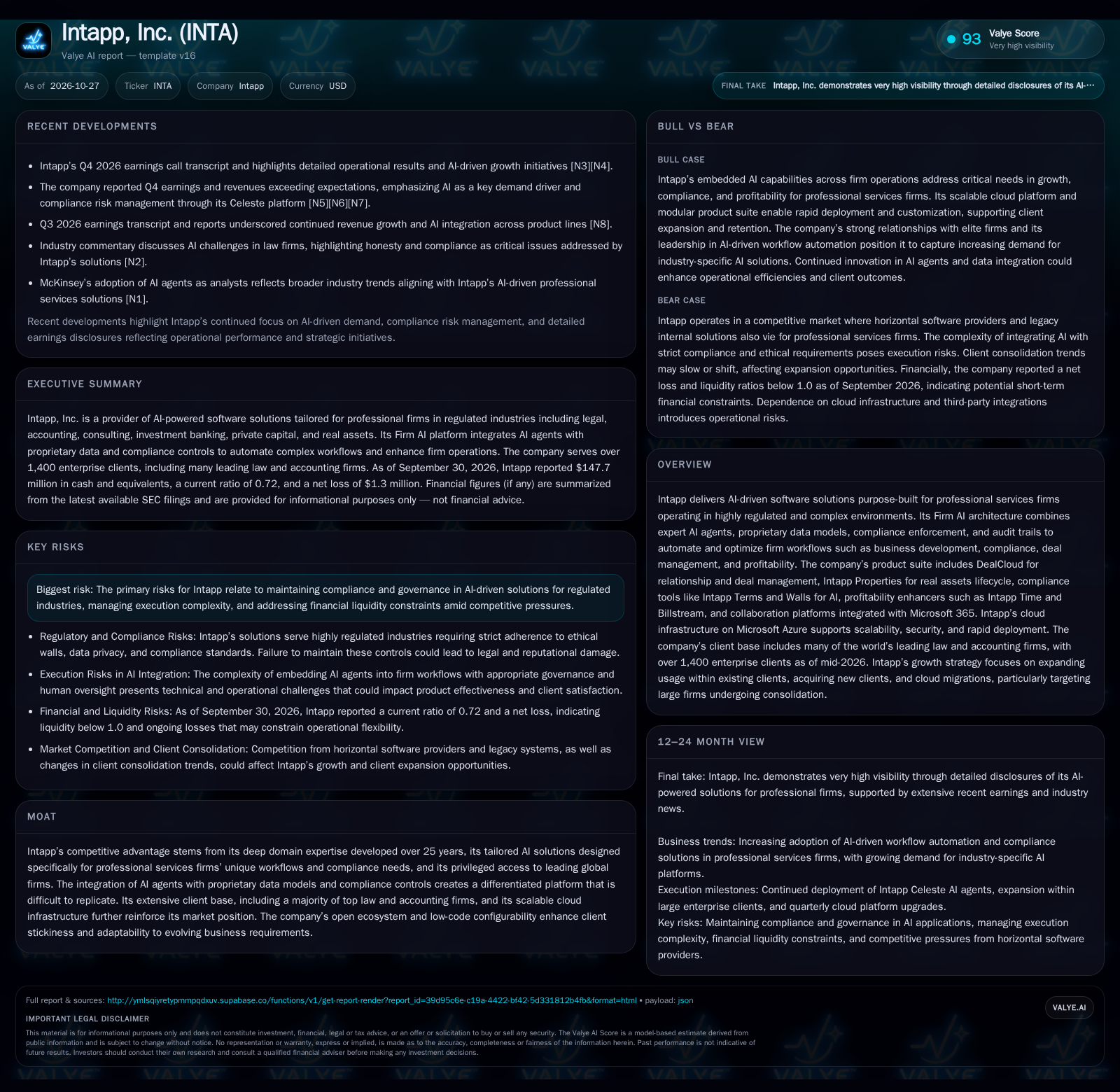
Intapp, Inc. occupies a distinctive niche as the AI and workflow automation backbone for the world’s most demanding professional services firms. Its Firm AI and Celeste platforms promise to transform how law, accounting, and consulting organizations handle compliance, client relationships, and operational complexity. The company’s 2026 financials and client disclosures reflect both the promise of industry-specific AI and the tensions of scaling in a competitive, regulation-heavy landscape.
Recent Client Growth and AI Platform Momentum Shape the Strategic Landscape
As of June 30, 2026, Intapp reported over 1,400 enterprise clients with contracts above $50,000 ARR, including a dominant presence among the Am Law 100 and top 20 accounting firms [S1]. This entrenched client base positions Intapp as a mission-critical vendor in regulated professional services, where workflow automation and compliance are existential needs.
The Firm AI and Celeste platforms, built around AI agents, proprietary data, and compliance controls, are now central to the company’s value proposition. Recent earnings calls and news coverage emphasize that AI-driven demand and compliance risk management are fueling both product innovation and client interest [N3] [N4] [N5] [N6] [N7] [N8].
Despite these commercial advances, Intapp reported a net loss of $1.3 million for the quarter ending September 30, 2026, with a current ratio of 0.72 and cash and equivalents of $147.7 million [S2]. The company reported cash and liquidity metrics for the period; these figures do not by themselves establish operating runway, investment capacity, financial flexibility, or financing capacity.
Economic Model: Recurring Revenue, Expansion Potential, and the Cost of Compliance
Intapp’s business model is built for recurring revenue, with most clients signing annual or multi-year contracts—though the exact contract durations and renewal rates are not disclosed. The $50,000+ ARR threshold suggests a focus on large, sticky accounts where switching costs and integration depth can be significant.
The company’s modular product suite—spanning deal management (DealCloud), compliance (Terms, Walls for AI), profitability (Time, Billstream), and collaboration (Microsoft 365 integrations)—enables cross-sell and up-sell opportunities within existing clients. If Intapp can increase product penetration per client, revenue per account could rise with minimal incremental selling cost, driving operating leverage.
However, the economics of AI-enabled compliance are complex. Intapp must invest heavily in R&D and cloud infrastructure (notably on Microsoft Azure), maintain robust data governance, and support quarterly platform releases to address ever-evolving regulatory requirements. These fixed and semi-fixed costs could be amortized over a growing client base, but may also pressure margins if revenue growth slows or client consolidation accelerates.
[S2]
Defensible Niche or Vulnerable Beachhead? Intapp’s Market Position Under Scrutiny
Intapp’s core strength lies in its specialization: it tailors software for the unique, regulated workflows of law, accounting, and capital markets firms—segments underserved by generic horizontal platforms. Its deep integration with top-tier firms and domain-specific compliance features make displacement by off-the-shelf solutions challenging.
However, horizontal enterprise software vendors (such as Salesforce, Microsoft, and ServiceNow), emerging AI workflow startups, and legacy in-house IT teams represent credible substitutes. These competitors can offer broader ecosystems, aggressive pricing, or custom solutions, especially as AI commoditizes key features.
Client consolidation—such as law firm mergers or accounting firm roll-ups—may create both threat and opportunity. Larger entities may standardize on fewer platforms, raising the stakes for winning or retaining consolidated accounts. Conversely, successful cloud migrations and AI adoption could deepen Intapp’s entrenchment if it delivers measurable ROI and regulatory assurance.
Switching frictions are likely substantial for core workflow and compliance systems, but the exact magnitude depends on contract terms, data migration complexity, and regulatory auditability—factors not fully disclosed in current filings.
AI-Driven Expansion Unlocks Profitable Scale and Deepens Client Stickiness
If Intapp’s Firm AI and Celeste platforms deliver demonstrable compliance, operational efficiency, and profitability gains, large professional firms could accelerate adoption across additional business lines and geographies. This would drive both seat expansion and greater product penetration per client, boosting average revenue per account and improving gross margins as cloud infrastructure and R&D are leveraged across a broader base.
The most favorable scenario would see Intapp become the default AI workflow and compliance partner for global law and accounting firms, with its proprietary data models and auditability features setting an industry standard. This could enable premium pricing, reduce churn, and could create network effects as firms and their clients operate on a common compliance substrate.
Evidence supporting this scenario would include accelerating contract wins with large expansion components, disclosure of net retention rates well above 100%, rising attach rates for new AI modules, and public case studies from marquee clients documenting ROI and risk reduction.
Incremental Growth Amidst Execution Complexity and Competitive Pressures
The most plausible trajectory for Intapp is continued, if moderate, expansion within its core verticals as AI adoption progresses unevenly and compliance requirements evolve. The company may steadily grow revenue by deepening relationships with its existing blue-chip client base, adding new accounts at the margin, and migrating legacy deployments to the cloud.
Profitability could improve gradually as fixed costs are absorbed by a larger revenue base, but ongoing investment in AI, compliance, and integration will likely constrain margin expansion in the near term. Competitive incursions from horizontal vendors and internal IT teams may cap pricing power and force ongoing product innovation.
Confirmation of this scenario would come from steady increases in enterprise client count, modest improvement in operating margins, and continued references to AI-driven demand and successful cloud migrations in earnings commentary.
Liquidity Constraints and Disrupted Adoption Undermine Growth Ambitions
A less favorable outcome would see Intapp’s growth stall as large clients slow expansion, competitive alternatives erode win rates, or regulatory changes complicate AI deployments. [S2]
Execution risks in embedding AI agents into mission-critical, regulated workflows could manifest as delayed deployments, compliance failures, or customer dissatisfaction—potentially resulting in churn or reputational harm. Meanwhile, aggressive pricing or bundling from large horizontal vendors could compress margins and force increased sales and support spending.
This scenario would be corroborated by stagnant or declining client counts, rising customer churn (if disclosed), negative cash flow trends, or news of major contract losses or compliance incidents.
Milestones and Data Points That Will Test Intapp’s AI Platform Thesis
Quarterly net retention rate—if disclosed—would indicate whether existing clients are expanding usage or contracting.
Number and size of expansion deals with existing top-tier clients, especially among Am Law 100 and top 20 accounting firms.
Adoption rates and attach rates for new AI modules, particularly Celeste and Firm AI features.
Operating margin trends and gross margin improvement as a signal of operating leverage and product mix shift.
Public disclosures or case studies demonstrating quantifiable compliance, efficiency, or profitability gains from Intapp’s solutions.
Competitive win/loss data against horizontal software vendors or in-house solutions—if shared in management commentary.
Incidents or regulatory developments affecting AI deployment in professional services, which could impact product roadmaps or client demand.
Disclaimer: This is research-only, informational analysis and not investment advice. It may include AI-generated interpretation and general industry context. Always verify important details using primary sources.

Comments