
CTO Realty Growth: Retail Focus and Dividend Dynamics in Today’s REIT Landscape
CTO Realty Growth reports consistent revenue from income-oriented retail real estate, but persistent net losses and a reported liquidity position raise questions about the sustainability of its dividend-centric strategy in a shifting commercial property landscape.
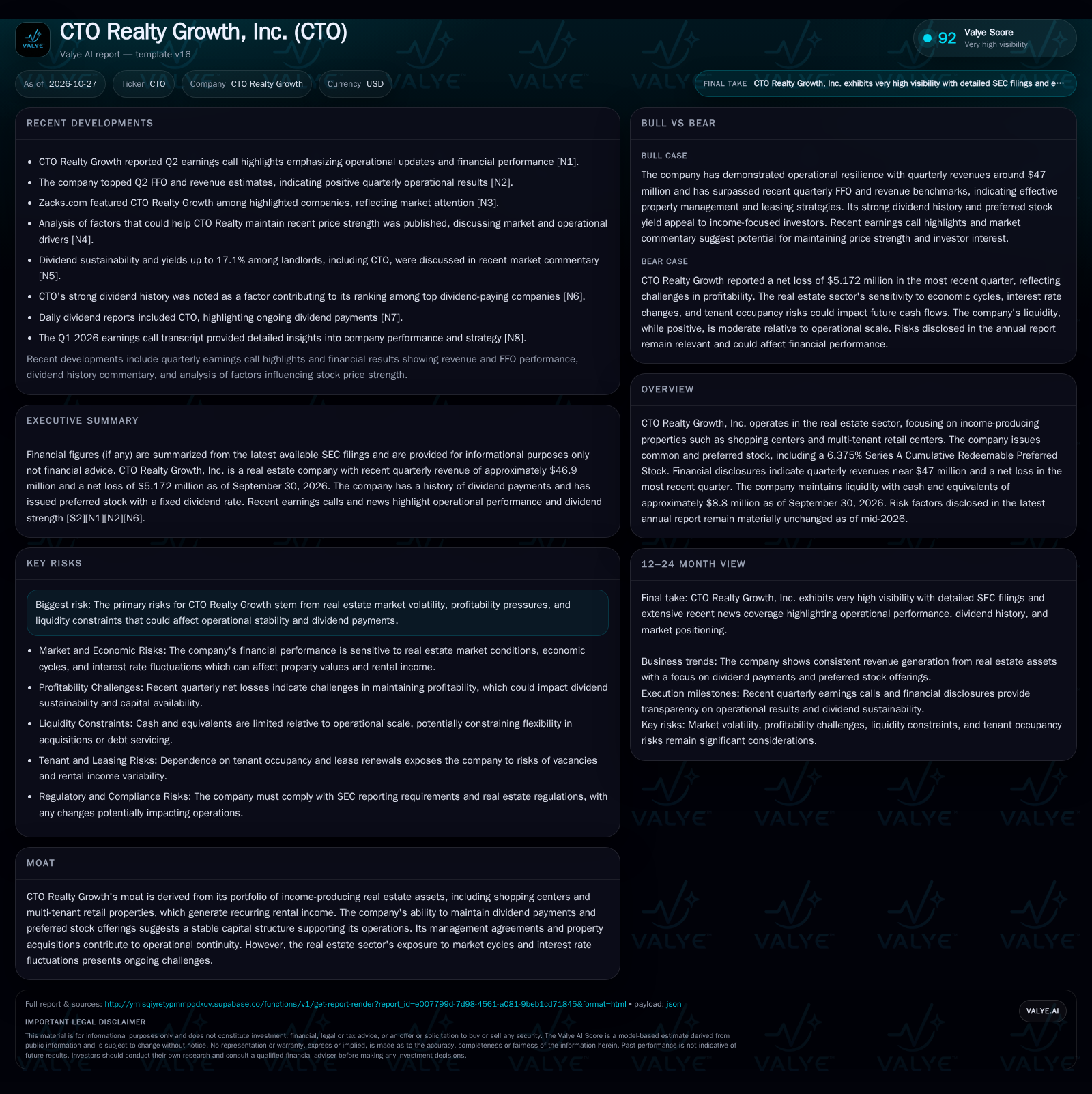
CTO Realty Growth, Inc. operates a portfolio of income-producing retail properties, reporting $46.9 million in Q3 2026 revenue but a net loss of $5.172 million. The durability of its dividend and tenant base will be critical to long-run shareholder value. [S2] [N1] [N2] [N6]
CTO Realty Growth, Inc. stands at a crossroads familiar to many retail-focused REITs: it delivers consistent rental income and boasts a strong dividend history, yet its most recent quarter showed a net loss and only reported liquidity position. While recent earnings outperformed expectations, ongoing sector headwinds—ranging from tenant risk to shifting consumer behavior—pose real challenges to sustaining its income-oriented strategy. The company’s ability to balance dividend commitments, property-level economics, and capital needs will shape its value proposition in a rapidly evolving commercial real estate market.
Profitability and Liquidity Trends in Recent Financial Results
CTO Realty Growth reported Q3 2026 revenue of $46.9 million but ended the quarter with a net loss of $5.172 million and EPS of -$0.19 [S2]. While the company continues to generate substantial recurring income from its portfolio of shopping centers and multi-tenant retail properties, these figures underscore ongoing profitability challenges. Cash and equivalents totaled $8.815 million at quarter-end, which is modest relative to the company’s revenue base and the capital needs typical of retail-focused REITs [S2]. Despite these pressures, CTO has maintained its strong dividend record and recently exceeded FFO and revenue estimates, suggesting some operational momentum [N1] [N2] [N6]. The interplay between dividend commitments, property-level performance, and available liquidity is now central to the company's medium-term outlook.
Given the reported cash balance against the backdrop of fixed dividend commitments, any delay or shortfall in rent collections could quickly strain liquidity. Additionally, the company's access to revolving credit facilities or capital markets financing, if available, would be critical in bridging short-term cash flow gaps. The interplay between operating cash flows, capital expenditures for maintenance or tenant improvements, and debt maturities must be carefully managed to avoid forced asset sales or dividend cuts. This dynamic underscores the need for robust cash flow forecasting and contingency planning in the current environment.
Cash Flow Patterns in CTO’s Retail Real Estate Operations
CTO Realty Growth’s core economics are driven by leasing income from a portfolio of shopping centers and multi-tenant retail properties. Revenue is largely recurring, reflecting contracted lease terms, but is exposed to tenant turnover, lease renegotiations, and variable occupancy rates. Expenses are a mix of fixed (property taxes, maintenance, debt service) and variable (utilities, tenant improvements, leasing commissions), with property-level margins depending on occupancy and rent growth.
Operating leverage can be meaningful if rent increases or occupancy rises, but the flip side is that vacancies or rent concessions rapidly erode profitability. The company’s ability to generate distributable cash flow is also shaped by its capital structure, which includes both common and preferred equity (the latter with a 6.375% fixed dividend obligation) [S1]. REITs like CTO typically distribute a substantial portion of cash flow as dividends to maintain tax-advantaged status, but this can constrain retained earnings available for reinvestment or debt reduction.
If interest rates remain elevated, refinancing costs and cap rates could pressure both income and property valuations, amplifying the need for operational discipline.
Another layer to CTO’s cash flow dynamics involves the potential impact of lease structure variations across its portfolio. For example, properties with a higher proportion of triple-net leases may offer more stable and predictable income streams, as tenants bear many operating expenses. Conversely, leases with rent abatements, percentage rents tied to tenant sales, or shorter lease terms introduce volatility and risk to cash flow visibility. The company’s ability to negotiate lease terms that balance tenant retention with income stability is therefore pivotal. Furthermore, capital expenditures required to keep properties competitive or to attract new tenants can pressure distributable cash flow, especially if funded through operating cash rather than external financing.
Challenges Facing CTO’s Retail REIT Model from Tenant and Location Factors
CTO Realty Growth’s competitive position relies on the quality, location, and mix of its retail properties. In a crowded sector, scale and property quality can drive better tenant retention and pricing power, while geographic diversification can buffer against local economic shocks. However, shopping centers and multi-tenant retail face ongoing threats from e-commerce substitution, shifting consumer traffic patterns, and the evolving needs of anchor tenants.
The company’s ability to maintain high occupancy, attract desirable tenants, and manage lease rollovers is critical. Larger REITs or those with dominant regional footprints may enjoy better access to credit, lower cost of capital, and stronger negotiating leverage with national tenants. CTO’s strategy of supporting dividends with both common and preferred stock offerings is a double-edged sword: it can widen the investor base but also adds fixed obligations that must be met regardless of operating volatility [S1] [N6].
The sector’s traditional barriers to entry—capital intensity, property management expertise, and tenant relationships—remain relevant, but are not insurmountable. The question is whether CTO can differentiate itself through superior asset selection, proactive leasing, or capital discipline in a market where many retail landlords are under pressure.
From a competitive standpoint, CTO’s scale relative to larger retail REITs may limit its bargaining power with national tenants, who increasingly demand flexible lease terms and concessions amid retail sector uncertainty. Smaller or regional landlords often face higher per-unit costs for property management and capital improvements, which can compress margins. Geographic concentration risk also plays a role; properties clustered in economically vulnerable regions may face correlated occupancy declines. In contrast, a well-diversified portfolio can mitigate localized economic shocks but may dilute management focus and increase operational complexity. CTO’s strategic decisions regarding portfolio composition and tenant mix will influence its resilience against these competitive pressures.
Opportunities for Sustaining Dividends and Enhancing Operations
An upside scenario for CTO Realty Growth would involve sustained or improved occupancy rates, successful lease renewals at higher rents, and continued outperformance on FFO and revenue metrics. If the company can leverage its property portfolio to attract stable, creditworthy tenants and manage expenses, distributable cash flow could support ongoing dividends and potentially enable selective reinvestment.
Positive catalysts could include favorable refinancing terms, successful asset recycling into higher-yield properties, or sector tailwinds such as a rebound in brick-and-mortar retail traffic. In this environment, CTO could reinforce its reputation as a reliable income vehicle, attracting further investor interest and potentially narrowing its cost of capital.
This scenario would be confirmed by consistent or rising occupancy, positive same-property NOI trends, and dividend coverage ratios that remain robust even as interest rates fluctuate.
Margin Trends for a Mid-Sized Retail REIT Amid Economic Pressures
The most plausible trajectory for CTO Realty Growth is a continuation of modest revenue growth offset by persistent cost pressures and episodic tenant churn.
Management may pursue incremental asset sales or capital recycling to fund obligations, but large-scale acquisitions or transformative growth appear unlikely without a material change in liquidity or access to credit.
This scenario would be falsified by either a major positive catalyst (such as a portfolio acquisition or a step-change in rent growth) or a negative shock (such as a wave of tenant defaults or a dividend suspension).
Risks to Dividend Stability and Tenant Performance in Economic Downturns
The adverse scenario for CTO centers on a deterioration in tenant quality or occupancy, perhaps triggered by a cyclical downturn, sector-specific distress (e.g., anchor retailer bankruptcies), or a spike in interest rates that pressures refinancing costs.
Downside confirmation would come from declining occupancy, negative same-property NOI, or announcements of major tenant departures. If property values fall or refinancing becomes punitive, CTO could be forced to sell assets at unfavorable prices or issue equity at dilutive levels to meet obligations.
The risk is amplified by the company’s relatively small liquidity reserve and the sector’s exposure to macroeconomic shocks. A dividend reduction or suspension, while sometimes prudent for long-term survival, would likely trigger a sharp re-rating by income-focused investors.
Factors Influencing the Stability of CTO Realty Growth’s Dividend and Valuation
Quarterly occupancy rates across the property portfolio, as persistent declines would signal pressure on revenue and margins.
Same-property net operating income (NOI) growth, if disclosed, as a direct indicator of property-level performance.
Distributable cash flow coverage of both common and preferred dividends—a useful metric if provided in earnings materials.
Trends in tenant mix and lease rollover schedules, with particular attention to exposure to troubled or non-credit tenants.
Capital recycling activity: asset sales, acquisitions, or redevelopment projects, and the associated yield on new investments.
Interest expense trends and refinancing activity, especially in a rising rate environment.
Disclaimer: This is research-only, informational analysis and not investment advice. It may include AI-generated interpretation and general industry context. Always verify important details using primary sources.

Comments