
Sherwin-Williams: Margin Pressures, Expansion, and the Capital Structure Tradeoff
Sherwin-Williams continues to grow through store expansion and acquisitions, but rising costs and a leveraged balance sheet are reshaping its margin profile and potential financial flexibility. The company’s ability to balance operational investments with debt obligations will determine whether it can sustain its historical outperformance in a more volatile macro environment.
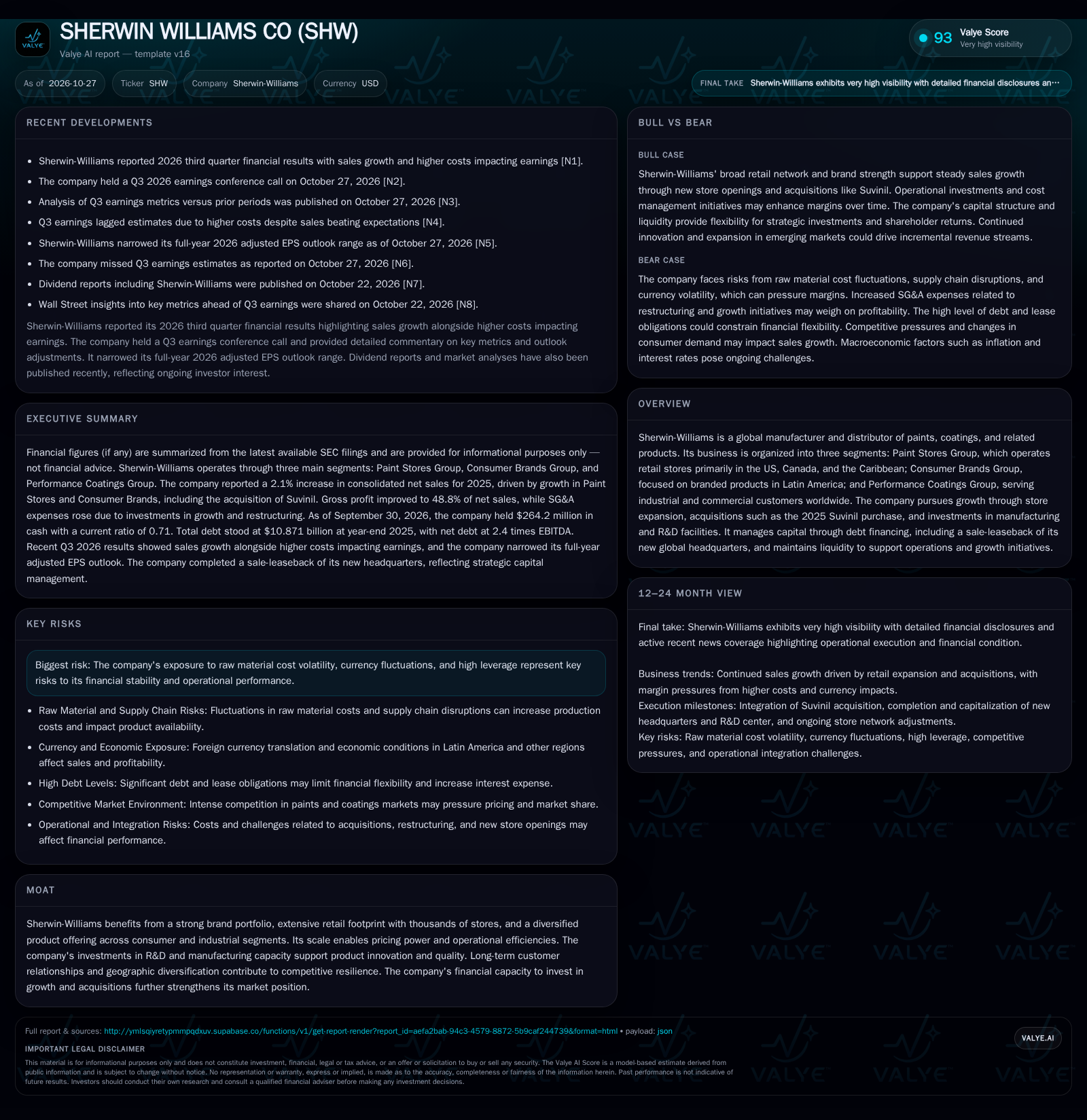
Sherwin-Williams reported modest sales growth in 2025, aided by its Suvinil acquisition and ongoing store expansion, but faces higher costs and a tightening margin outlook. With a current ratio of 0.71 and net debt at 2.4x EBITDA, the company’s capital structure is increasingly a central variable. The narrowing of its 2026 adjusted EPS outlook underscores both persistent demand and the headwinds of expense inflation and integration risk. Sherwin-Williams’ scale and brand strength remain competitive levers, but execution on cost control and debt management will be critical if market conditions worsen. [S1] [S2] [N1] [N4] [N5]
Sherwin-Williams is navigating a delicate balance between growth and profitability as it expands its store network and integrates recent acquisitions. While 2025 brought higher sales and improved gross margin, rising SG&A costs and a more leveraged capital structure highlight the changing economics of the business. The third quarter of 2026 saw sales outpace expectations but higher costs weigh on earnings, prompting a narrowing of the full-year EPS outlook. The company’s ability to manage debt, sustain margin expansion, and deliver on integration promises will be decisive as macroeconomic and industry pressures persist. [S1] [S2] [N1] [N4] [N5]
Sales Growth Meets Rising Costs: The 2025–2026 Operating Snapshot
Sherwin-Williams reported a 2.1% increase in consolidated net sales for 2025, reaching $23.574 billion. This growth was led by the Paint Stores Group and Consumer Brands Group, and further boosted by the acquisition of Suvinil in October 2025. Gross profit rose 2.9% to $11.516 billion, pushing gross margin up to 48.8%. However, SG&A expenses climbed 3.7% to $7.695 billion, reflecting the cost of growth initiatives, new store openings, acquisition-related expenses, and restructuring. The company’s net income for Q3 2026 was $821 million, and while sales exceeded expectations, higher costs resulted in earnings lagging consensus estimates. As of September 30, 2026, Sherwin-Williams held $264.2 million in cash with a current ratio of 0.71, and net debt stood at 2.4x EBITDA at year-end 2025. The company narrowed its full-year 2026 adjusted EPS outlook, indicating near-term cost and integration headwinds. [S1] [S2] [N1] [N4] [N5]
How Store Expansion, Acquisitions, and Cost Inflation Shape Sherwin-Williams’ Profitability
Sherwin-Williams’ core economics are defined by a mix of retail-driven Paint Stores Group sales, branded consumer products, and industrial coatings. Its vertically integrated model historically delivers strong gross margins, as evidenced by the 48.8% rate in 2025. Revenue growth is heavily volume-driven, stemming from net increases in store count (80 new Paint Stores in 2025) and strategic acquisitions like Suvinil, which can bring both immediate top-line growth and longer-term integration costs. Pricing power is supported by brand strength and the company’s scale, but raw material costs and wage inflation can quickly erode margins. The fixed cost base—driven by physical retail, manufacturing infrastructure, and SG&A—offers operating leverage when sales are strong, but also exposes the company to downside risk if volumes soften or costs spike. Recent investments in headquarters and R&D signal a long-term commitment to innovation but add to capital requirements. The company’s $10.871 billion in debt and sale-leaseback obligations increase financial leverage, amplifying both potential returns and risks, particularly in a higher interest rate environment. [S1] [S2]
The interplay between fixed and variable costs in Sherwin-Williams’ operating model is critical to understanding its margin sensitivity. While fixed costs such as manufacturing overhead and retail store leases provide operating leverage during periods of volume growth, they also create vulnerability when sales volumes decline or stagnate. This dynamic means that even modest fluctuations in demand or cost inflation can disproportionately impact profitability. Additionally, the company’s reliance on global supply chains for raw materials exposes it to commodity price volatility and geopolitical risks, which can disrupt input availability or increase costs unexpectedly. Effective hedging strategies and supplier diversification would help mitigate these risks but may also introduce complexity and additional expenses.
Capital allocation decisions further complicate Sherwin-Williams’ profitability profile. Investments in innovation and infrastructure aim to secure long-term competitive advantages but require upfront capital and can depress short-term free cash flow. The balance between reinvesting in growth initiatives and maintaining prudent leverage levels is delicate, especially in a rising interest rate environment where debt servicing costs increase. If the company prioritizes aggressive expansion or acquisition integration without commensurate improvements in operational efficiency, its return on invested capital could decline. Conversely, disciplined capital deployment that targets high-return projects and cost rationalization could enhance margin resilience and potential financial flexibility over time.
Brand Scale, Retail Footprint, and the Challenge of Margin Defense
Sherwin-Williams’ competitive edge stems from its vast network of nearly 5,000 Paint Stores and its broad product portfolio across consumer and industrial segments. This scale enables some degree of pricing power and supply-chain efficiency, which smaller regional or specialty competitors struggle to match. The company’s investments in R&D and manufacturing further support product innovation and quality consistency. However, the paints and coatings market is mature, price-sensitive, and exposed to input cost volatility. Large global peers and private-label offerings from home improvement retailers act as ongoing threats. The Suvinil acquisition expands Sherwin-Williams’ presence in Latin America, but integration risk and currency exposure are higher in these markets. Ultimately, the company’s ability to defend margins will hinge on sustaining customer loyalty, leveraging its distribution advantage, and managing cost pressures more effectively than peers.
Margin Recovery and Synergy Capture Could Unlock Further Value
A positive scenario for Sherwin-Williams would see cost inflation moderating and the company successfully integrating Suvinil, extracting synergies through procurement, distribution, and cross-selling. If the company can leverage its scale to negotiate better terms with suppliers and continue raising prices without volume loss, gross margins could expand further. New store openings—if accompanied by robust same-store sales growth—would drive operating leverage, helping SG&A as a percentage of sales to decline. Evidence confirming this would include sustained gross margin improvement, a reduction in SG&A growth relative to sales, and management commentary on realized acquisition synergies. Conversely, failure to control costs or integrate acquisitions would falsify this scenario.
Expansion Continues, but Margin and Leverage Constraints Persist
The most plausible outcome is that Sherwin-Williams continues to grow sales through incremental store expansion and periodic acquisitions, but faces ongoing pressure from cost inflation and elevated SG&A. Gross margin may remain near current levels, with modest improvement only if raw material prices stabilize. Store network productivity will be key, as underperforming locations or regions (such as the Consumer Brands Group’s contraction in Latin America) could offset gains elsewhere. Confirmation would come from continued low-single-digit sales growth, stable or slightly improved margins, and leverage ratios remaining in the current range. Should debt levels rise further or margins erode, downside risks would become more pronounced.
Cost Surges, Integration Stumbles, or Macro Slowdown Could Expose Sherwin-Williams’ Leverage
In a negative scenario, further increases in raw material, labor, or logistics costs could compress margins, particularly if the company is unable to pass through price increases. If integration of Suvinil or other acquisitions proves more difficult than anticipated—resulting in higher-than-expected SG&A or operational disruption—profitability could decline sharply. A macroeconomic downturn, especially in construction and remodeling, could reduce paint demand and expose the company’s fixed-cost base. With net debt already at 2.4x EBITDA, a material earnings shortfall would put pressure on debt covenants, restrict capital investment, or force asset sales. Evidence for this scenario would include falling gross or operating margins, rising net debt/EBITDA, persistent underperformance in one or more business segments, and negative revisions to earnings guidance.
What Will Determine Sherwin-Williams’ Margin Trajectory and Strategic Flexibility?
Gross margin trend, especially in the context of raw material and wage inflation.
SG&A growth rate relative to sales, particularly as integration and restructuring efforts continue.
Net store openings versus closures by business segment, highlighting the effectiveness of expansion.
Net debt to EBITDA ratio, especially if operating performance weakens or rates rise.
Cash generation and changes in working capital, which would affect liquidity and capital deployment options.
Progress on Suvinil integration, including any disclosed synergy metrics or cost savings.
Same-store sales growth, if disclosed, as an indicator of organic demand and pricing power.
Management guidance changes, especially regarding EPS outlook, margin expectations, or capital allocation priorities.
Disclaimer: This is research-only, informational analysis and not investment advice. It may include AI-generated interpretation and general industry context. Always verify important details using primary sources.

Comments