
Valmont Industries: Infrastructure Momentum, Irrigation Innovation, and the Realities of Cyclical Exposure
With strong recent earnings and a raised FY26 EPS outlook, Valmont Industries stands at the intersection of U.S. infrastructure stimulus, global water scarcity, and technological shifts in agriculture. The company’s ability to convert government funding waves and precision ag adoption into sustainable margin performance will define its next phase—amid raw material volatility and capital cycle risk.
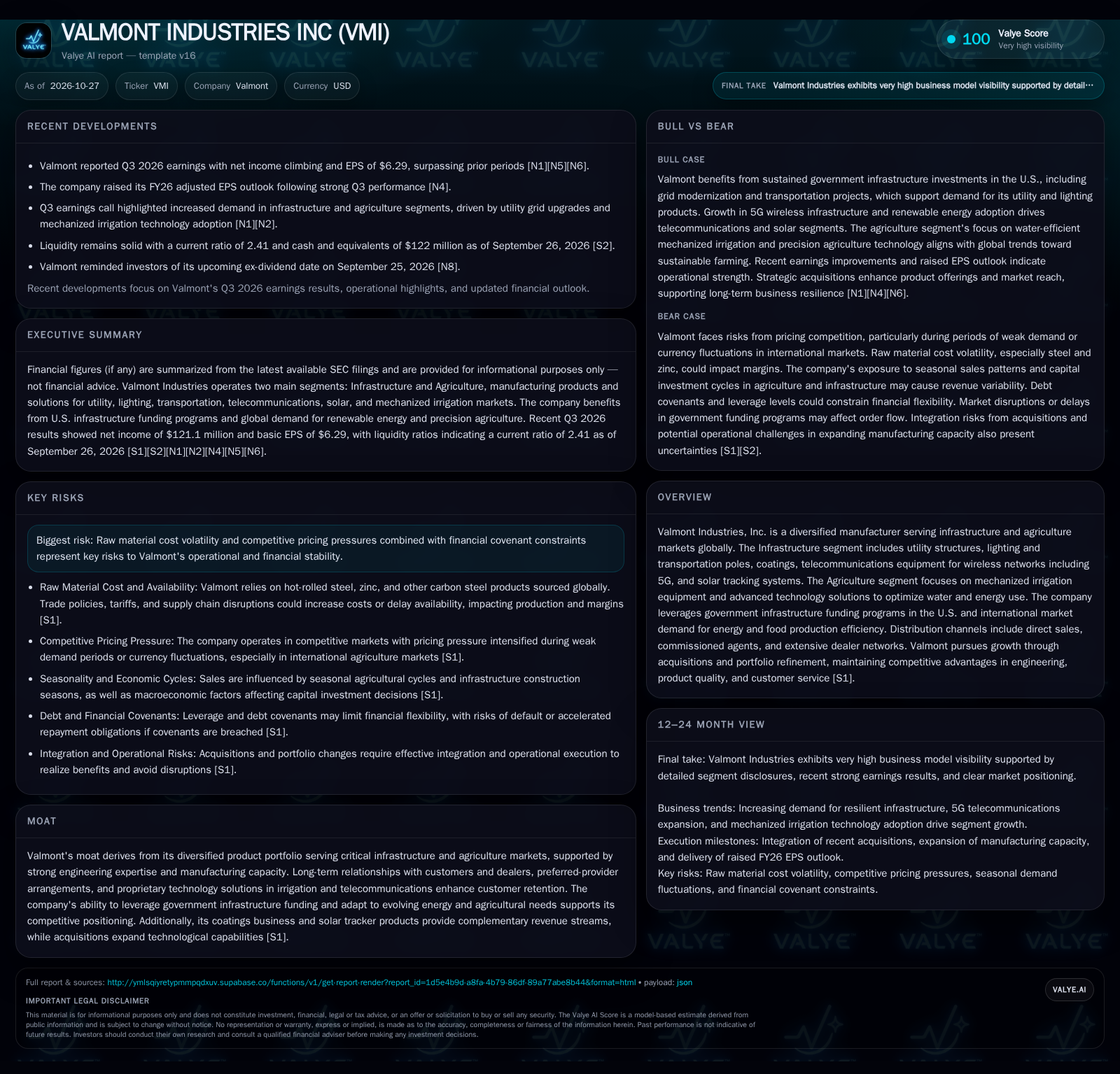
Valmont Industries reported robust Q3 2026 earnings and increased its full-year EPS outlook, reflecting strong demand in both infrastructure and agriculture segments. U.S. government funding for grid and transportation upgrades, along with global adoption of mechanized irrigation, are current tailwinds. However, exposure to steel/zinc price swings and cyclicality in both core markets remains a central challenge to sustaining margin gains and growth.
Valmont Industries, a diversified manufacturer with deep roots in infrastructure and agricultural equipment, is capturing current tailwinds from U.S. government stimulus and accelerating global demand for water-efficient farming solutions. Its latest earnings report reveals not just operational strength but also the company’s exposure to the cyclical and input-sensitive nature of its markets. As Valmont leans into 5G infrastructure and precision irrigation, the central question becomes whether these growth vectors can consistently outrun the risks of margin compression and capital cycle volatility.
Recent Earnings and Demand Drivers Reshape Valmont’s Near-Term Outlook
Valmont Industries reported Q3 2026 net income of $121.1 million and basic EPS of $6.29, driven by robust performance in both its infrastructure and agriculture segments [S2]. Following this, the company raised its FY26 adjusted EPS outlook, citing ongoing strength in demand for grid modernization, utility structures, and mechanized irrigation systems [N4]. U.S. government funding initiatives—particularly the Infrastructure Investment and Jobs Act and Inflation Reduction Act—are currently supporting infrastructure sales, while global water scarcity and the need for farming efficiency are bolstering the agriculture segment [S1]. Reported liquidity metrics include a current ratio of 2.41 and $122 million in cash at quarter-end, though leverage and covenant compliance are flagged as ongoing considerations [S2].
Infrastructure and Ag Equipment: Volume, Mix, and the Margin Equation
Valmont’s revenue model is a blend of project-based infrastructure sales and recurring aftermarket/service income from its installed base, especially in irrigation. The infrastructure segment’s economics are highly volume-driven, with large contracts for utility and telecom structures offering operating leverage but also exposing the company to swings in public funding and construction cycles. Pricing power is limited by competitive bidding, and margins are sensitive to fluctuations in steel and zinc input costs—a risk that can erode profitability in periods of raw material inflation unless contract structures allow for pass-throughs. The coatings business, with its recurring nature, likely provides some earnings stability.
In agriculture, Valmont’s Valley brand underpins a global dealer network that drives both new system sales and higher-margin aftermarket parts and technology upgrades. The addition of over 175,000 connected devices signals a shift toward data-driven, subscription or service-oriented offerings, which could gradually improve margin mix if adoption increases. However, overall segment sales remain cyclical, tied to farm incomes, commodity prices, and regional water regulations. Investments in new technology and manufacturing capacity (including recent acquisitions) require careful balance: they offer growth and potential margin expansion, but also demand upfront capital and integration execution.
Engineering Depth and Channel Breadth as Defenses Against Commoditization
Valmont’s competitive position is anchored by its dual-segment structure, engineering capabilities, and established distribution channels. In infrastructure, the company competes with regional and global manufacturers of utility poles, lighting structures, and telecom towers—categories where scale, reliability, and project execution are vital but where product differentiation can be thin. Engineering expertise and manufacturing capacity enable Valmont to participate in large-scale, technically demanding projects, while coatings and solar tracker offerings add complementary revenue streams and deepen customer relationships.
In agriculture, Valley’s reputation for product quality and its global dealer network provide switching-cost frictions and help defend market share against both large OEMs and lower-cost entrants. The move toward advanced irrigation technology and connected solutions may raise barriers to entry, as customers become increasingly reliant on integrated platforms and aftermarket service. However, price competition—especially in emerging markets—and the risk of lower-cost substitutes or new digital entrants remain persistent threats. The company’s ability to leverage government funding and preferred-provider arrangements could support its moat, but only if it continues to innovate and execute on integration.
Sustained Infrastructure Spending and Precision Ag Adoption Drive Step-Change in Margins
A favorable scenario for Valmont would see multi-year U.S. infrastructure appropriations and global government support for sustainable agriculture translating into steady backlog growth and improved pricing discipline. If input cost volatility remains manageable—either through supply chain agility or successful contract pass-throughs—operating leverage in utility, lighting, and telecom structures could push segment margins higher than historical norms. Concurrently, accelerating adoption of precision agriculture and connected irrigation (potentially moving toward subscription-based revenue) would shift the agriculture segment’s mix toward higher-margin, recurring business.
Evidence supporting this scenario would include a sustained increase in infrastructure order backlog, disclosed improvements in segment gross margins, a rising share of aftermarket/service/technology revenue in agriculture, and consistent EPS outperformance relative to guidance. A falsification would be the re-emergence of margin compression from input costs, or a visible slowdown in infrastructure order intake despite ongoing federal programs.
Cyclical Resilience Tested by Input Volatility and Patchy Global Ag Demand
The most plausible path is that Valmont continues to ride current infrastructure and ag technology demand, but with periodic setbacks from steel/zinc price spikes and uneven international market conditions. Infrastructure sales should remain healthy as U.S. public funding flows, but pricing power remains limited and competitive intensity high. Agriculture segment growth is likely to be choppy, with technology upgrades offsetting some weakness in new equipment sales if farm incomes or commodity prices falter.
Confirmation would come from stable-to-rising infrastructure and agriculture segment revenues, but with gross margins fluctuating in line with input costs and product mix. Falsification would be significant order delays or cancellations tied to funding gaps, or a sharp drop in ag segment sales not offset by aftermarket or tech solution growth.
Margin Squeeze and Capital Cycle Turn Could Derail Earnings Momentum
A negative outcome could materialize if raw material costs spike and cannot be passed through, compressing margins at the same time that U.S. infrastructure funding slows or is delayed. In this scenario, aggressive price competition could erode both top-line growth and profitability, particularly in international ag markets facing currency or demand headwinds. If leverage or covenant constraints limit Valmont’s ability to invest in manufacturing or technology upgrades, the company could lose share or fail to capture the next wave of demand.
Confirmation would come from sequential declines in segment margins, order book contraction, or earnings misses tied to cost pressures or funding shortfalls. Early warning signs would include negative working capital trends, increased reliance on short-term debt, or management guidance cuts.
Milestones That Will Define Valmont’s Next Value-Generation Phase
Infrastructure segment order backlog growth and visibility into multi-year project awards, if disclosed, would clarify demand momentum and revenue durability.
Gross margin trends in both segments, particularly evidence of successful pass-through of raw material cost increases or a shift toward higher-margin technology/service mix.
Agriculture segment revenue split between new equipment sales and aftermarket/connected technology, if broken out, would help test the margin expansion thesis.
Integration progress and realized synergies from recent 5G and solar energy acquisitions—including any disclosed cost savings or cross-selling metrics.
Leverage and covenant compliance metrics, as reported, to assess ongoing potential financial flexibility and risk of covenant pressures.
Capital expenditure levels and manufacturing capacity utilization, especially in the context of announced expansion projects or demand spikes.
Competitive win rates in large infrastructure or ag technology projects, if disclosed, to monitor share gains or losses.
Disclosure of recurring revenue as a percent of total, particularly from aftermarket service and connected ag solutions, would indicate progress toward a more resilient business model.
Disclaimer: This is research-only, informational analysis and not investment advice. It may include AI-generated interpretation and general industry context. Always verify important details using primary sources.

Comments